


Words: Richard Edwards | Photos: Philip Proulx
Published 17 October 2026
The arrival of the XPeng X9 brings genuine choice to the luxury electric MPV market. So how does it stack up?
Until recently, nobody in New Zealand spent $120,000 on a people mover because there was nothing to spend it on. The bulk of the MPV market here goes to rental fleets. Beyond that, the choice has largely been van-based European models at one end and parallel-imported Toyota Vellfires at the other, the latter serving a loyal and largely Asian customer base. Anyone else with that sort of money and a family to move bought a large SUV.
Then the Chinese arrived. The Zeekr 009 opened the door, the Denza D9 followed, and now XPeng has landed the X9. For the first time, there is a genuine choice of luxury electric people movers, and this one makes the strongest case yet for cross-shopping against the big SUVs.
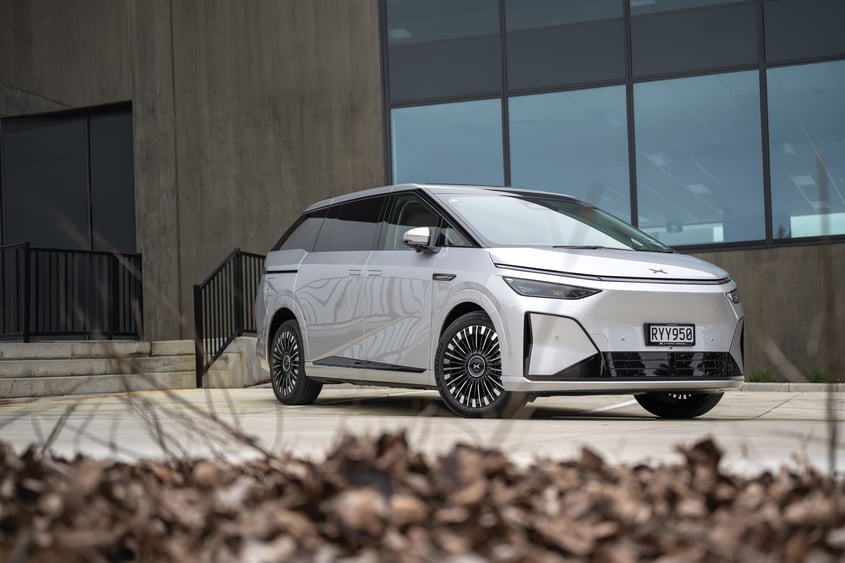
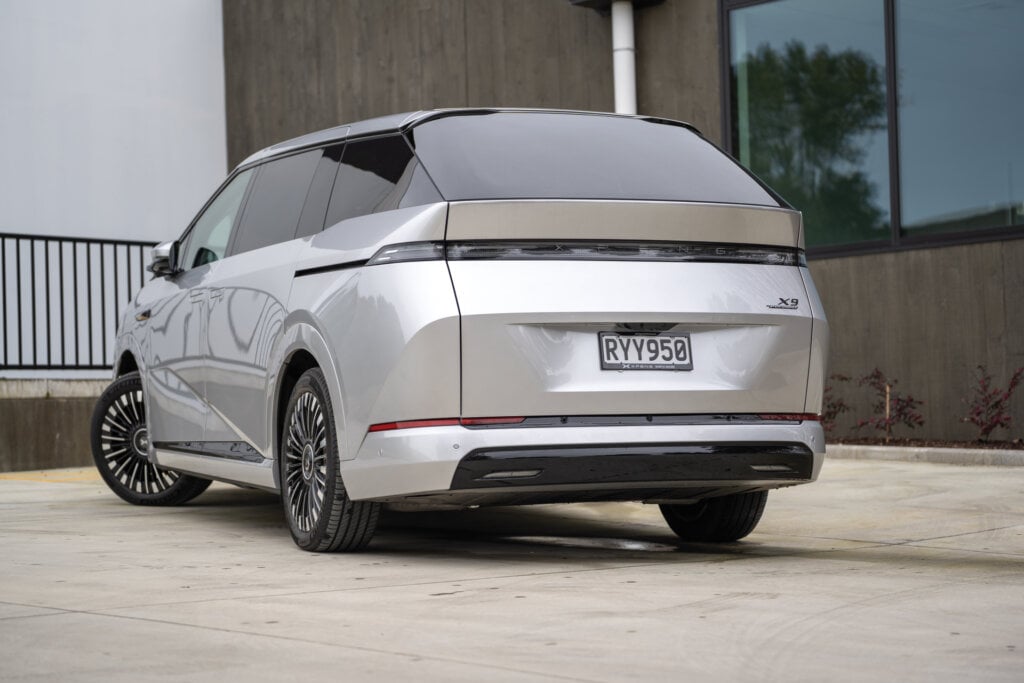
It is enormous, for a start. At nearly 5.3m long and sitting on a 3.2m wheelbase, it dominates anything parked alongside it. It is also styled like nothing else in the segment. The nose is bluff, with active vents that open as the car unlocks, a full-width light bar and headlights buried low in the bumper. XPeng calls it a flagship. We kept calling it a spaceship.
Two versions are on sale here. The front-drive Standard Range is $104,990, while the AWD Performance tested here costs $124,990. Its most obvious rival is the Zeekr 009, and model for model, the XPeng is around $25,000 cheaper. It is also the more modern car.
Charging that changes the maths
The number that matters most here is 337kW, the peak charging rate we saw at ChargeNet’s Kaiwaka site, where new 400kW hardware is currently limited to 345kW during commissioning.
Starting from three per cent with the battery preconditioned, the X9 was past 300kW within four minutes. After 19 minutes and 30 seconds, it had taken on 97kWh, enough for roughly 500km of driving. We called it at 93 per cent after 23 minutes, with 104.7kWh added.
That makes it the fastest public charging session yet recorded in New Zealand, and the car was nowhere near its limit. XPeng rates the X9 at up to 542kW, so the record will fall again as soon as the hardware catches up. In practice, it means this is a road-trip car that can recharge in about the time it takes to use the bathroom and buy a coffee.
AC charging is a more modest 11kW, which means a full overnight refill of the 110kWh battery from a low state of charge takes around 11 hours. The charge port has an electric flap, but you still have to pull out two cheap plastic dust caps before plugging in, which rather defeats the purpose.
Seven seats that all work
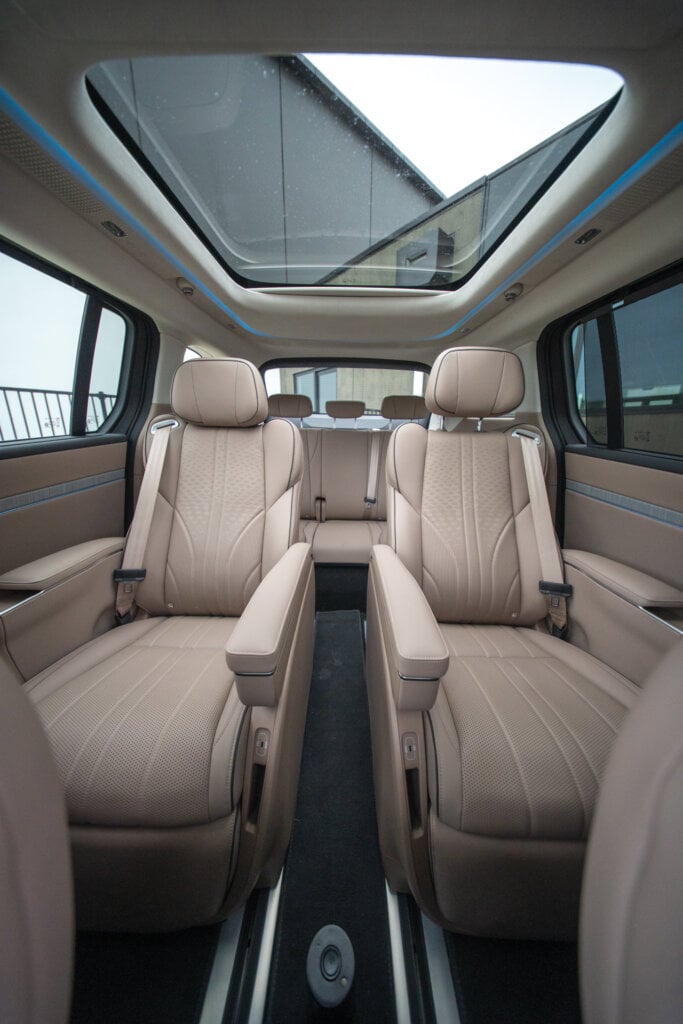
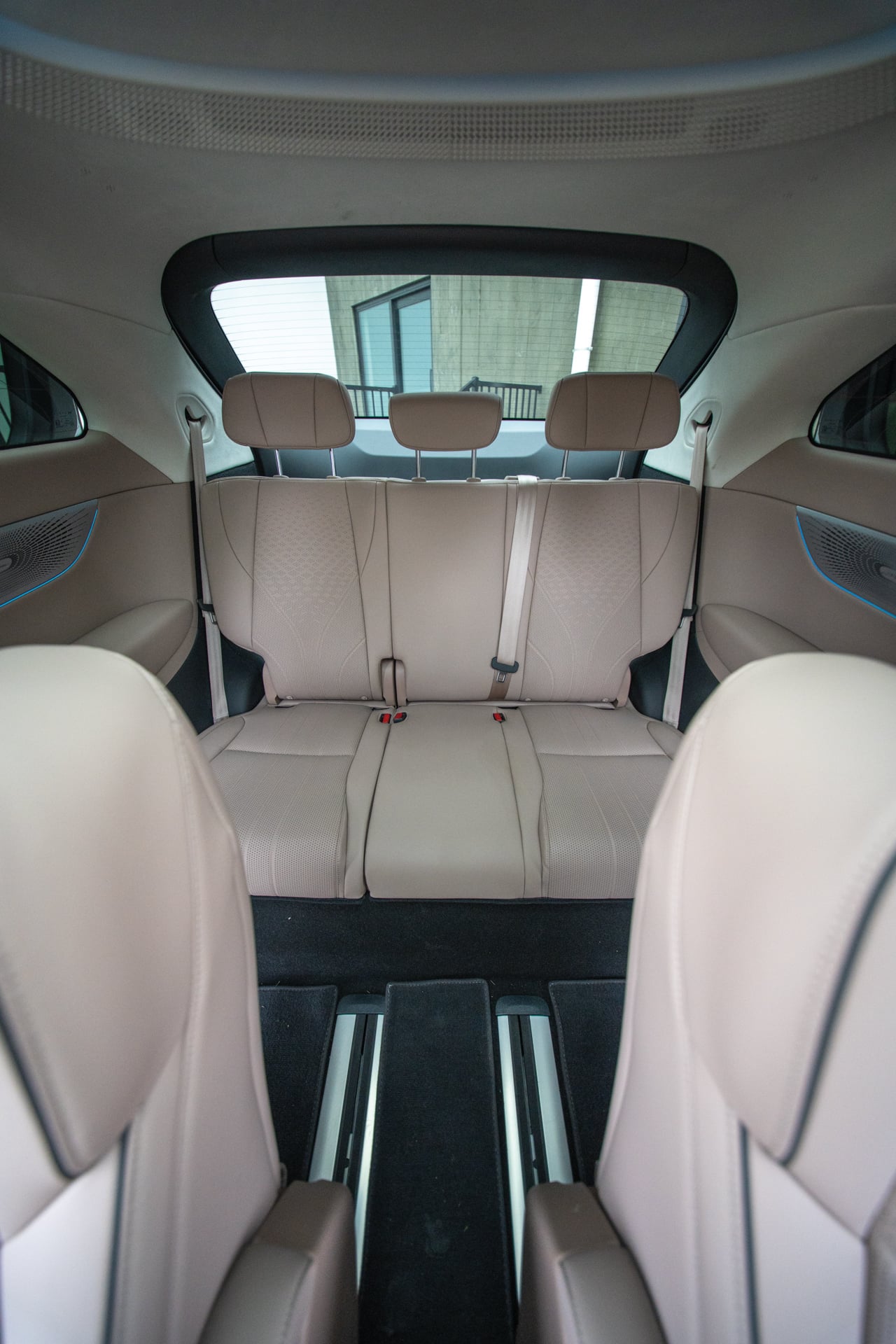
Open the electric sliding doors and the interior is where the X9 earns its price. The second row is the place to be. Two large captain’s chairs recline, extend a leg rest and drop into a zero-gravity setting at the touch of a button. They also feel roomier than the equivalent seats in the Zeekr.
A large roof-mounted entertainment screen is internet-connected in its own right, so there is no need to tether a phone. Netflix, Disney, Spotify and YouTube are all there, and the voice assistant will turn the screen on from the back seat.
The third row is properly usable. Two adults fit comfortably, with real space for their feet beneath the seats in front, heated cushions, adjustable backrests, a USB-C port and electric sliding access. Three adults across would be a squeeze, there is no centre armrest and headroom is a little tight because of the tapering roofline. Even so, it is far better than most.
There is more than 700 litres of luggage space with all seven seats in use. Hold two buttons and the third-row headrests drop, the backrests fold and the entire bench tucks flat into the floor, leaving around 2500 litres with the second row still in place. Travelling with four people and bikes is realistic.
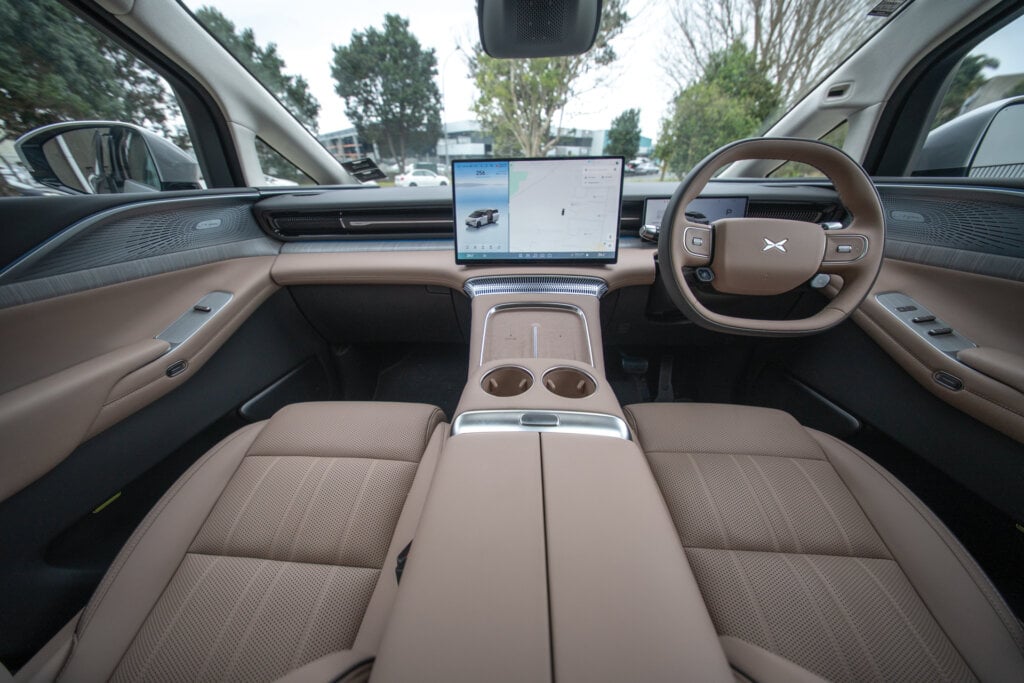
The driver’s environment is nicely finished. A wide dashboard is broken up by large speaker enclosures, there is real metal trim rather than plastic imitation, and two high-speed wireless phone chargers sit ahead of the squared-off wheel.
The huge central screen is usually split between a live representation of the traffic around you and the navigation display, with Apple CarPlay and Android Auto also available. The system is a close relative of the one in the G6 and remains one of the simpler Chinese interfaces to live with.
Every seat is heated, while the front four are ventilated and the front pair add massage functions. The steering wheel is heated and there is a refrigerator in the back. Data connectivity for app control is free for 10 years, while multimedia data is free for one year, with ongoing pricing yet to be confirmed.
Cabin storage is only average, with a small centre bin and nothing in the doors large enough to hold a big bottle.
The pop-out door handles were our main frustration during the test. They seemed slow to recognise the phone key, and getting in and out sometimes meant waiting. We later discovered that the digital-key sensitivity is adjustable through the settings, so your experience may vary. Soft-close doors and push-button sliding rear doors offer some compensation.
Drives like an SUV
The Performance has 370kW and 640Nm, enough to reach 100km/h in 5.9 seconds. It never feels like a sports car off the line, but it picks up its skirts and goes. Even with a full load of passengers, it never felt short of urge.
It is efficient too. Around town, we saw consumption as low as 17kWh/100km, a good figure for something this size. XPeng quotes a WLTP range of 580km from the 110kWh NMC battery, and we think 450 to 500km is a safe real-world expectation.
Dual-chamber air suspension is standard, with around 90mm of ride-height adjustment across six manual levels and separate Comfort and Sport settings. Rear-wheel steering is also standard, which helps when manoeuvring a 5.3m vehicle through tight car parks.
The driving position is SUV-like rather than van-like, with plenty of reach and rake adjustment in the steering wheel and a wide range of seat movement. Visibility is good, helped by a camera-based rear-view mirror that still works when the cabin is full of heads.
On the open road, grip is never in question. The nose will push wide if you overdo it, as you would expect with well over two tonnes on the move, but there is more front-end bite than in the Zeekr. It feels better than a vehicle this size has any right to.
It is also very quiet on coarse-chip surfaces and in the wet. The brakes are strong, although the pedal feels a touch soft in its initial response, even in the most aggressive setting. In Comfort mode, with the ride height raised, there is a faint suspension noise. That is common in air-sprung cars and not something most owners would notice.
There is no ANCAP or Euro NCAP rating yet. The X9 holds a five-star Chinese crash-test rating and has been designed with that target in mind. It has nine airbags, including curtains extending to the third row, something not every Chinese seven-seater manages.
The driver-assistance suite is comprehensive and mostly well judged. On the motorway, the X9 will largely drive itself. On B-roads, it slows aggressively for corners, and while that function can be switched off, there is no middle setting. One thoughtful detail is that if a warning chimes repeatedly, the car offers to silence it for the rest of the drive instead of making you dig through menus.
Verdict
It is easy to be impressed by a $125,000 car packed with features. What stands out about the X9 is how well those features are executed. The seating works, the cabin feels expensive, it drives like a decent SUV rather than a heavy van, and it charges faster than anything else on New Zealand roads. Compared with the large luxury SUVs it undercuts, some of which now carry prices well north of $100,000, the X9 looks like strong value. We did not expect to say that about a people mover.
XPeng X9 AWD Performance
$124,990 / 19.6kWh/100km / 0g/km
0-100 km/h 5.9s
Motor output 370kW
Max torque 640Nm
Battery 110kWh
Range 580km
Drivetrain Single-speed auto / AWD
Front suspension Wishbones / air springs
Rear suspension Multilink / air springs
Turning circle 10.8m
Front brakes Ventilated discs
Rear brakes Ventilated discs
Stability systems ABS, ESP
Safety AEB, ACC, BSM, LDW, RCTA, ALK, AHB
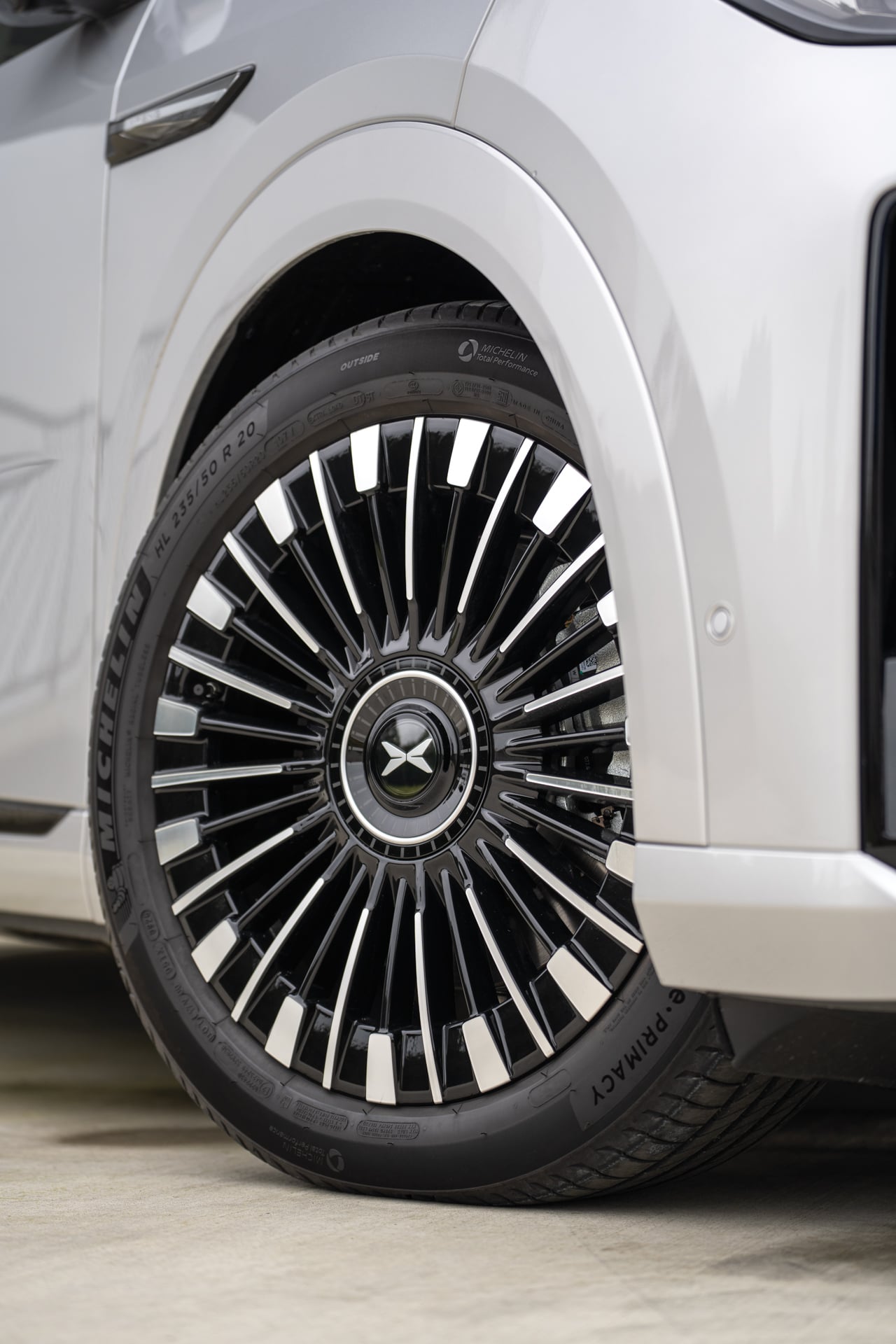
Tyre size f/r-235/50R20
Wheelbase 3160mm
L/W/H 5316 / 1988 / 1785mm
Trackf-1688mm r-1702mm
Luggage capacity 721-2514L
Tow rating 750kg (1500kg Braked)
Service intervals 12 months / 20,000km
Warranty 7yrs / unlimited km
ANCAP rating Not yet rated
Weight (claimed) 2745kg
