


AutoTrader NZ
Published 10 October 2026
We travel to Yokohama to find out whether BYD should sell its first kei car outside Japan.
Kei cars have been a private club for Japanese manufacturers since the 1950s. The rules surrounding them are strict, the dimensions tiny and the market enormous, with kei vehicles accounting for more than a third of the country’s new-car sales. Until now, every one of them has been built by a Japanese brand. Enter the BYD Racco, the first foreign model to break that run.
It went on sale in Japan in July, priced from ¥2.145 million (around NZ$23,500), and no Western publication had managed to get its hands on one. So we paid our own way to Tokyo, economy class, to change that.
We collected a top-spec Racco 300 Premium from an underground car park in Yokohama, in 36-degree heat and the kind of humidity that makes simply moving a chore. The plan was to take a car designed for postage-stamp parking spaces on a 430km road trip into the mountains, then sleep in it.

What it is
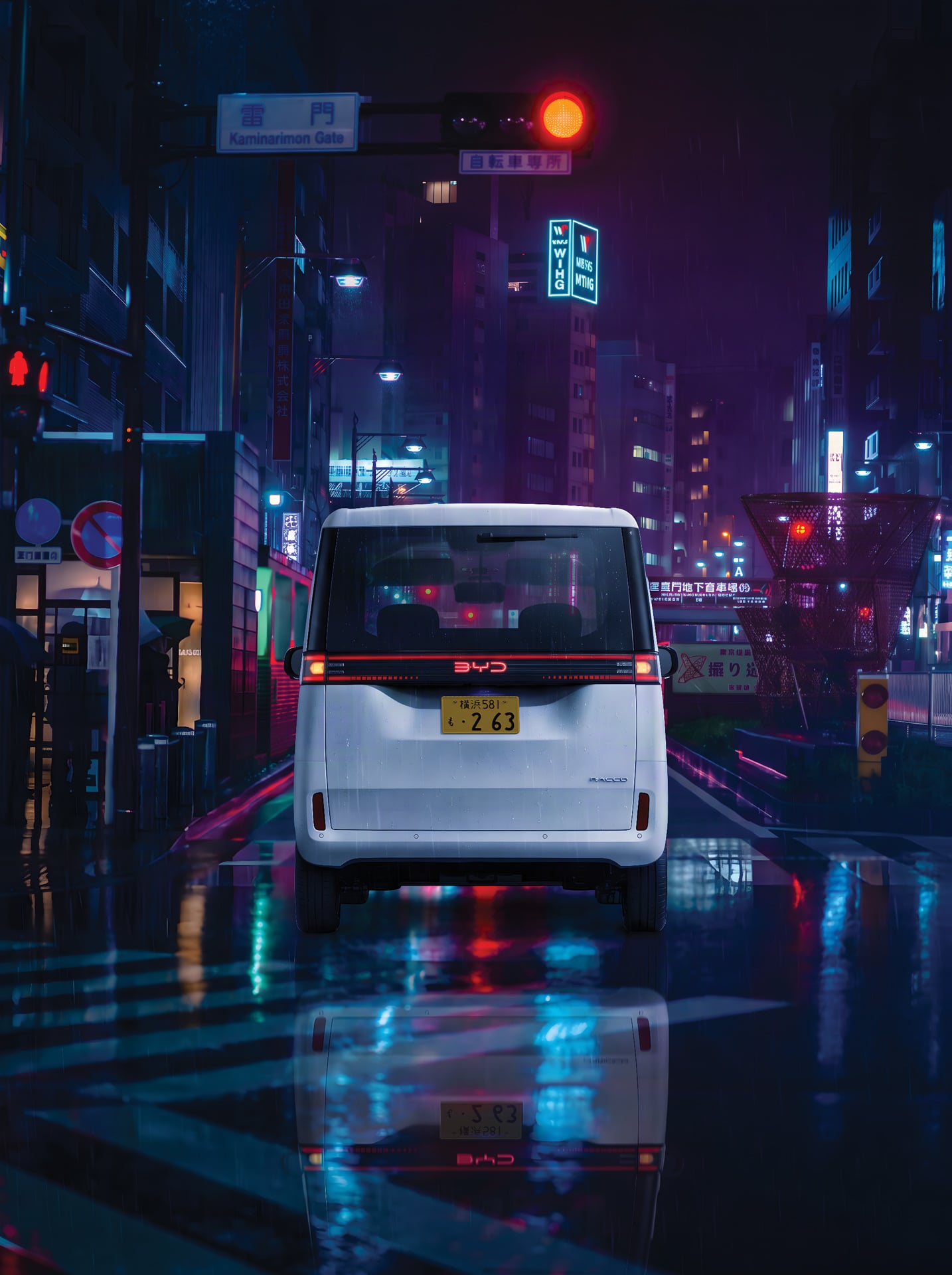
The kei formula limits a car to 3.4m long, 1.48m wide and 47kW, regardless of what powers it. The Racco uses every available millimetre and kilowatt.
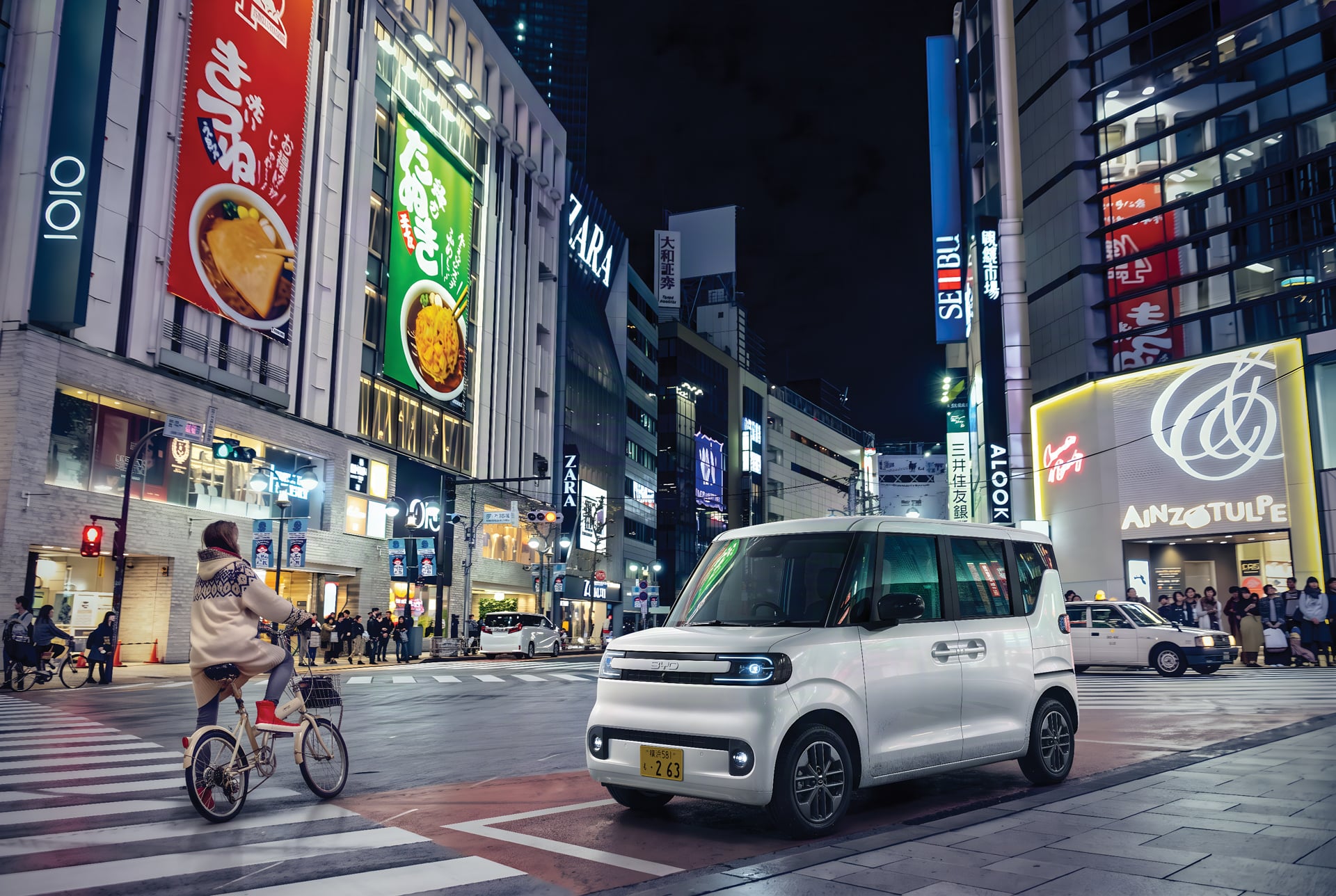
At 1.8m tall, it sits in the super-height-wagon class Japanese families actually buy, alongside the Honda N-Box and Suzuki Spacia. It is also the first EV in that class from any manufacturer.
What makes this small car more significant is that Suzuki president Toshihiro Suzuki has publicly called BYD a major threat. Those are strong words from a company boss. As for the humble name, Racco means otter in Japanese, which is why our first stop was an animal café to feed one.
There are three variants available. The Racco 200 pairs a 22.4kWh Blade battery with 210km of WLTC range. The 300 Plus and 300 Premium get a 35.8kWh pack good for 320km, making them the first kei EVs in Japan with a range exceeding 300km.
All use a single front-mounted motor producing 47kW and 160Nm. Powered sliding rear doors on both sides, vehicle-to-load capability, battery preheating, over-the-air updates and a full suite of driver-assistance features are standard across the range. Japan’s ¥150,000 EV subsidy applies to all three models. BYD says the platform, body, powertrain and control systems were developed specifically for the Racco.
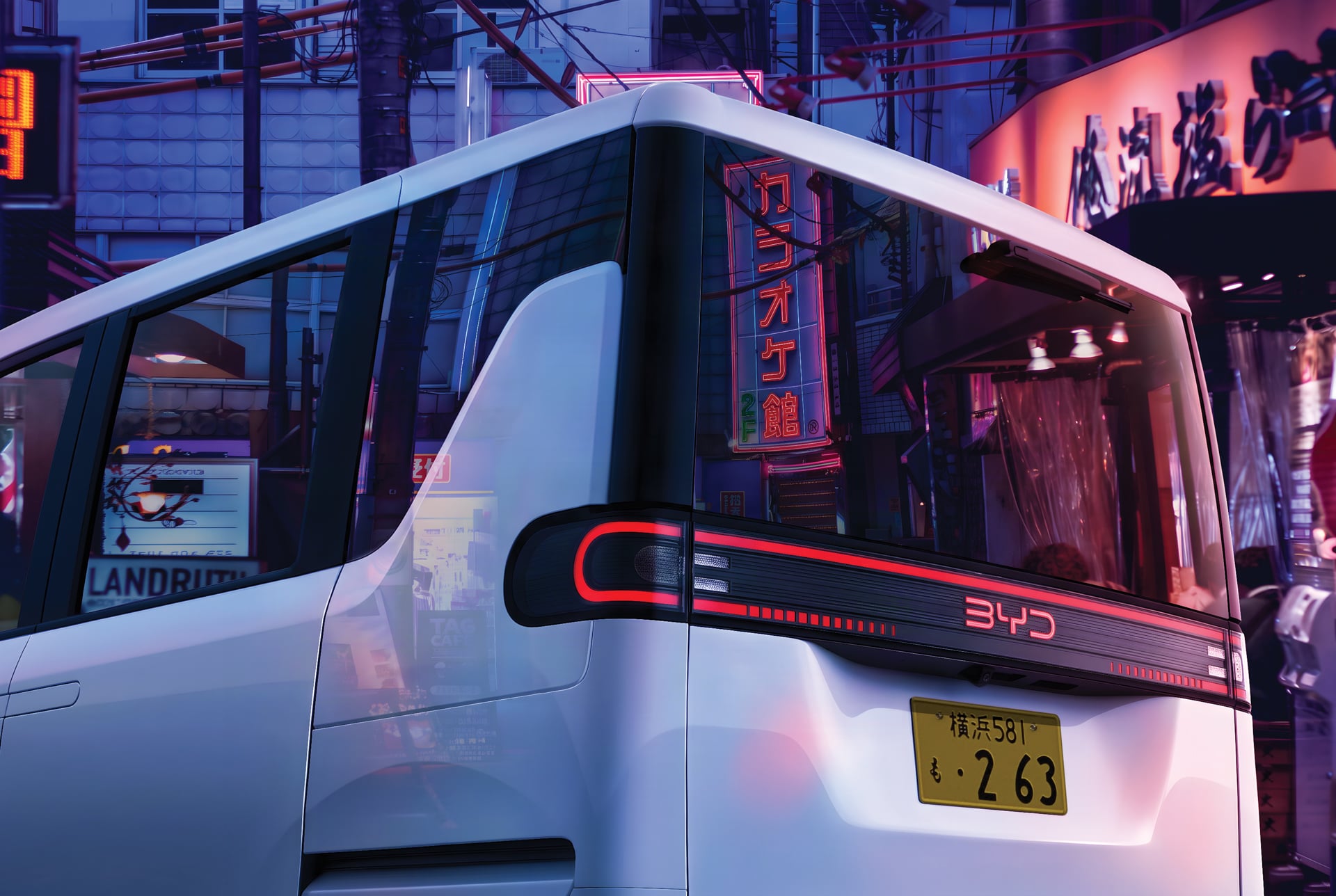
There isn’t much scope for design flair within the kei box limitations, so BYD has leaned into them. The Racco is a clean rectangle with short overhangs, wheels pushed to the corners and a smooth white face that has no need for a grille. LED lighting at the front and rear helps lift it above the appliance look.
The front doors open to a full 90 degrees. The rear sliding doors are powered and, on the Premium, can be opened by placing a foot in a projected light beneath the sill while the key is in your pocket. Sliding doors are usually slow, but there is so little door here that they open relatively quickly.
Inside story
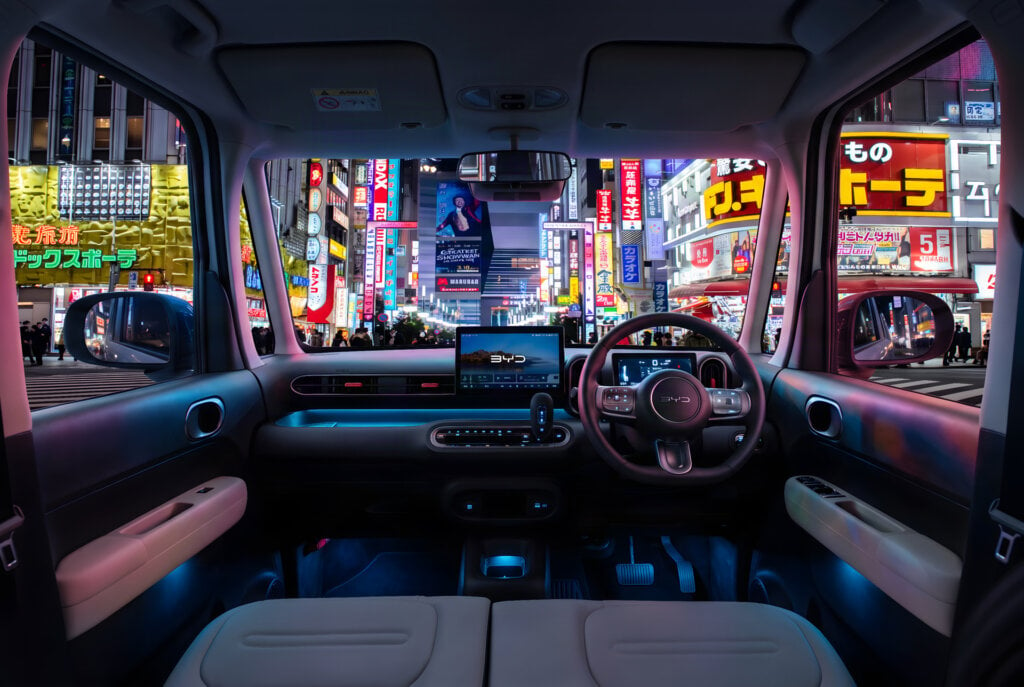
Visibility is the best of any car we’ve driven this year. The roof is absurdly high, the A-pillars are split and pushed out of the driver’s sightline, and the seating position puts your eyes above the roofline of the Prius in front. It’s a conservatory on wheels.
The dashboard is simple and logical. A 10.1-inch touchscreen handles most functions through the familiar BYD interface, including three-finger swipes to adjust the temperature and fan speed. Physical climate-control buttons are also provided, which is welcome. There is a USB-A port, a USB-C port, a 12V socket and a drink warmer, but no wireless phone charging or built-in navigation. That leaves you relying on Apple CarPlay or Android Auto. Ours got badly lost in Yokohama, although that was Google’s fault.
Plastics are hard throughout and the door tops are unkind to elbows, although there is a padded section where your arm actually rests. The driver’s seat is electrically adjustable, while the passenger’s is manual.
At 178cm, we could slide the seat so far back that the pedals were out of reach, so taller drivers should be well catered for. Storage is clever, with bins and trays everywhere, including a pull-out tray accessible from the front or rear. The glovebox, however, is tiny.
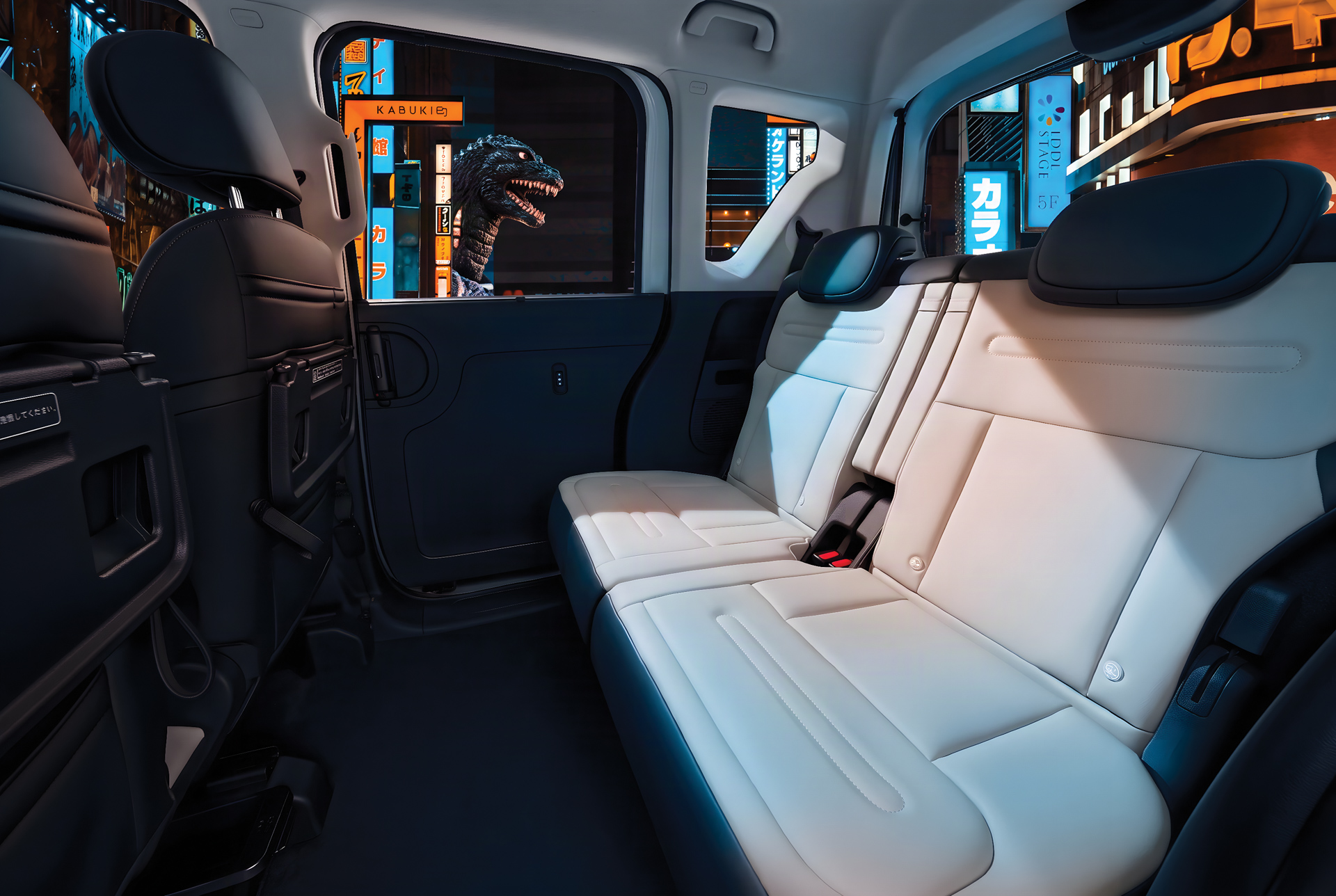
Rear legroom and headroom are more generous than a car this size has any right to offer. The seats slide and recline, while a strap flips the cushions forward to create a flat floor. The front passenger seat folds as well, which formed the basis of our ill-fated camping plan.
Boot space expands to 1327 litres with the seats folded, and the tailgate is large enough to shelter beneath in the rain. The rear windows only drop halfway, an odd decision for such tall doors, while the sun visors are wide but so shallow that they block only direct sunlight. The central screen could also use more brightness on a sunny day.
The Racco has six airbags, disc brakes on all four wheels, a body made from 70 per cent high-strength steel and a full suite of active-safety systems. There is no independent crash-test result yet. BYD says it is targeting five stars, but, of course, every car maker is targeting five stars. What rating the Racco actually achieves remains to be seen.
On the road
With 47kW moving 1220kg, the Racco takes around 15 seconds to reach 100km/h. Its 0–50km/h time of approximately 4.4 seconds is the figure that matters in town, and in Sport mode there is enough torque to jump into gaps without embarrassment.
The drive modes are Normal, Sport, Snow and Eco, selected using a scroll wheel. As with other BYD models, regenerative braking is light even in its strongest setting, and there is no one-pedal mode. That’s a shame in Tokyo traffic, although an auto-hold function keeps the car stationary at the lights.
A light, short-wheelbase car on narrow tyres ought to fidget, but the Racco doesn’t. The suspension is soft and comfortable over broken tarmac. BYD won’t quote a battery weight, but we estimate the LFP Blade pack weighs around 260kg and sits low in the floor. That helps this tall, narrow car feel planted.
On the hairpins near Mount Fuji, the limits arrive early and the tyres complain immediately, but the Racco is honest, predictable and good fun in the slow-car-fast tradition.
Its one dynamic weakness is crosswinds. Strong side gusts, or a passing truck on the expressway, push it around, and you feel every one.
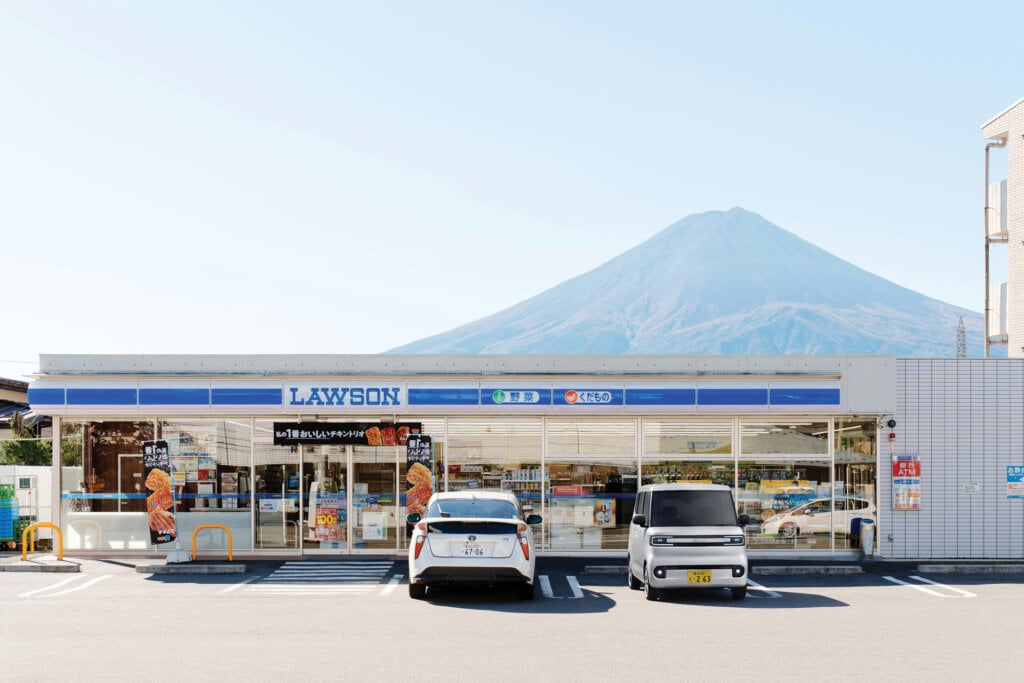
Manoeuvrability is the whole point of the car. With a 2.52m wheelbase, we reversed into spaces that would have been abandoned in anything larger. The reversing-camera image is sharp, as images from BYD cameras usually are.
The Level 2 driver-assistance system is properly calibrated for a car this cheap. It holds the centre of the lane rather than wandering and managed Tokyo’s stop-start expressways without intervention. Finding the button to activate it took several attempts, although this was partly user error, as the steering-wheel controls must be pressed in a particular order.
Road noise on coarse surfaces is noticeable but not tiring. The warning chimes can be turned down through a pull-down menu, although some return after every restart. Leapmotor’s single silence button is something BYD should copy.
Slow charger
Charging is the weak spot, and it happens to align with the limitations of Japan’s infrastructure. The Racco 300 Premium can accept a maximum DC charging rate of 50kW, the same as a 15-year-old Nissan Leaf, while the 200 manages 30kW. Both take around 40 minutes for a charge.
AC charging is limited to 6kW in the 300 and 3kW in the 200, so a home wallbox needs around six hours to recharge the larger battery from a low state of charge. The plug is CHAdeMO, because this is Japan.
That hardly matters for a city car with 320km of range, but it becomes more relevant on a road trip. Japan has around 13,800 DC chargers serving roughly 645,000 plug-in vehicles, with most delivering 50kW or less.
We found the network patchy. One charger didn’t appear to exist when we reached its supposed location, another was busy, and a third ended the session by itself at 70 per cent. The experience left us with the impression that Japan’s charging network resembles New Zealand’s from a dozen years ago.
Efficiency, however, is excellent. Driven hard, mostly on highways and with the air conditioning working overtime in 36-degree heat, the Racco averaged 11.1kWh/100km.
The night in the car
Well, it didn’t happen. We reached the campsite in the dark and hours late, folded the seats flat, unrolled a sleeping bag bought at a luxury outlet mall and discovered that the Racco’s interior child-detection sensor treats a sleeping human as an intruder.
Combined with an army of friendly insects, strict rules against running the car’s air conditioning overnight and just 18 minutes remaining before the gates were locked, we took this as a sign to retreat to air-conditioned accommodation a few kilometres down the road. There was nothing wrong with the car, apart from its refusal to let us stay in it.
Japan’s car makers have spent 70 years perfecting small-car packaging. BYD has matched them on its first attempt
Will it come to New Zealand?
BYD New Zealand says it is monitoring the situation, and both the local operation and BYD’s global headquarters are watching the response to this review closely. That means if you like the look of the Racco and wouldn’t mind one in your driveway, you’ll need to say so.
The import industry, however, hasn’t waited. A top-spec Racco 300 Premium can be landed in New Zealand today for just under $38,000. That figure is inflated by the awkwardness of a car effectively being sold new twice in two different countries, although it should fall quickly.
The verdict
The Racco is slow, charges slowly and has hard plastics everywhere. Despite that, it is comfortable, remarkably spacious, easy to drive and park, efficient enough to make a small battery go a long way, and well equipped for the money in a segment that has never faced outside competition.
Japan’s car makers have spent 70 years perfecting small-car packaging. BYD has matched them on its first attempt. Whether Japanese buyers will accept a Chinese badge is the open question. Suzuki’s president clearly thinks they might.
BYD Racco 300 Premium
$TBC / 12.4kWh/100km / 0g/km
0-100 km/h 15s
Motor 47kW / 160Nm
Battery/Range 35.8kWh / 320km
Drivetrain 1-speed auto / FWD
Weight 1220kg
