View all
1 more image
2026 Ford Everest Sport 2.0 Review
Words: Kyle Cassidy | Photos: Kyle Cassidy
The Ford Everest is a popular seller here and has recently undergone a makeover. The primary update concerns a new engine for the 2.0-litre models. Is it still worthy?
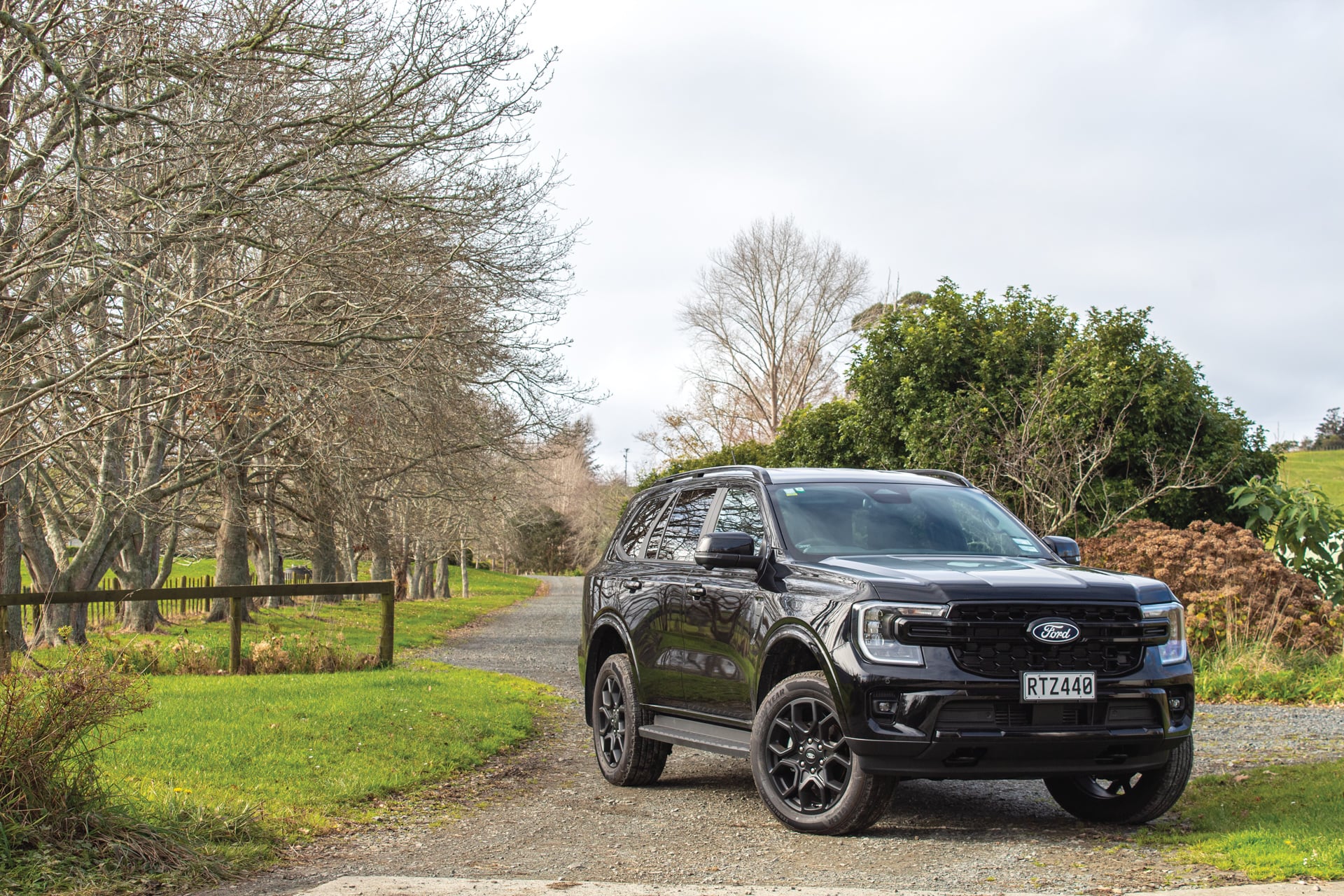
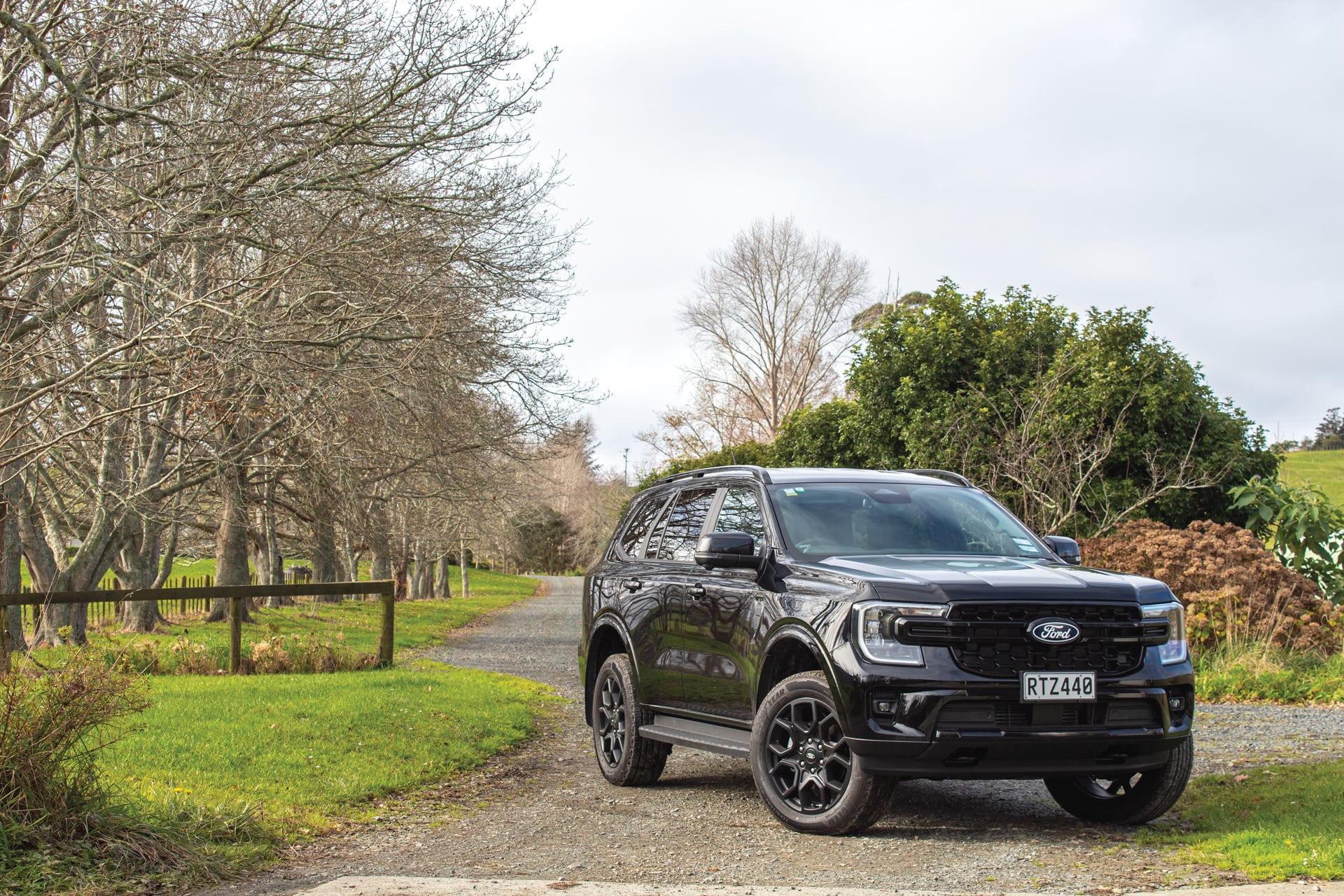
Like the Ranger on which it is based, the Ford Everest has had a makeover of sorts, with the line-up now including a revised entry-level model powered by a new 2.0-litre diesel. Ford’s big SUV continues to sell well despite its elevated price tag. It is the brand’s best-selling passenger vehicle here, though that’s not hard when there aren’t many to choose from now.
As a refresher, the current Everest was introduced in 2022 and sits on the same ladder-chassis platform as the Ranger, though it has been modified with a shorter wheelbase. While the front end is the same, the rear is different. It still has a solid axle, but it’s located via trailing arms and a Watt’s linkage, and rides on coil springs.
That adds a touch of refinement to what remains a genuine 4×4 with switchable four-wheel drive, a low-range transfer case and a rear diff lock.
The revised line-up consists of the new Active model, kicking off at $68,990. That’s cheaper than the Trend it replaces, despite having more equipment on board, including leather trim, a larger touchscreen, 18-inch alloys, tinted windows and LED lights. The Sport remains available with both four- and six-cylinder motivation, with the 2.0-litre model tested here costing $77,490, while the V6 is $85,490. Other options include the Wildtrak ($88,990) and Platinum ($93,490), both powered solely by the V6.
New 2.0
Like the Ranger, the 2.0-litre models now adopt the new single-turbo four-cylinder, which is down on output but will hopefully deliver greater long-term reliability and reduced servicing costs thanks to its more robust timing-chain arrangement. Output falls from 154kW and 500Nm to 125kW and 405Nm, with a slight reduction in emissions too.
Do you miss the newtons? Not in general day-to-day running. Those who opt for the Everest as a family-friendly SUV and operate around the city aren’t going to feel hard done by. Ford says the 2.0-litre is its “most responsive” diesel unit, and it works harmoniously with the 10-speed auto. Turbo lag is not really a thing, with the torque streaming in by 1750rpm, and it responds smartly to throttle inputs. So does the transmission, which is quick with its choice of gears, usually selecting the right one for the task. We also like the more conventional gearlever; it’s simply easier to use than the by-wire shifter in the V6 models.
Where you do notice the lack of urge is when you’re going for an overtake. While we recorded 10 seconds for the 0–100km/h sprint in the bi-turbo Trend, this Sport was busting its boiler to get there in 12 seconds, while the 80–120km/h run took more than 10 seconds. If you’ve got a big boat or horse float to haul, you’re best advised to look at the 600Nm 3.0-litre models. Even though both the 2.0- and 3.0-litre models are rated to tow 3500kg, the V6 will haul your load more assertively.
But otherwise, this 2.0 ain’t all that bad. It’s reasonably quiet for a diesel, even under load, with minimal vibration. It’s okay on fuel too, rated at 8.2L/100km, while we saw 9.5L/100km with a mix of urban and motorway driving. The V6 version is said to use 9.7L/100km.
Competent all round
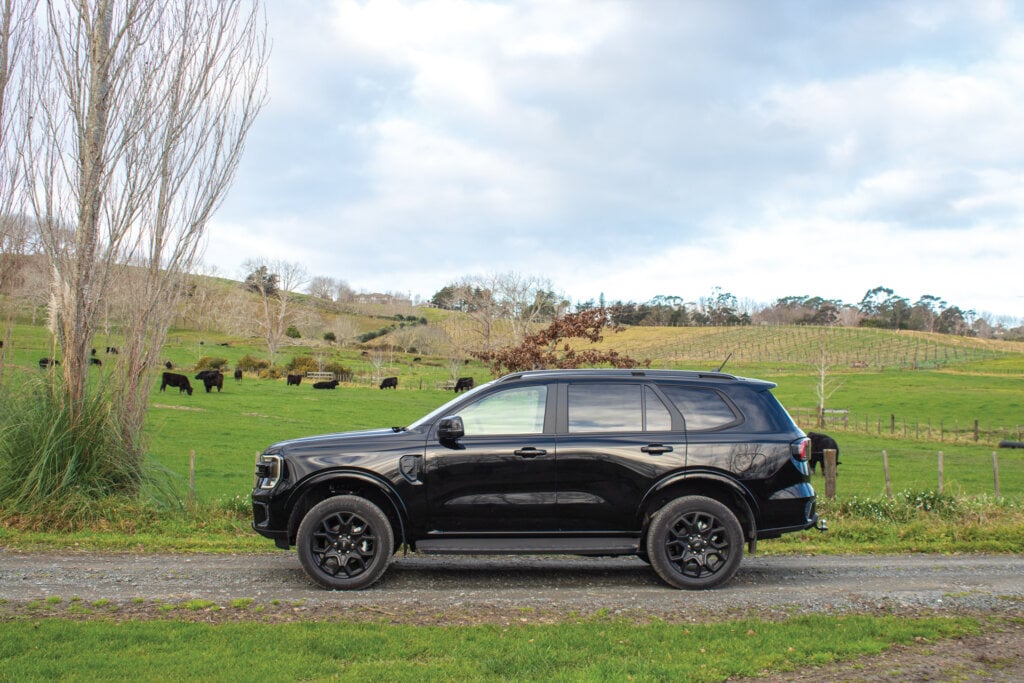
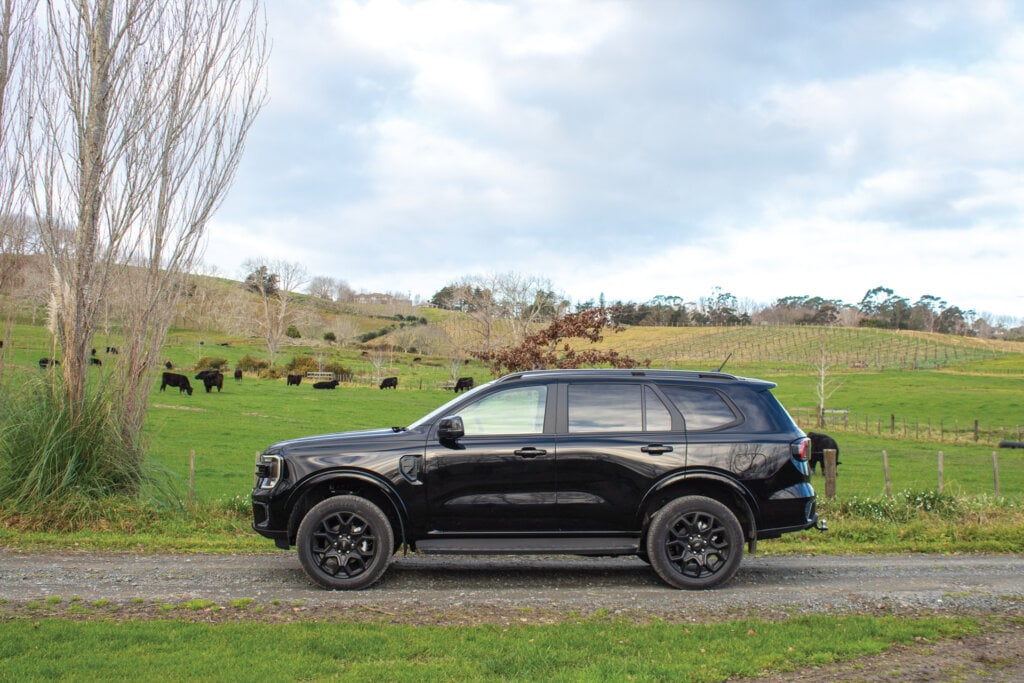
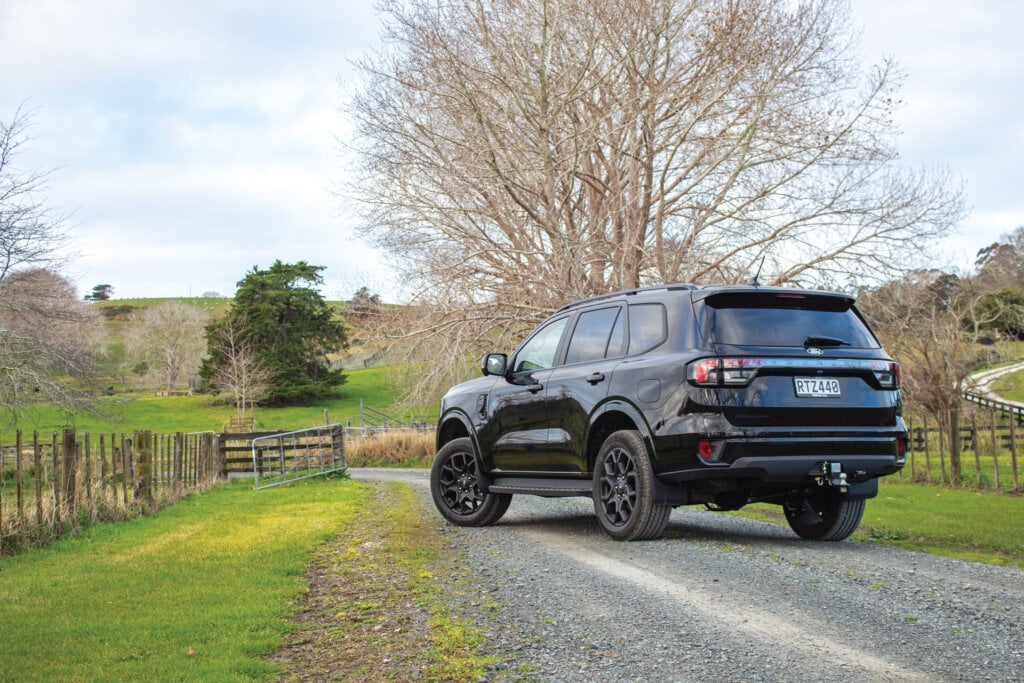
The Everest’s popularity probably stems from the fact that it looks adventure-ready and is properly competent across the board. For something so capable off-road and with such a high towing capacity, it’s remarkably civil in the city. With a bit of solid-axle jiggle, the ride isn’t as calm as that of a unibody crossover, yet it’s not unbearable either. And it’s not too wobbly, despite riding as high as it does.
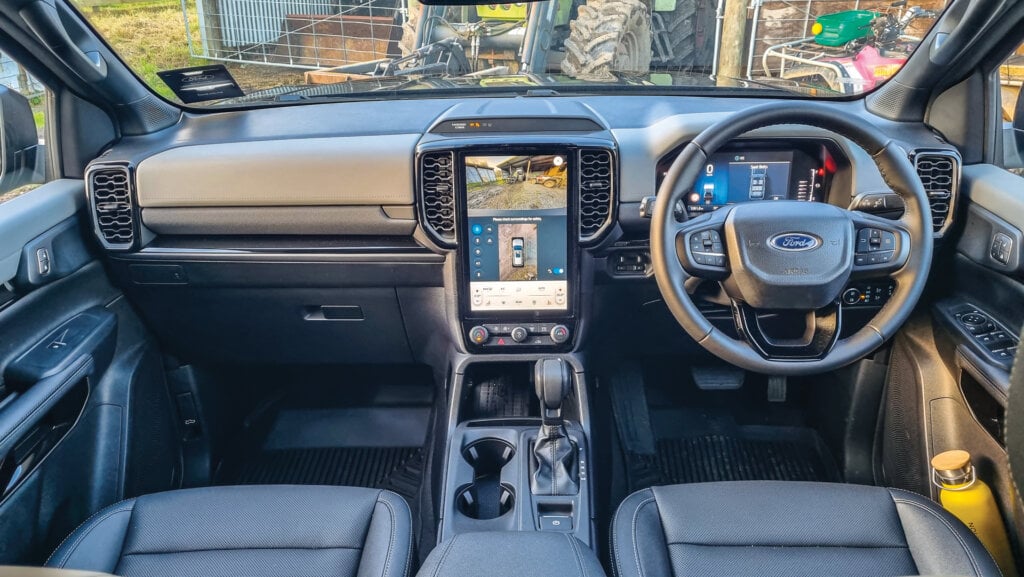
The steering is positive too. It’s quite light, but still feels connected, while the turning circle is manageable. From your elevated driving position, you’ve got a commanding outward view, aided by big wing mirrors and a 360-degree camera, which is a new addition for the Sport.
Barrel down a winding country road and you can expect a serve of body roll, yet it manages to negotiate the bends without excessive tyre squeal or alarming understeer. The rear end is well behaved too, aiding overall stability. It’s heavy, however, and always feels it.
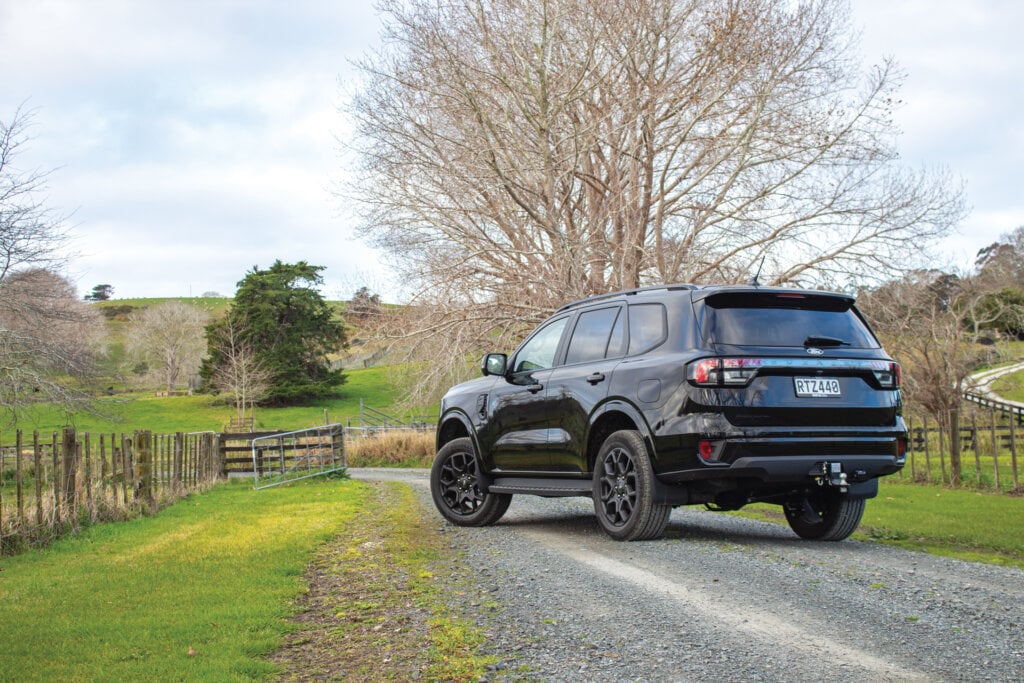
If your school run involves gravel roads, this eats up corrugations and potholes, but you may miss the added traction of the 4A on-demand AWD mode, which isn’t part of the 2.0-litre model’s set-up. Instead, there is just the usual 4H setting. There is also low range and a locking rear diff for those who want to test the 229mm of ground clearance, 800mm wading ability or 30.2-degree approach angle. The departure angle is 25 degrees.
Versatile too
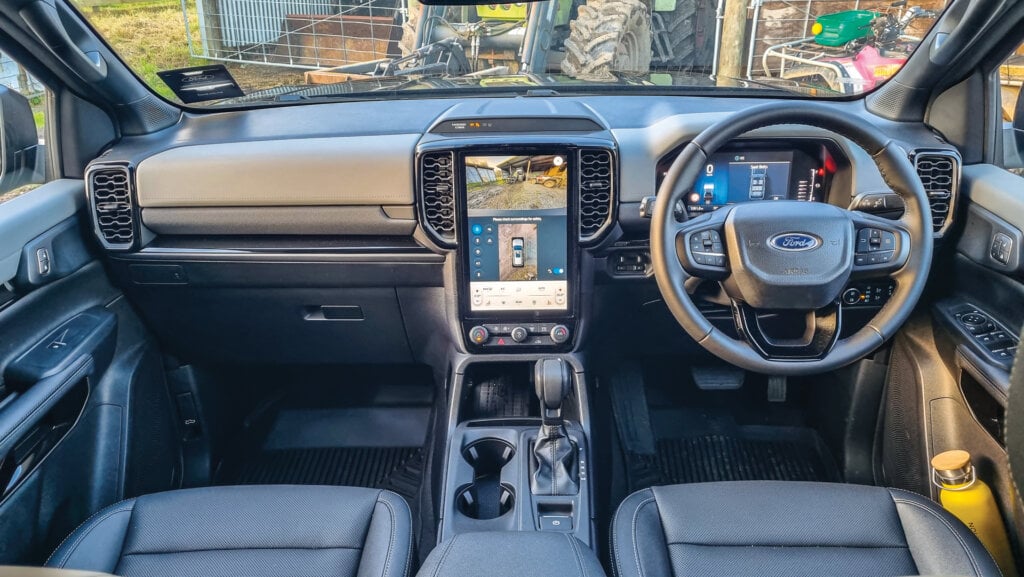
This is a jack of all trades, though you might feel the cabin is a tad utilitarian for the money. Like the Ranger, plastic trim is plentiful, with just a smattering of softer surfaces. It has a mass-market feel; you’re not going to mistake it for a premium offering.
The screen has been upsized, while the leather seats are powered on both sides and now include heating and ventilation, which are also new for the Sport model. Ford’s SYNC system handles the basics competently, with wireless Apple CarPlay and Android Auto ready to add more connectivity. You also get a charging pad, smart key and enough practical storage.
It has enough active safety features to keep you out of harm’s way, with all the systems working without causing aggro. The active cruise control behaves itself, while the speed-sign recognition system issues a discreet ding when you stray over the limit. If you find the lane-keeping assistance too insistent, usually on highways, it is easily switched off.
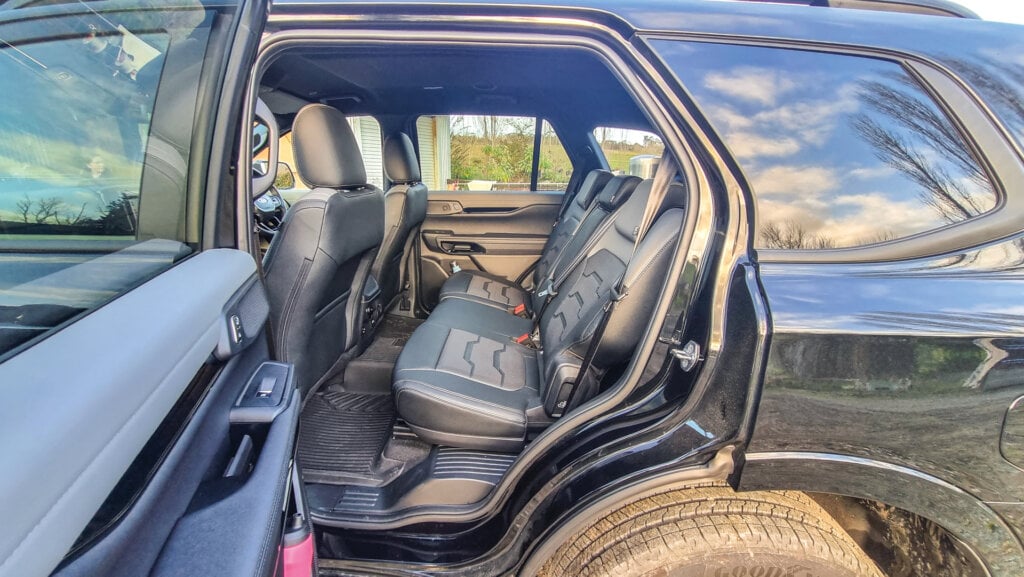
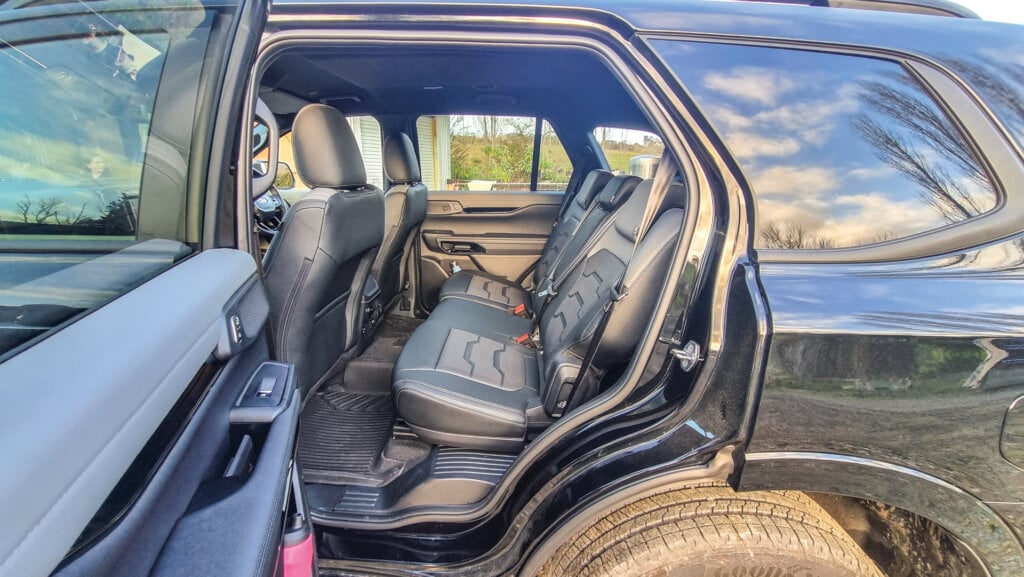
This has room for the kids, with the back seat offering both slide and recline functions, along with ISOFIX points. Power outlets and ventilation controls should help keep them happy. Access to the rearmost seats is straightforward, if a little tight, while legroom is limited for anyone no longer at primary school.
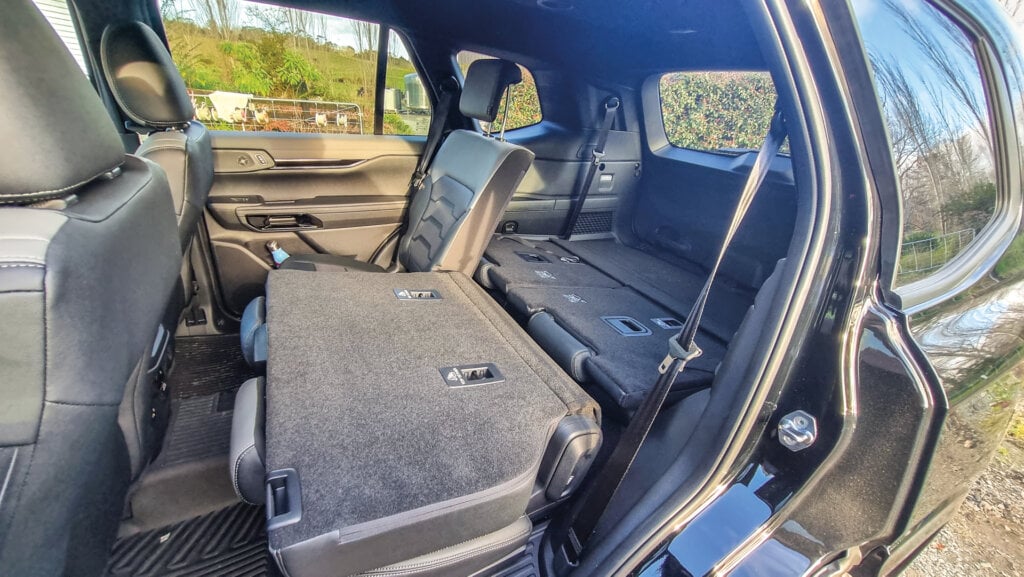
The seats are easily deployed and stowed, though there’s not much luggage space left over when they are in use. There is plenty when they are tucked away, even with the high-set load floor.
Still competitive?
So, what else could you choose instead? The Toyota Prado is the obvious one. However, it’s more expensive, with the GXL priced at $84,590, and it doesn’t really work as a seven-seater because of its compromised boot and third-row arrangement. Its overall quality and refinement are superior, however.
There’s also the Denza B8, a plug-in hybrid, but it’s pricier again at $110,000 for the seven-seater, although it delivers a bona fide premium experience. The Pajero Sport is cheaper at $64,990, but the extra cost of the Active would be worth every cent for its additional interior space and superior on-road refinement. The Everest also outclasses the $80,000 Isuzu MU-X. And that’s why it sells in big numbers; it does everything very well while remaining competitively priced within its segment.
Ford Everest Sport 2.0
$77,490 / 8.2L/100km / 217g/km
0-100 km/h 12.39s
80-120 km/h 10.12s (300m)
100-0 km/h 37.89m
Speedo error 97 at an indicated 100km/h
Ambient cabin noise 70.4dB@100km/h
Engine 1996cc / IL4 / TDI
Max power 125kW@3500rpm
Max torque 405Nm@1750-2500rpm
Drivetrain 10-speed auto / switchable 4×4
Front suspension Wishbones / swaybar
Rear suspension Solid axle / swaybar
Turning circle 11.8m (3.25 turns)
Front brakes Ventilated discs
Rear brakes Discs
Stability systems ABS, ESP, TV
Safety AEB, ACC, BSM, LDW, RCTA, ALK, AHB
Tyre size f/r-255/55R20
Wheelbase 2900mm
L/W/H 4978 / 2015 / 1876mm
Track f-1620mm r-1620mm
Fuel capacity 80L
Luggage capacity 259-898-1823L
Tow rating 750kg (3500kg braked)
Service intervals 12 months / 15,000km
Warranty 5yrs / unlimited km
ANCAP rating ★★★★★ (2022)
Weight (claimed) 2381kg