View all
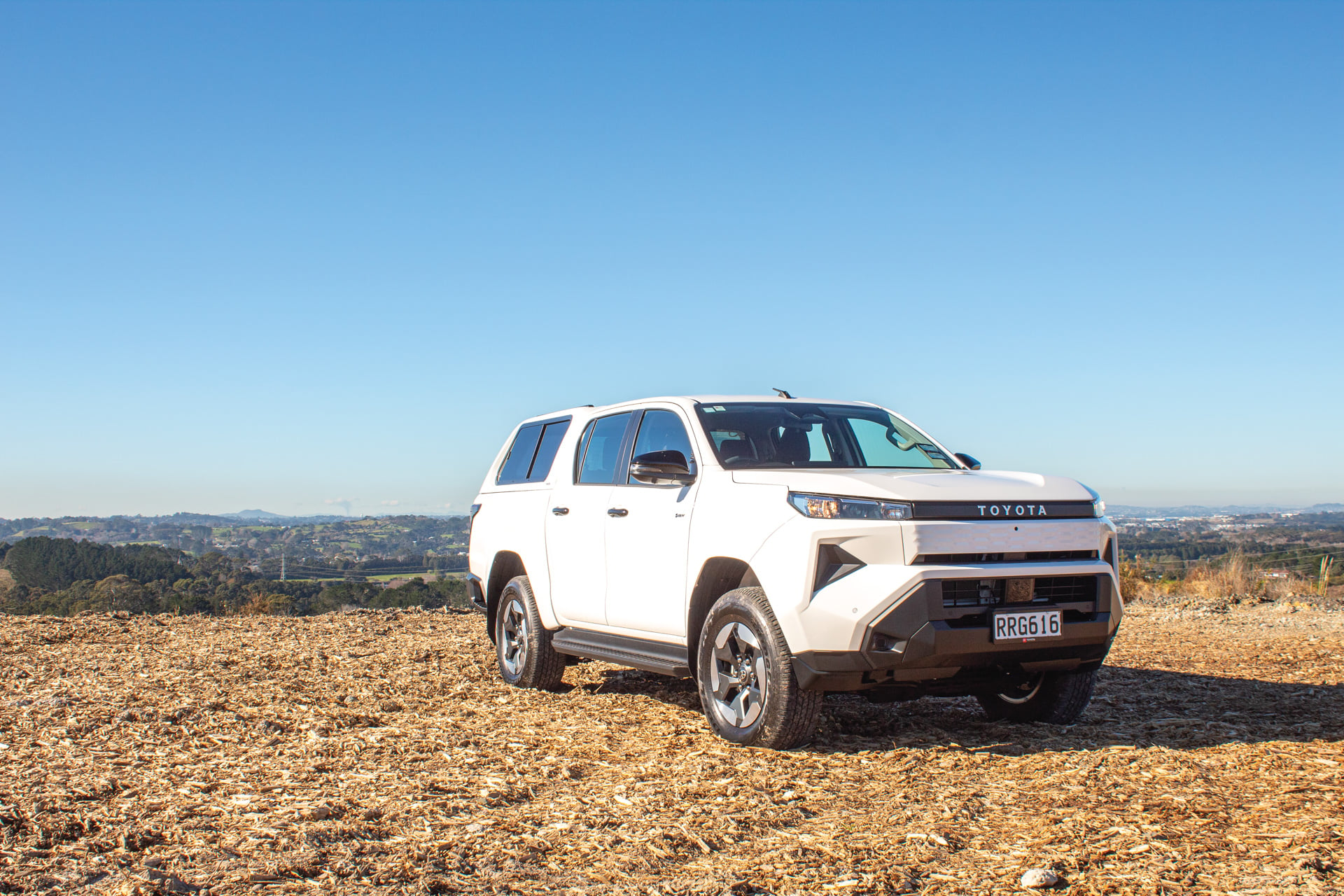
2026 Toyota Hilux SR BEV Review
Words: Kyle Cassidy | Photos: Kyle Cassidy
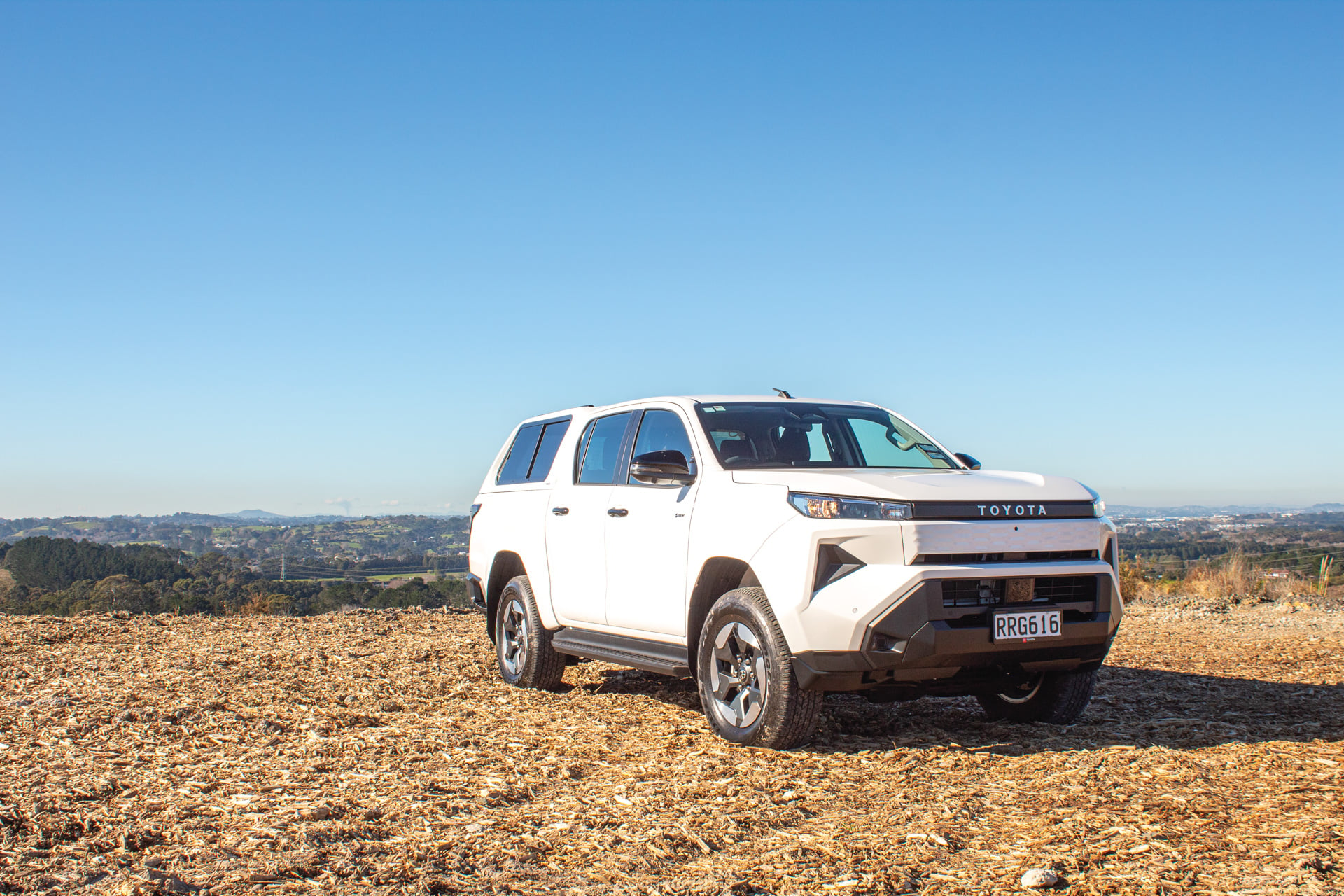
Hilux is a brand in its own right in New Zealand, one that has a faithful following. However, the base tends to be a little conservative. One might remember when Hilux evolved to include an independent front-end; some thought it had lost its soul, and they didn’t like it when it gained a turbocharged engine. And now this electric thing has come along, crikey! But they need not fear. The Electro-Lux is a niche offering, not intended to replace the conventional Hilux. It serves a purpose for a small market of corporations and government departments that require a capable, zero-emissions vehicle.
For the majority of Hilux buyers, it simply doesn’t stack up. There’s the price, this SR double cab being $82k, while the SR5 is $86k. That’s a $25k premium over the diesel.
While we learnt that the Hi-voltage-lux is very capable off-road from our experiences down in the Manawatu during the media launch event, it comes with a few compromises. Whereas the SR5 diesel weighs in at 2155kg, has a payload of 965kg and can haul 3500kg braked, the BEV tips in at 2455kg, its payload is 715kg and the tow rating is restricted to 2000kg.
And then there is the issue of how far you can get on a full store of energy. A fully fuelled SR5 diesel will give you between 700-800km thanks to its 80L tank. The Hilux BEV has a 59kWh battery, and has an NEDC range figure of 315km. But that’s wildly optimistic. When we got into the Hilux BEV SR, the DTE was showing just 209km.
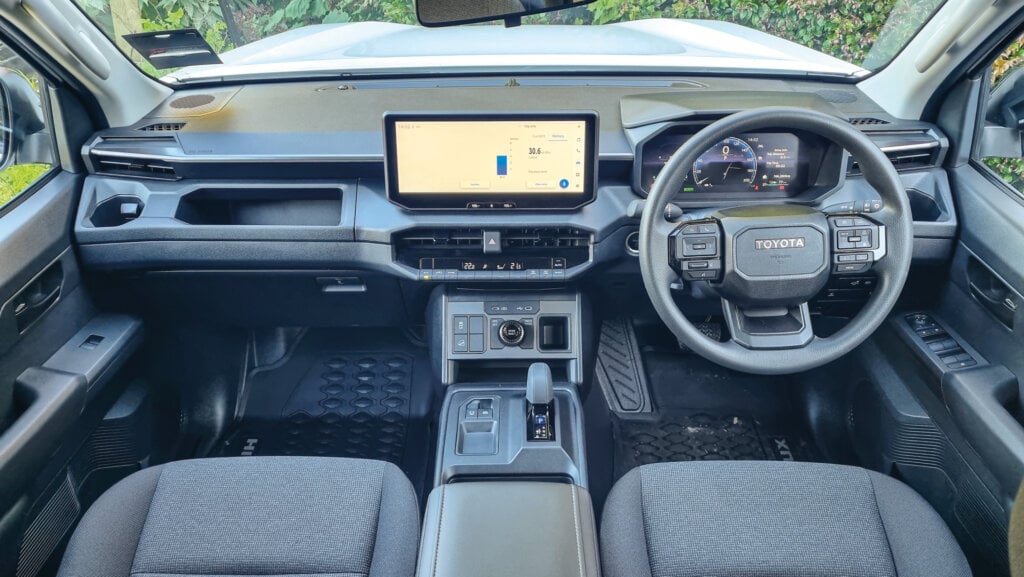
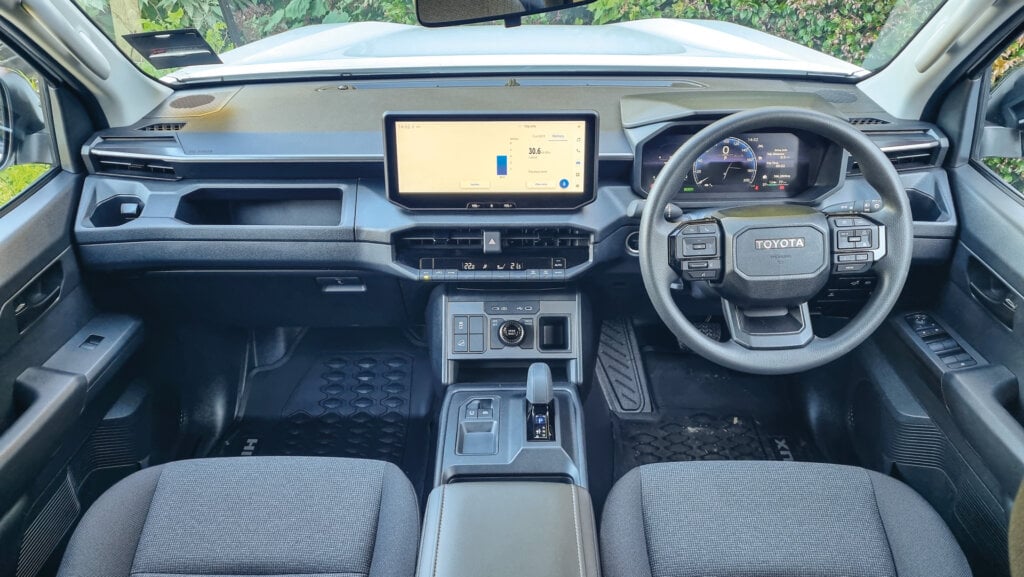
And that’s the main concern with this ute; a relatively small energy store and a ravenous appetite for volts. It’s officially rated at 20.2kWh/100km but that’s a best case scenario. Even tootling around town, it was consuming around the 25kWh/100km mark. And with a few hundred kilos of passengers and gardening supplies on board it was into the 30s. So don’t expect to get far between charges.
The DC refuelling rate is 150kW. We didn’t get a chance to put it on a charger as the few times we drove past the local ChargeNet site (with four pumps) they were all occupied (with people queuing). We guess that’s part of the ‘EV sales surge’; there are now more people competing for charge points. Toyota says a portable home charger will take 26hrs to recharge, while a wall box will refresh it in between five (with three phase power) and eight hours.
The flip side to all of this is that a BEV Hilux (charged via renewables) will contribute zero grams of CO2 to the local environment, whereas a diesel-powered Lux will be responsible for more than 44 tonnes of CO2 over 200,000km. There’s also a service advantage, the price being $260 for the BEV and $465 for the diesel, though both have the same 15,000km/one year intervals. Buying a Hilux BEV (as opposed to an electric alternative from a newer brand) also gives you access to the most comprehensive service network in the country, as well as parts supply.
Performance-wise it’s on par with the diesel. Toyota states a total output of 144kW from its twin motor set up (82kW/205Nm front and 129kW/268Nm rear), which gives it permanent AWD. With no need to wait for the boost, it’s away smartly, with the usual punchy EV acceleration, and it gets to 100 in 9.8sec. However, acceleration tails off quickly, and the 80-120km/h overtake requires 8.4sec. Along with its more instant delivery, the big benefit of the BEV is noise reduction; it’s so much quieter than the diesel, while road rumble and wind rustle are well suppressed too. Its general operations are well sorted. The brake pedal is well calibrated at low speeds, while brake regen can be added via the gearlever. It’s not a one-pedal mode however, but is smooth, the braking added progressively. The unladen ride quality leaves a lot to be desired, even for a ute. In SR trim, this is a lot lumpier than the SR5 Limited diesel we tried the week before.
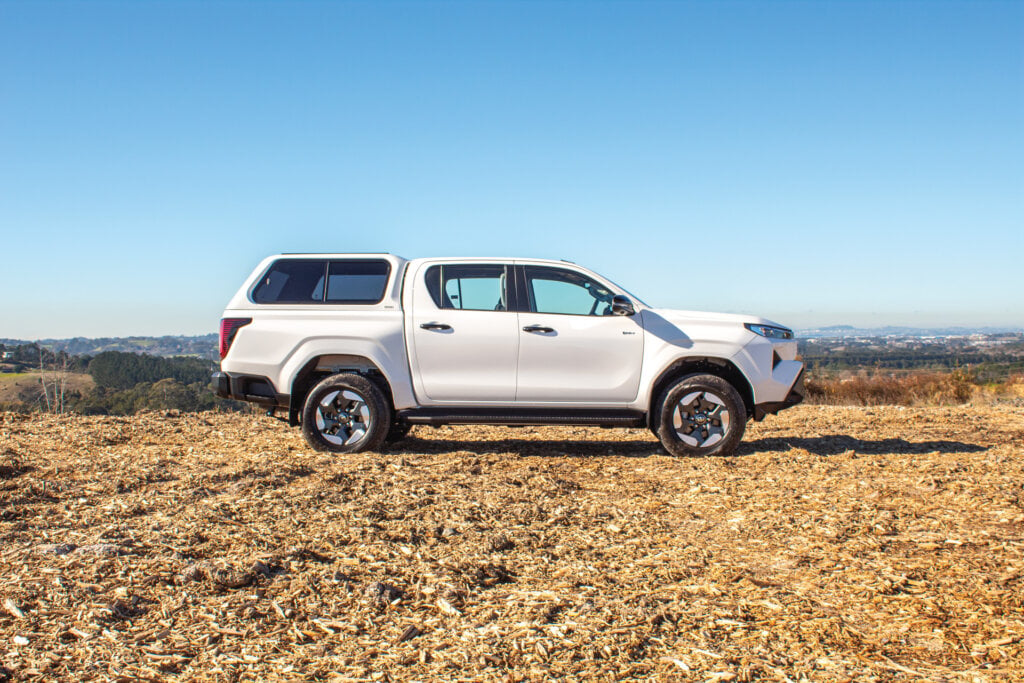
The BEV set up delivers superior traction over its diesel counterpart. With its permanent AWD and superior digital control of the flow of Newtons, it rarely struggles for grip on slippery surfaces. It sorts out gravel roads nicely. In lieu of a low-range setting and a locking differential, there are various off-road drive modes to help make it more capable.
On road, its dynamics impress too. Yes, it’s heavier, but that extra mass is low and centralised. It turns with a bit more vigour and holds on well up front. The rear is stable too, though bigger bumps will upset it.
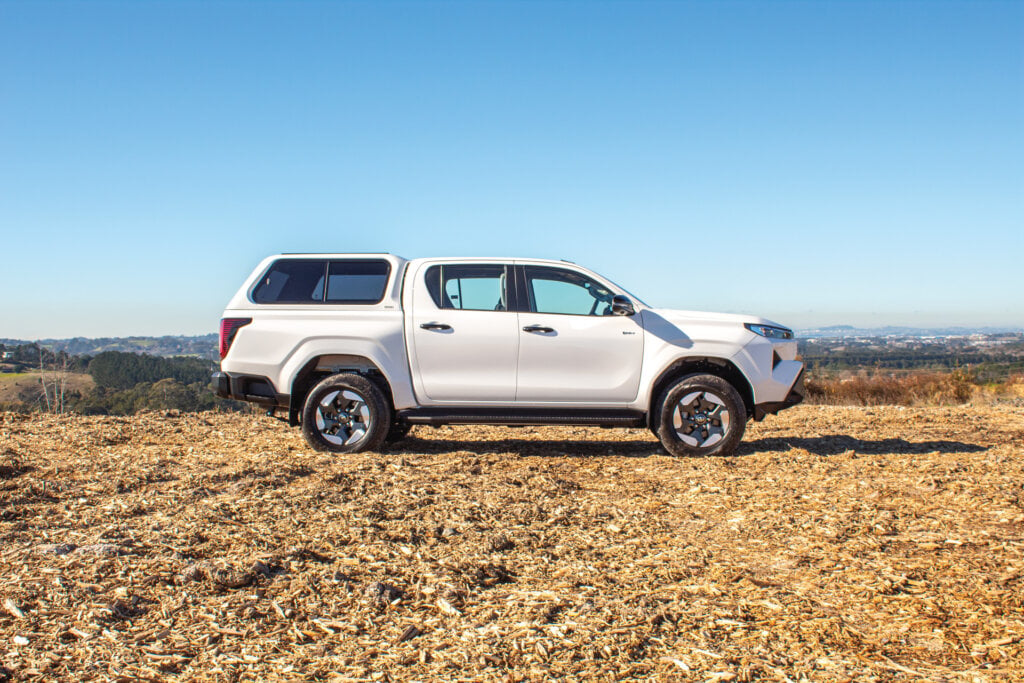
This SR variant is the worker spec, with fabric seats and a vinyl floor. It misses out on the niceties like the padded surfaces and trimmed wheel, though connectivity is sorted and the safety suite of driving aids is present, as is a surround view camera, which is a good addition to the spec list. It comes with a five star ANCAP rating. The BEV also has the same tray dimensions and cabin space as the diesel version.
With its pricing and hefty consumption, the Hilux BEV has limited appeal. It has corporations in mind, those that need to meet a certain CO2 target, and taking a diesel vehicle out of a fleet is a good way to do that. The fundamentals are sound however; it’s refined, drives well and is capable. Better efficiency (or a bigger battery) and a smaller premium are required for it to have broader appeal, however.
Toyota Hilux SR BEV
$81,990 / 20.2kWh/100km / 0g/km
0-100 km/h 9.8s
Motor 144kW / 473Nm
Battery 59kWh / 315km
Drivetrain 1-speed auto / AWD
Weight 2455kg