Would you lease an EV from your pay packet? The parties aren’t saying
Words: Richard Edwards
A proposal that would let New Zealanders lease an electric car using their before-tax pay has not won a commitment from either National or Labour, with the 7 November election days away.
Under the EV Salary Boost, put forward by Rewiring Aotearoa and Drive Electric, an employee would lease a new or used EV for three to five years. The payments would come out of their pay before tax, lowering the cost of running the car. The idea is based on Australia’s novated leasing system, though the groups say they are not proposing a direct copy.
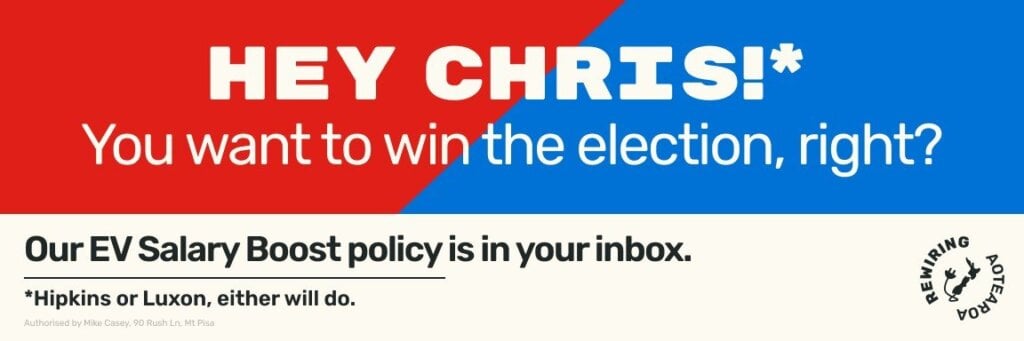
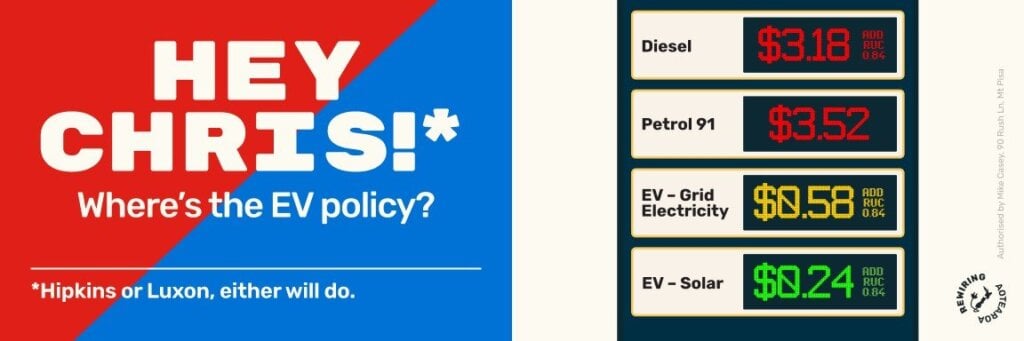
They have pitched the scheme to every party in Parliament. Their latest billboards are addressed to National leader Christopher Luxon and Labour leader Chris Hipkins, with the line “Hipkins or Luxon, either will do.”
Rewiring Aotearoa chief executive Mike Casey says a participating worker would save an average of $36 a week compared with a standard car loan. He puts the cost to taxpayers at about $5000 a car.
He told RNZ that upfront prices still put new EVs out of reach for many people, and that politicians leaving uptake to the market “are not being strategic or courageous.”
“One of the biggest problems that we’re seeing, for example, is tradies all having to put their prices up on everything because of the price of diesel,” he says.
The groups are not asking for the scheme to be introduced straight away. They want the next government to commit to a formal assessment within its first 100 days. That review would cover:
- what the scheme would cost the government, and whether it should be capped;
- how it would work for PAYE, fringe benefit tax and GST;
- whether used EVs would qualify;
- price caps on eligible vehicles;
- lease terms and consumer protections;
- what happens to the lease if you change jobs.
Deloitte has prepared an initial paper on the tax settings, which has been shared with political parties.
Drive Electric chair Kirsten Corson says the scheme would also put more used EVs on the market for people who can’t afford a new one.
“High fuel prices show how exposed households and businesses are to costs set offshore. Every car that switches makes us a little less exposed to the next global fuel shock,” she says.
What the parties said
Asked by RNZ, National pointed to its target of 10,000 public EV chargers by 2030 and funding for cleaner heavy vehicles.
“National supports New Zealanders having access to a competitive and affordable range of vehicles, including efficient and electric vehicles,” a party spokesperson said.
Labour pointed to its plans to strengthen clean car emissions standards and expand the charging network. Neither directly said whether it would back the leasing proposal.
How it works in Australia
Australia removed fringe benefit tax from eligible EVs in July 2022, making EV novated leases much cheaper. More than 100,000 Australians have used the exemption. According to figures cited by the two groups, battery electric and plug-in hybrid vehicles grew from 1.8% of new car sales in May 2022 to 22.9% by March 2026.
The exemption has also cost far more than expected: about A$1.35 billion in 2025-26, against an original forecast of A$90 million. From April 2027, EVs priced over A$75,000 will move to a partial rate.
Casey says a New Zealand version would avoid some of Australia’s settings, including the one that lets novated-lease buyers avoid GST on the vehicle.
EVs make up 3.3% of New Zealand’s light vehicle fleet. Their share of new car sales fell from about 20% in 2023 to under 10% in 2024 after the Clean Car Discount ended, before recovering this year.