Bridgestone – License to Thrill
Words: Richard Edwards | Photos: Supplied
Not all tyres are created equal. We head to Bridgestone’s development centre in Thailand to check out the new Potenza Adrenalin RE005.
New Zealanders don’t think enough about their tyres. They are, quite literally, the only thing between you and the road, and there’s not a huge amount of contact patch doing that job either, roughly a hand print per corner. So when a tyre maker invites you to Thailand to flog a set around a world-class proving ground, you pay attention.
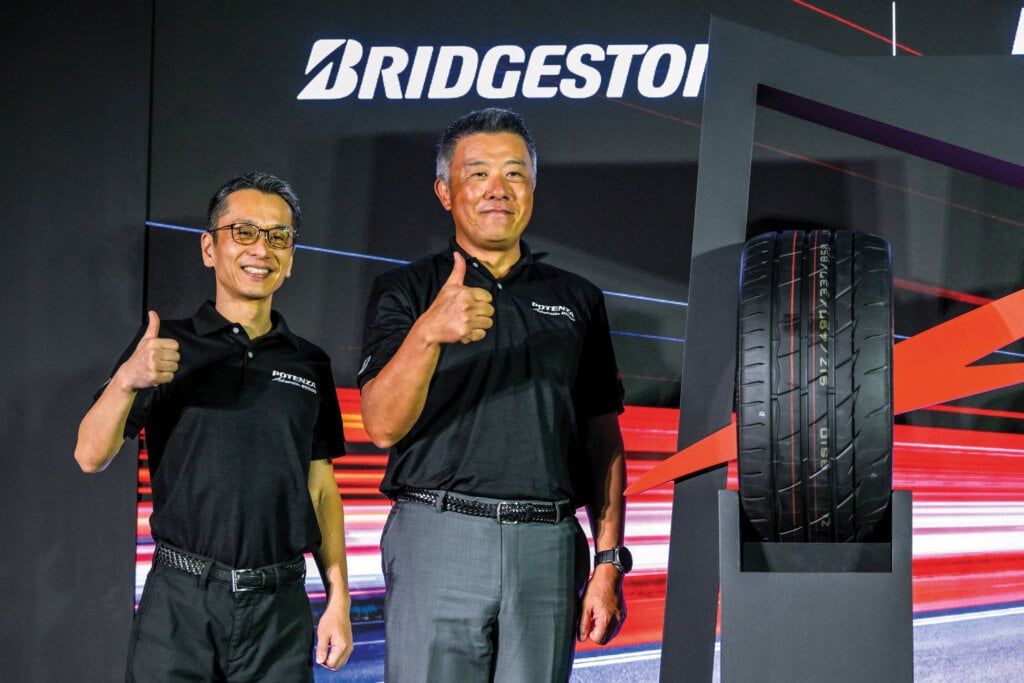
Bridgestone’s Potenza line needs little introduction to anyone who has owned a performance car. It is the Japanese giant’s flagship street performance range, while the Adrenalin sub-brand arrived in 2007 as an Asia-Pacific creation, developed specifically for drivers in this region under a simple brief: maximise driving pleasure for everyday use. It was, as Bridgestone’s Vice President of Sales and Marketing Seigo Hata puts it, “a movement born in Asia Pacific.” The original RE001 was developed with input from former Formula One driver Stefano Modena, who remains involved with Bridgestone as Technical Marketing Manager at their Rome facility nearly two decades later. Five generations on, the RE005 carries forward that same philosophy while addressing the realities of a market that now includes EVs, broader vehicle types, and drivers who want performance without the compromises that once came with it.
What’s new?
The RE005 replaces the RE003 in New Zealand. Interestingly, we skipped the RE004 entirely as local representatives felt it did not deliver a significant enough improvement over the highly regarded RE003. They opted to wait for something more substantial, and the RE005 is the result.
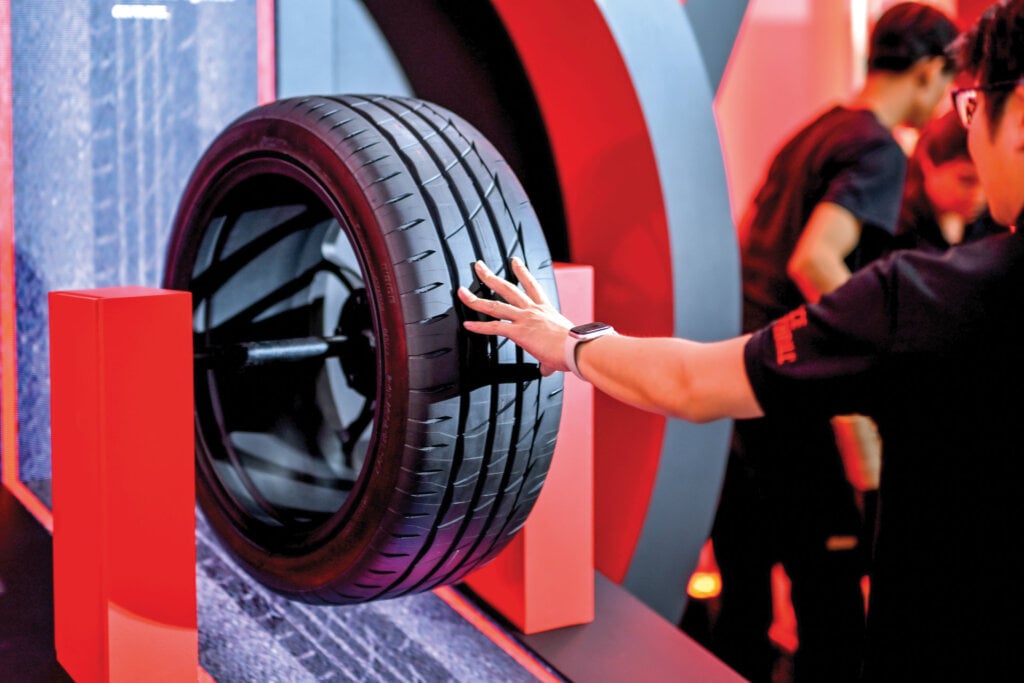
The headline numbers versus the RE003, tested on a Volkswagen Golf GTI in 225/40R18: dry grip is up seven per cent, wet grip improves by 12 per cent, rolling resistance drops by a remarkable 25 per cent, weight comes down seven per cent, and wear life extends by four per cent. The tyre also scores better on material circularity, reflecting Bridgestone’s broader sustainability push through its ENLITEN platform.
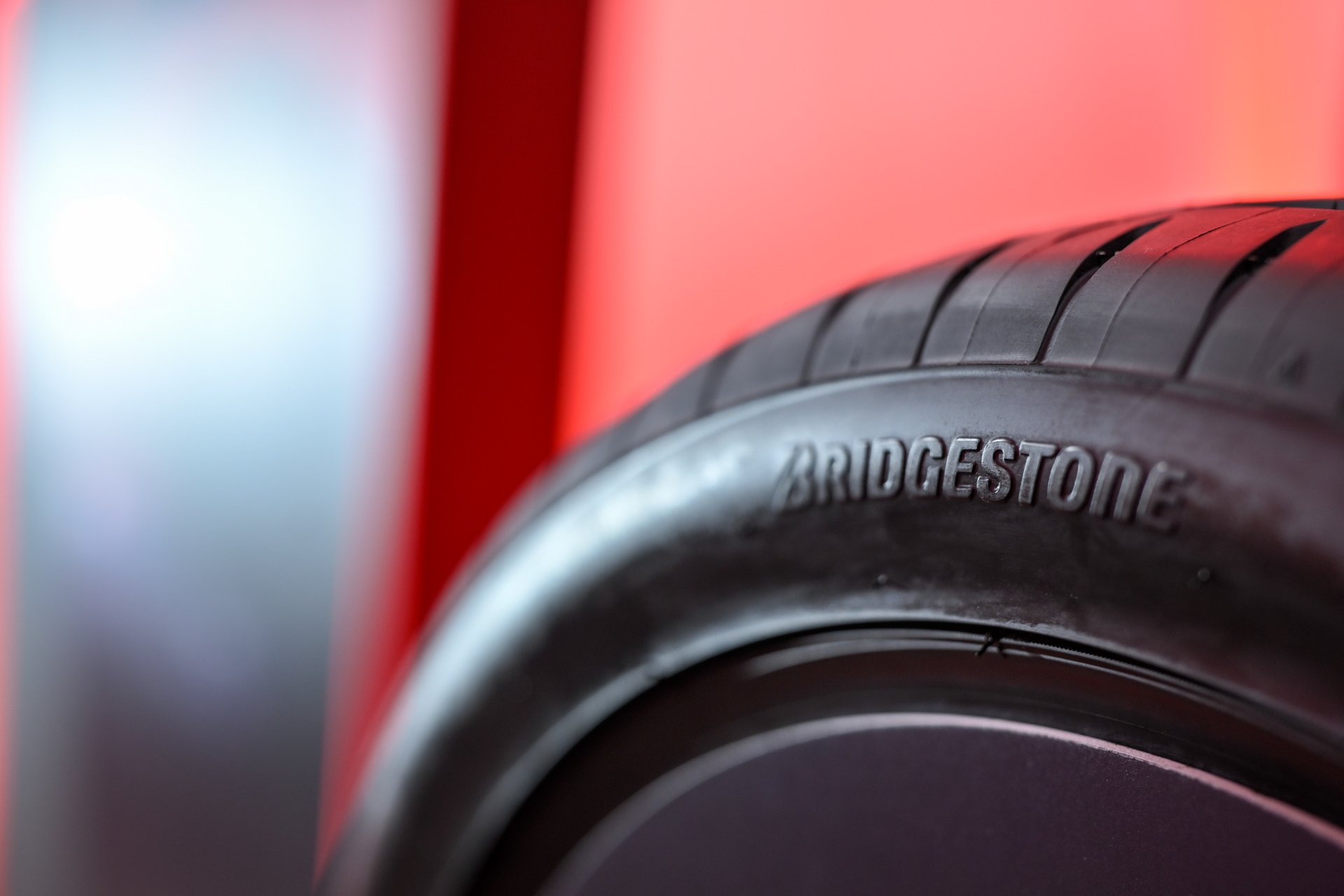
Under the skin, there is a new rubber compound combining silica and polymer through Bridgestone’s Nano Pro-Tech process, which is primarily responsible for the wet grip and rolling resistance gains. The tread pattern features what Bridgestone calls an “A” shape groove, a signature design element that has appeared across all five Adrenalin generations. There is also a widened inside rib for sharper steering response, connecting blocks for cornering stability, and advanced rain pulse grooves for water evacuation.
Behind the scenes
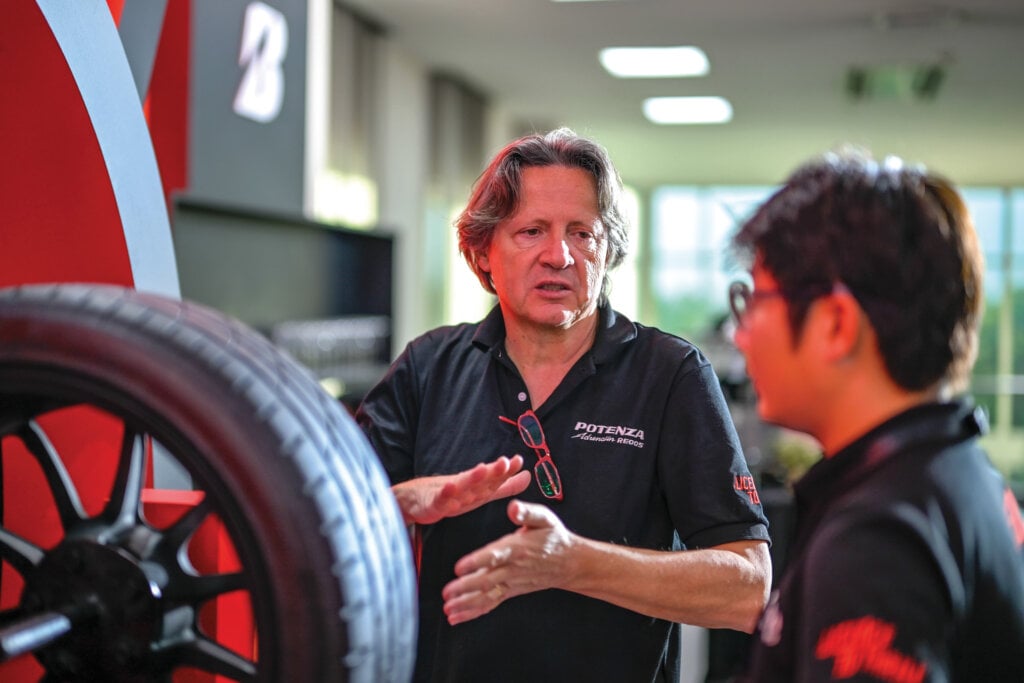
Bridgestone took us through its product development centre and manufacturing plant. It is one thing to read about tyre technology in a press release. It is quite another to see the sheer scale of the operation that turns those claims into reality.
The development centre houses testing equipment that operates on a scale that is difficult to fully appreciate until you are standing next to it. Machines simulate thousands of kilometres of road surface contact, replicating years of wear in compressed timeframes, and the volume of data being generated across dozens of rigs running simultaneously is staggering. Competitor products sit alongside Bridgestone’s own tyres throughout the facility, all subject to the same battery of tests. There is no guesswork here.
What surprised me most was the compound development process. For all the science and technology involved, there is still an element of art to mixing the varying attributes to get the right balance. Wet grip, dry grip, rolling resistance, wear life, noise: the engineers are making judgment calls about trade-offs that no formula can fully resolve.
The production line operates almost as an elongated triangle: tyres start life looking broadly the same at a raw material level, before the line spreads outward as layers are pieced together for their different purposes, each size and specification diverging along its own path. At the far end, they converge again to be cured and shaped in massive hot moulds, the point where the tyre finally becomes the finished product. It is an impressive piece of industrial choreography.
On the proving ground
The Thai Bridgestone Proving Ground has 500,000 square metres of purpose-built test surfaces including a 3.3-kilometre oval, wet and dry handling circuits, a skid pad, hydroplaning station, and multi-surface braking zones.
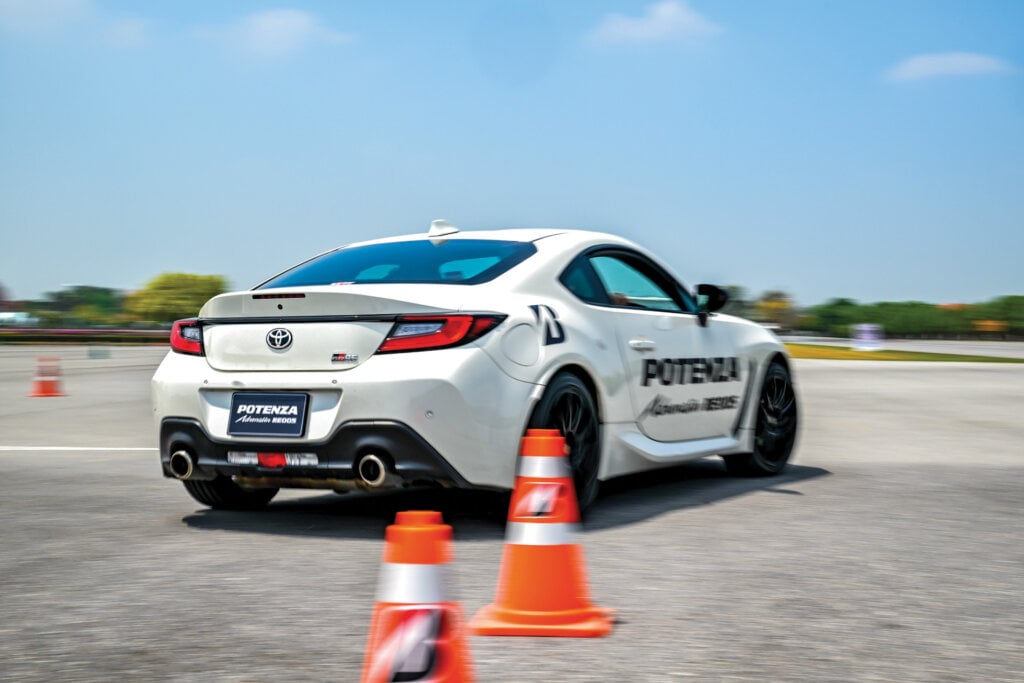
The test programme put us through back-to-back comparisons on several exercises, switching between the RE005, the outgoing RE003, and competitor tyres across a mix of vehicles including a Toyota GR86, BMW 3 Series, and Tesla Model 3.
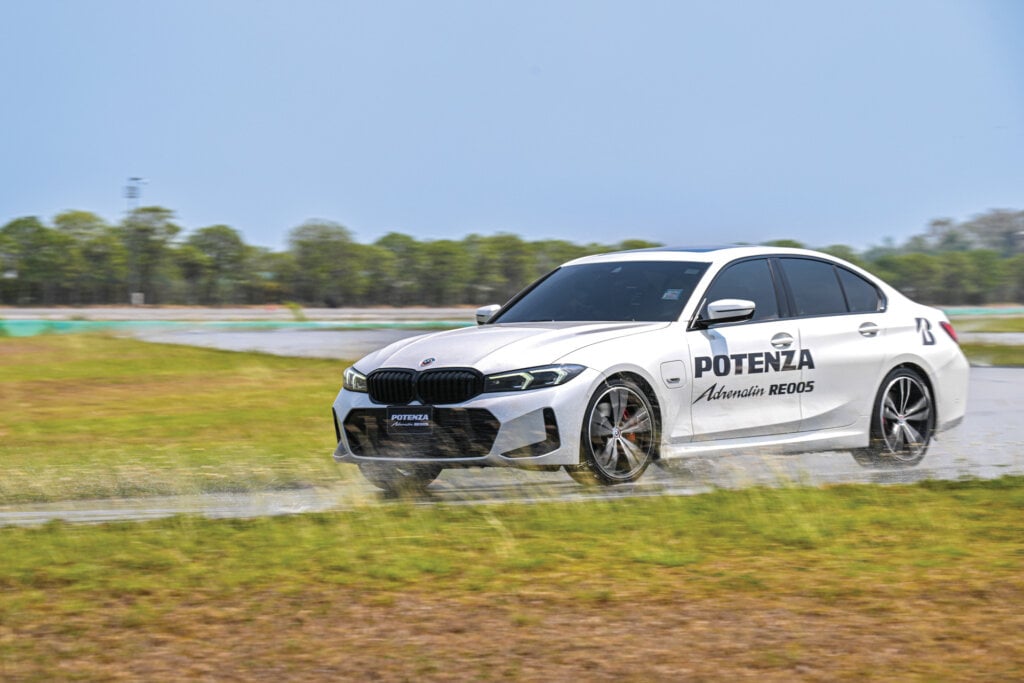
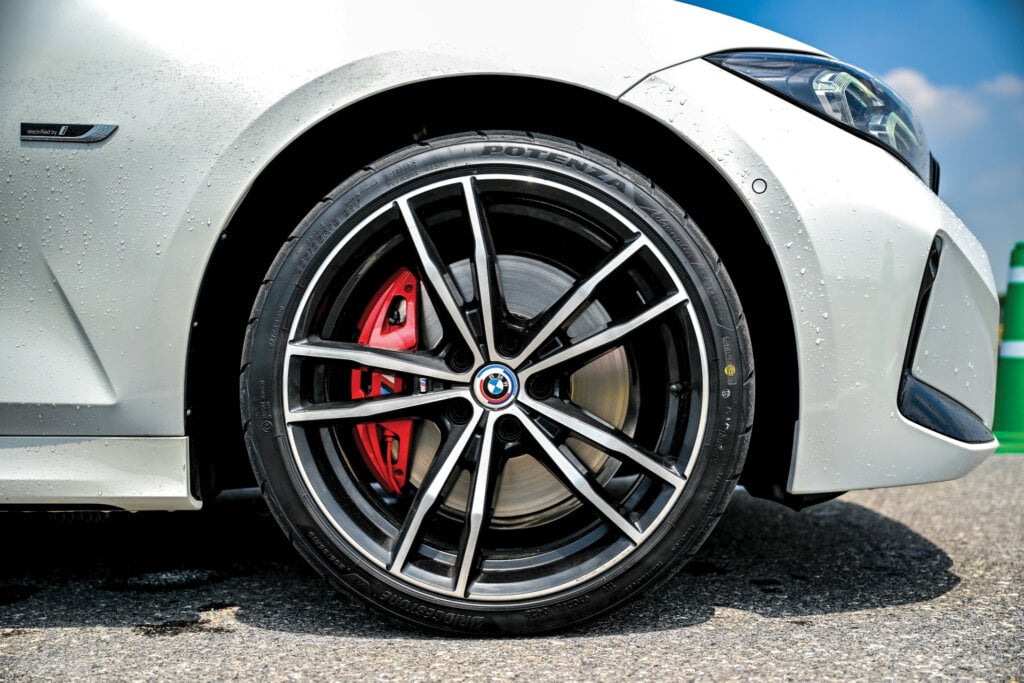
The wet handling circuit in the BMW provided the most revealing comparison. Driving on the RE003s first, I deliberately pushed to find where the tyres would give up grip, noting where traction control intervened and where the rear started to come around. The RE003s are no slouch in the wet, they have served me well on my own vehicles back home, but there is a definite point where they let go and when they do, they go fairly quickly. Switching to the RE005s on the same circuit at the same pace, the difference was immediately apparent. The corners where the RE003s had broken loose were now manageable. When the RE005s did eventually let go under provocation, the breakaway was more progressive and recovery was noticeably quicker. As the Bridgestone instructor beside me confirmed with a knowing grin, the recovery behaviour is a genuine step forward. Bridgestone’s own wet grip testing data backs up the seat-of-the-pants impression: measured in lateral acceleration on a 225/45R17, the RE005 pulls 0.88G compared to 0.83G for the RE003, and sits comfortably ahead of three competitor products tested on the same basis.
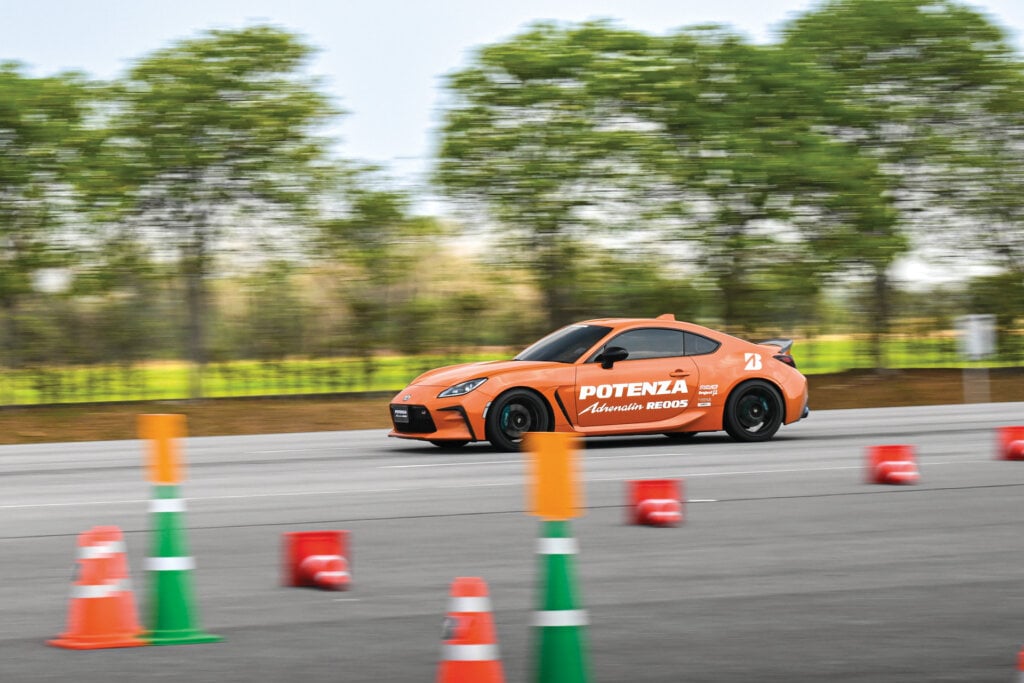
The dry handling exercises on the GR86 were equally telling. Through a slalom, lane changes, and a flowing circuit, the RE005s delivered strong initial bite and precise turn-in. There was a crispness to the steering response that made the car feel more alert. The competitor tyres, tested on an identical car immediately afterwards, required more steering input to achieve the same line and produced a noticeable push understeer through lane changes that simply wasn’t there on the Bridgestones. They were also audibly noisier.
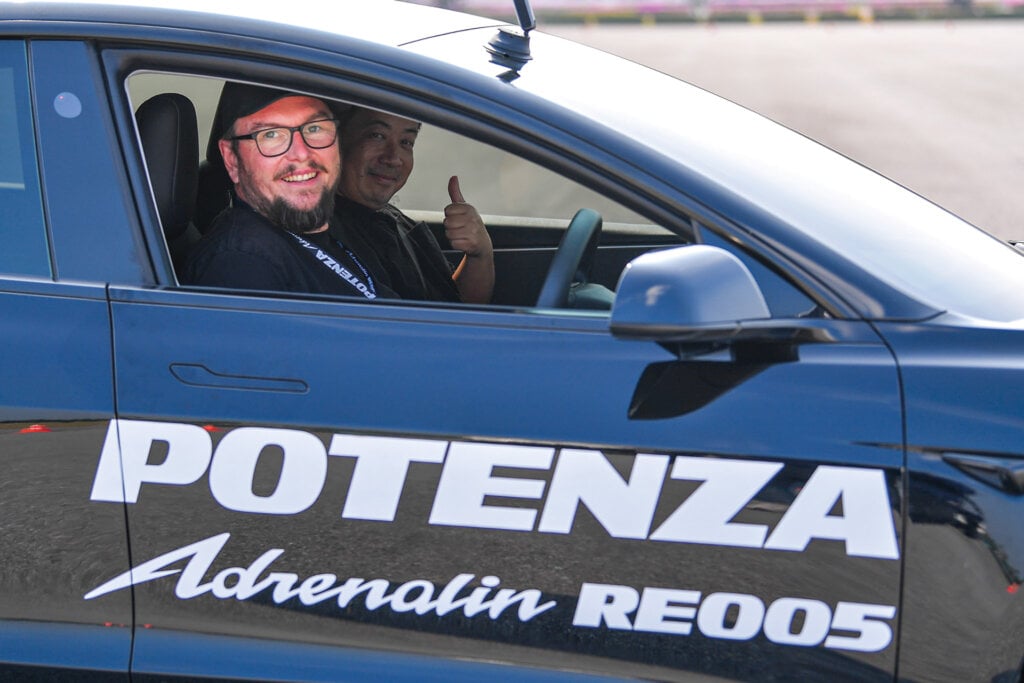
On the Tesla Model 3, the focus shifted to how the tyre performs on an EV, and this is where the rolling resistance and weight reductions become relevant. The RE005 was impressively quiet on the grippy test surface, and through a tight handling course it maintained strong grip without any of the squirmy, imprecise feel that some performance tyres exhibit on heavier electric vehicles. The improvement in rolling resistance and weight saving are genuine engineering achievements. “We have not compromised any other performance,” CTO for Asia Pacific, Takashi Oono says. “We have strong confidence that this balance is the best for the customer.” That matters, because the typical engineering trade-off with tyres is a zero-sum game: you improve one attribute, you pay for it somewhere else. The RE005’s party trick is that the performance spider chart has grown in almost every direction simultaneously.
Where it sits
The RE005 arrives in New Zealand in 48 sizes spanning 15-inch to 20-inch fitments, covering everything from the Mazda MX-5 and Toyota GR86 through to the Ford Mustang and larger European and EV performance fitments. Pricing starts at $207 and averages $410 across the range, which puts it in roughly the same territory as Bridgestone’s touring-focused Turanza line, perhaps 10 per cent more in some sizes. For a genuine performance tyre, that represents strong value.
The elephant in the room for any performance tyre launch is the Michelin Pilot Sport series, which has been the go-to choice among enthusiasts since the Super Sport set the benchmark back in 2011. The current Pilot Sport 4 and its sharper sibling, the Pilot Sport 5, are the tyres to beat in this segment, and Bridgestone is clearly aware of that. Continental’s SportContact 7 is another strong contender in the premium performance space, though it carries a price premium, while the Yokohama Advan Fleva V701 offers a more budget-conscious alternative that has built a loyal following among hot hatch owners. The RE005’s pricing undercuts the Michelin and Continental, positioning it as a genuinely competitive option for drivers who want strong performance without paying the European premium.
Bridgestone is positioning the RE005 as something broader than a pure enthusiast product. Hata described it as a tyre for “whoever really wants to enjoy the drive,” whether that is weekend winding-road fun, the daily commute in something sporty, or extracting more engagement from a performance EV. It sits below the track-focused RE-71 series, which prioritises outright circuit performance at the expense of tyre life, and above the Turanza range, which leans toward comfort and longevity.
That positioning makes sense. The RE005 is not trying to be the ultimate track tyre, and it is honest about that. What it does deliver is a genuinely engaging driving experience with strong wet-weather confidence, improved durability, and EV suitability, all at a price that doesn’t demand a second thought when the Turanza alternative costs almost the same. For New Zealand conditions, where wet roads are a fact of life for much of the year, the wet grip improvements alone make a compelling case.
After a day pushing these tyres hard across every surface Bridgestone’s proving ground could throw at them, the verdict is clear: the RE005 is a meaningful step forward from the RE003 in every measurable area, and in most of the subjective ones too.