Jaguar Type 01 revealed: 758kW electric GT due in NZ in 2027
Words: Kyle Cassidy
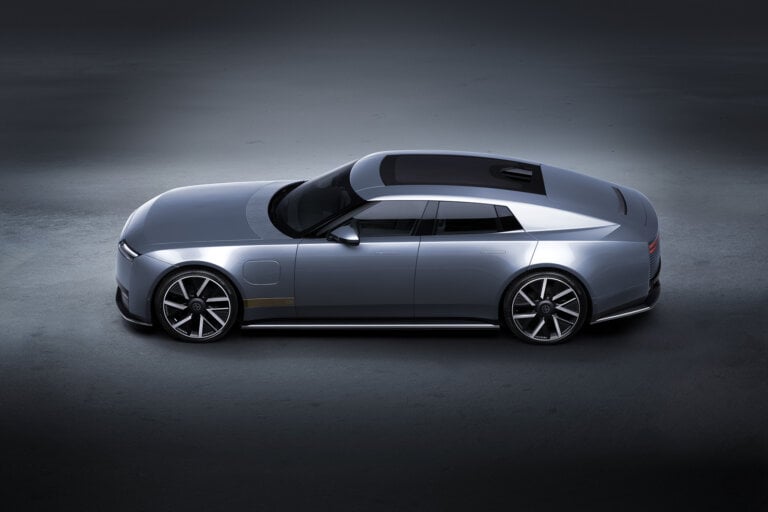
Jaguar has revealed the car that will spearhead its new era, and subtle it isn’t. The Type 01 is a four-door electric grand tourer with up to 758kW, a claimed range of around 720km and proportions that make a fairly emphatic statement.

New Zealand orders open early in 2027, with first deliveries expected in the second half of the year. Local pricing is still to be confirmed, leaving one fairly significant detail outstanding before buyers can decide whether this particular reinvention belongs in their driveway.
Said to be designed, engineered and built in Britain, the Type 01 is the first production model on Jaguar Electric Architecture, a dedicated EV platform. The name combines a reference to Jaguars past with zero tailpipe emissions and its position as the first of a new generation.

At 5235mm long and just 1403mm tall, this is a sizeable car with a low roof, short front overhang and an extended tail. Standard 23-inch wheels help to reinforce the stance, although 21-inch alternatives will also be available.
The long bonnet might recall the E-type and XJS, despite there being no combustion engine to accommodate. Jaguar has instead extended the battery ahead of the passenger compartment, helping preserve the low silhouette. A split in the pack creates additional foot space for rear occupants.

Apparently, Jaguar says that producing those clean surfaces wasn’t straightforward. It is claimed that engineers spent more than 1500 hours developing the aluminium rear quarter panel, which Jaguar calls the Impossible Panel. Its intersecting lines and five planes require a six-stage pressing process at Halewood.

Jaguar quotes a drag coefficient of 0.23, its lowest for a road car. Cooling vanes open when required, while a concealed rear spoiler deploys above 80km/h for efficiency, then changes angle above 155km/h to generate additional downforce.
Underneath, three electric motors provide all-wheel drive: one at the front and two at the rear. Combined output reaches 1030PS, equivalent to approximately 758kW, with 1365Nm. Independently controlled rear motors allow torque to be directed where it can best help traction and cornering.

Jaguar’s Formula E programme has also influenced the control systems. The company says its traction management can adjust motor torque in as little as one millisecond, while the rear motors can be deactivated during steady cruising to improve efficiency.
Jaguar claims 0–100km/h in 3.2 seconds, but places equal emphasis on the reserves available once moving. The quoted 100–180km/h time is just four seconds.

Making all that feel like a Jaguar will be the more interesting challenge. The chassis combines double-wishbone front and integral-link rear suspension with adjustable-volume air springs and twin-valve active dampers. A low centre of gravity and a claimed 50:50 weight distribution underpin the intended balance of comfort and control.
Bespoke Pirelli P Zero tyres are available in summer, winter and all-season compounds, developed specifically to suit the Type 01’s intended driving character.

Rear-wheel steering turns through up to six degrees, helping trim the wall-to-wall turning circle to 11.5m. At higher speeds, the rear wheels turn with the fronts for stability. It should make a car stretching beyond five metres less cumbersome when manoeuvring.
Jaguar mode prioritises comfort, while Dynamic stiffens the air springs, sharpens responses and can direct up to 87 per cent of power rearwards. Efficient, Ice & Snow and a configurable Curated setting complete the selection. Regenerative braking offers three strengths, alongside single-pedal operation.

“From its dramatic design to its captivating drive, Type 01 distils the essence of Jaguar into a luxury grand tourer for a new era,” says Jaguar managing director Rawdon Glover.
The usable battery capacity is 118kWh. Jaguar’s NZ announcement quotes 724km of WLTP range while a separate claim of up to 514km at a steady 120km/h provides another reference point for longer-distance driving.

An 850V electrical architecture supports DC charging at up to 350kW. Jaguar says a suitable charger can add up to 321km in 13 minutes, with a 10–80 per cent replenishment taking around 22 minutes. Those figures depend on battery temperature, charge level and the charging equipment.
Split charging also allows up to 250kW on compatible 400V equipment. AC charging reaches 22kW, with ports on both sides of the car to make plugging in easier. Thermal management moves heat between the battery, motors and cabin, while preconditioning prepares the pack for charging.

Inside, a full-length central spine divides the cabin into four individual spaces. Brass-effect aluminium trim runs along the console and doors, with leather or alternative upholstery and wool-blend textiles among the material choices. Heated and cooled front seats include massage; rear seats are also heated and cooled.

A 24-inch OLED display combines instruments and infotainment, supported by a seven-inch portrait touchscreen for commonly used controls. Another seven-inch screen serves rear passengers. Wireless Apple CarPlay and Android Auto are included, along with wireless charging for two phones and over-the-air software updates.

There’s no rear window in the solid tailgate. Instead, a camera feeds a display embedded in the soundbar across the windscreen base, replacing the conventional mirror. Jaguar says positioning it at door-mirror height reduces the adjustment required when shifting your gaze between views.

The Meridian system has 38 speakers, including 13 in that soundbar, while Sensory Audio adds vibrations through the front seats. Four-zone climate control, active road-noise cancellation and a panoramic roof with an adjustable virtual blind support the quieter side of the GT brief.

Practicality hasn’t entirely disappeared beneath the design exercise. The powered tailgate reveals more than 450 litres of luggage space, expanding to 1000 litres with the split rear seats folded. Driver assistance draws on 10 external cameras, five radars and 12 ultrasonic sensors.

The New York unveiling also introduced actor Florence Pugh as Jaguar’s new brand ambassador. The larger test comes when customers get behind the wheel: whether its performance, comfort and character justify that dramatic appearance. Kiwi buyers should get their opportunity during 2027.