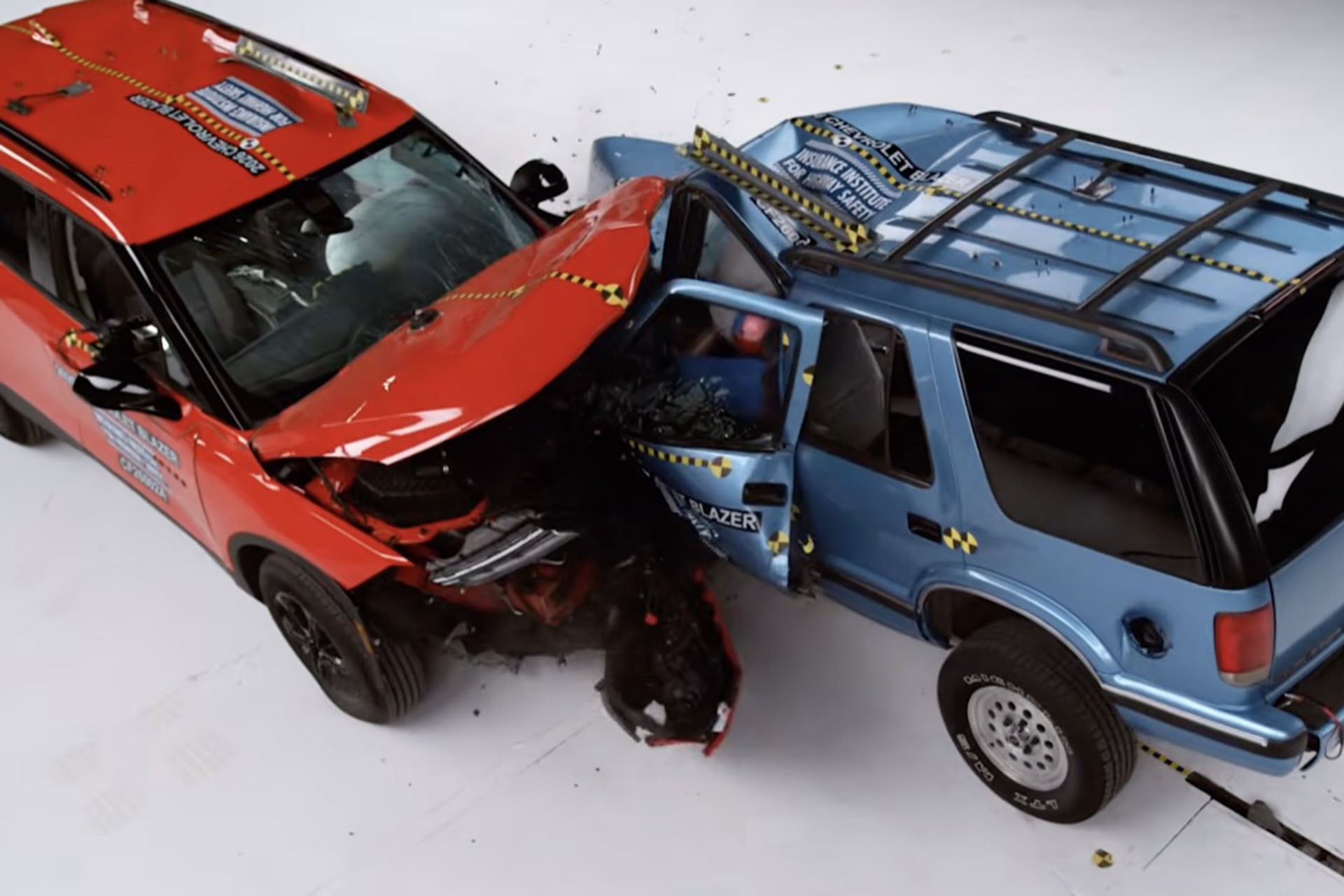
Old vs new crash test shows how far vehicle safety has come in 30 years
Words: Kyle Cassidy
A dramatic new crash test conducted by the Insurance Institute for Highway Safety (IIHS) in the US has highlighted just how much vehicle safety has improved over the past three decades.
To mark the 30th anniversary of its independent crash testing programme, the IIHS pitted a new 2026 Chevrolet Blazer against a 1996 Blazer in a head-on collision. The results were stark.
The test involved a moderate-overlap frontal crash, with both SUVs travelling at around 64km/h and colliding with 40 per cent of their front ends overlapping.
While the outcome may have been predictable, footage of the crash reveals the enormous strides made in vehicle safety since the mid-1990s.
According to the organisation, occupants of the older SUV would likely have suffered “serious, potentially fatal injuries” in a crash of this nature.
In the new model, modern crumple zones effectively absorb and redirect crash forces around the passenger compartment, leaving the cabin largely intact. Intrusion into the driver’s space is minimal and the driver’s door remains largely operable after the impact.
The IIHS says the occupant in the new Blazer would likely have escaped with only minor injuries.
The comparison highlights advances in structural engineering, restraint systems and crash protection that have become commonplace in modern vehicles. Features such as multiple airbags, electronic stability control and advanced body structures are now standard across much of the market, while active safety technologies like autonomous emergency braking and driver monitoring systems are increasingly helping drivers avoid collisions altogether.
The IIHS has staged similar demonstrations before. In 2009, the organisation famously crashed a 1959 Chevrolet Bel Air into a then-new Chevrolet Malibu to illustrate the safety improvements made over half a century.
According to the IIHS, safety improvements influenced by its testing programme have helped save nearly 50,000 lives since 1995.
“These results highlight the role of IIHS ratings in driving many of the key vehicle safety improvements of the past 30 years,” said IIHS Chief Operating Officer Joe Nolan.
“The difference between the two vehicles could not be clearer.”