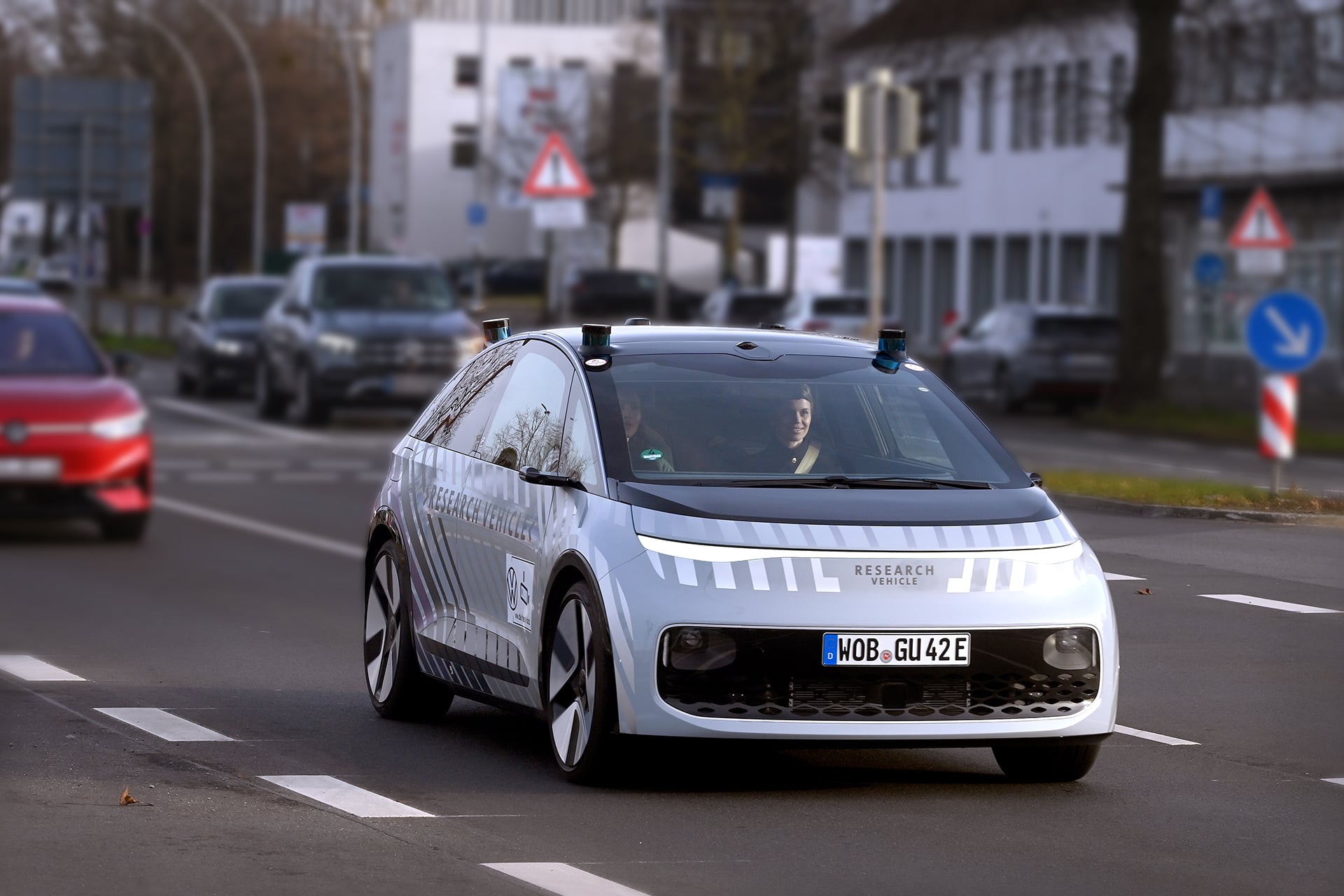
Volkswagen tests steering-wheel-free autonomous car on city streets
Words: Kyle Cassidy
Volkswagen Group is said to have begun the next phase of real-world testing for its autonomous driving research vehicle, Gen.Urban1, the company saying its prototype is now operating in live urban traffic in Wolfsburg, Germany.
The latest trials move beyond closed-course testing, allowing the self-driving vehicle to navigate everyday city conditions without a traditional steering wheel or pedals. Apparently the goal isn’t just to validate the technology, but ‘to understand how people actually feel riding in a fully autonomous vehicle—and what that means for future vehicle design’.
Focus on the passenger experience
According to the company, an interdisciplinary team from Volkswagen Group Innovation, including designers, human factors specialists, software engineers and materials experts, is closely monitoring how occupants interact with the vehicle. The research focuses on how passengers spend their time, which digital features best support work, entertainment or relaxation, and how intuitive the experience is for users of different ages.
Red more – Self-driving uprising: Driverless taxi torched by mob in US
Comfort and trust are said to be central themes of the trials. Researchers are examining how interaction between the vehicle and its occupants should work, particularly for children and older passengers, and whether people feel relaxed and confident when the car is in full control.
Personalised from the moment you step inside
Gen.Urban is designed to deliver a tailored experience before the journey even begins. Passengers can adjust settings such as cabin temperature and ambient lighting via an app or directly inside the vehicle. When they enter, the car greets them and automatically adjusts the seat, while the digital interior adapts to individual preferences using artificial intelligence.
A wide front display combines information, lighting and sound, which can all be themed to suit the passenger. Despite having no steering wheel or pedals, a trained safety driver is present in the passenger seat and can intervene at any time using a specially developed joystick-based control panel.
Real traffic, real challenges
The current test programme is limited to Volkswagen Group employees and will run for several weeks. Each test drive lasts around 20 minutes, following a near 10km loop through Wolfsburg’s city streets.
The route includes traffic lights, roundabouts, construction zones, residential and industrial areas, and sections prone to congestion—deliberately chosen to replicate the challenges autonomous vehicles will face in everyday urban driving.
Insights for future vehicles
Dr. Nikolai Ardey, Head of Volkswagen Group Innovation, says the research is about more than just autonomous technology.
“The technology for autonomous driving is making rapid progress. With our Gen.Urban research vehicle, we want to understand exactly how passengers experience autonomous driving. Why? Because the key to a positive customer experience is to build trust – through meaningful interaction, a relaxed atmosphere, and intelligent assistance systems that respond precisely to the needs of passengers. Ultimately, technology should fit people, not the other way around.”
Volkswagen Group says the findings from Gen.Urban will feed into future interior design and user experience concepts across its brands, shaping how fully autonomous vehicles may look—and feel—when they eventually reach customers.