View all
8 more images
The BIG Ute Guide – 2026
NZ Autocar
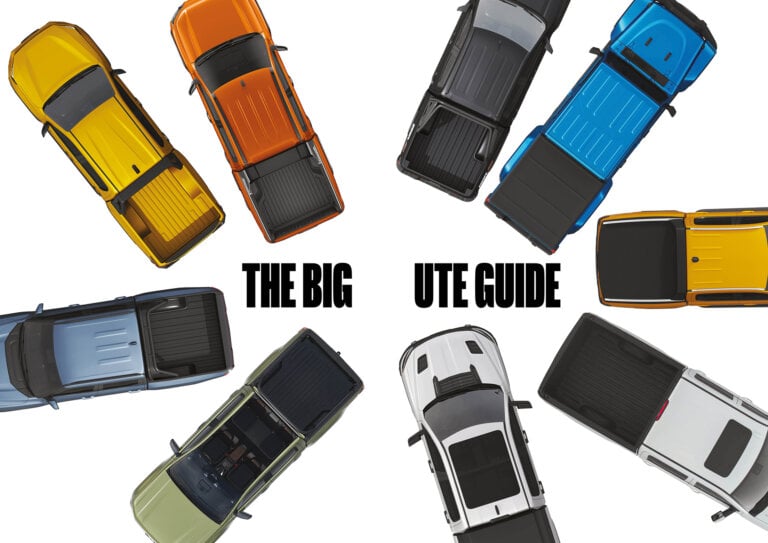
There has never been more choice in New Zealand’s ute market, although buying the right one hasn’t become any easier.
There has never been more choice in New Zealand’s ute market, although buying the right one hasn’t become any easier. The familiar diesel double-cab now shares showroom space with petrol, mild-hybrid, plug-in hybrid and fully electric alternatives.
Yet the market remains familiar at the top. At the halfway point of 2026, the Ford Ranger was New Zealand’s best-selling ute, followed by the Toyota Hilux and Mitsubishi Triton. Together, those three were comfortably ahead of every newer challenger, and account for 54 per cent of the entire light commercial market. Buyers might now consider a BYD Shark 6, GWM Cannon, Kia Tasman or one of several other newcomers, but the established trio continues to set the commercial pace.
That dominance reflects their broad model ranges and the established dealer networks which bring confidence in servicing and resale. New arrivals counter with sharp prices, long warranties and generous equipment, but changing long-standing buying habits takes time.
One cab doesn’t fit all
Before comparing engines and equipment, decide which body style suits the job. A single-cab generally provides two or three seats and the greatest load length. It is often supplied as a cab-chassis, allowing the buyer to add a flat deck, service body or tipper.
An extra-cab, also called a space cab, super cab or club cab, sits in the middle. It has occasional rear seating or extra secure storage, while retaining a longer deck than a double-cab. These two options however are a rarity in the market now.
The double-cab dominates modern ute sales. Four doors and seating for five allow it to work and carry a family. The compromise is a shorter tray and sometimes a lower payload once the heavier cab and extra equipment are considered.
Buyers can also choose between a factory wellside and cab-chassis on some model lines. A wellside looks tidier, contains smaller loads and works with hard lids, roller covers and canopies. A cab-chassis provides more freedom, allowing a wider flat deck, toolboxes or a body designed around a particular job.
The rise of the high rider
The low-riding, rear-wheel-drive workhorse seems to have disappeared from the NZ market. These were cheaper, lighter and often carried more than their glamorous siblings. They still make sense for sealed-road deliveries and urban trade work, but their numbers have dwindled.
Today’s default is the high-riding 4×4 double-cab. Buyers like the commanding driving position, tougher appearance and flexibility of four-wheel drive, even if many examples rarely venture beyond gravel roads or boat ramps. Higher grades have also become more SUV-like, adding leather, large screens, surround-view cameras and heated seats. That shift means buyers often pay for off-road hardware they may never use, while giving up some payload and fuel efficiency.
Not every high-riding ute is equally capable off road. Tyres, suspension travel, low-range gearing, traction control and differential locks can matter more than styling. A 4×4 badge is useful, but the specifications help reveal whether a vehicle is really suited to farm tracks, forestry roads or serious recreational use.
What the off-road figures mean
Ground clearance is the distance between the ground and the lowest specified point beneath the vehicle. More clearance reduces the chance of scraping the chassis, differential or underbody protection on ruts and rocks. Check how it is measured, because figures may be quoted laden or unladen, while side steps and towbars can create new low points.
The approach angle describes the steepest slope the ute can meet without its front bumper touching. The departure angle does the same at the rear. Long overhangs, low bumpers and towbar assemblies reduce these angles, so a long tray can drag its tail sooner than expected.
Ramp-over, or breakover, angle measures the ability to cross a crest without grounding the vehicle between its axles. A short wheelbase and generous clearance improve the number; stretching a chassis for more cabin or tray space generally reduces it. The figures are most useful when comparing similarly sized utes.
A quoted wading depth is the maximum water depth approved under specific conditions, not a challenge target. Water speed, the crossing surface and entry speed all affect the risk, so consult the owner’s handbook before taking the plunge.
Payload is more than tray capacity
Payload is the difference between kerb weight and gross vehicle mass, or GVM. It is everything the ute can legally carry: driver, passengers, luggage, tools and cargo, plus accessories such as a bullbar, canopy, drawers and roof rack. Your towball load counts too.
GVM is the maximum permitted weight of the fully loaded ute. A vehicle with a 2200kg kerb weight and 3200kg GVM has a theoretical 1000kg payload. Fit 200kg of accessories, add five 80kg occupants and place 300kg on the towball, however, and only 100kg remains. Kerb-weight definitions can differ, so check the documentation and use a weighbridge when operating close to the limit.
GCM, or gross combined mass, is the maximum permitted combined weight of the loaded ute and loaded trailer. This is where a headline 3500kg tow rating can mislead. A ute may be rated to tow 3500kg and reach its GVM separately, yet its GCM might not allow both maximums simultaneously. Load the tray heavily and the capacity available for the trailer may fall.
Towball download is the downward force the trailer applies to the hitch. Enough download helps stability, but the correct figure depends on the trailer manufacturer’s instructions. It must remain within the ratings of the vehicle, towbar and coupling. Because the force is carried behind the rear axle, it affects axle loading, steering and braking while consuming payload.
The right ute is therefore the one that suits the load, not necessarily the one with the largest advertised number. Work out what you will carry, how often you will tow, where you will drive and how many people need to come along. Compare complete vehicles in the specification you will actually buy. The figures are the starting point; matching the ute to its real job is what makes it the right choice.
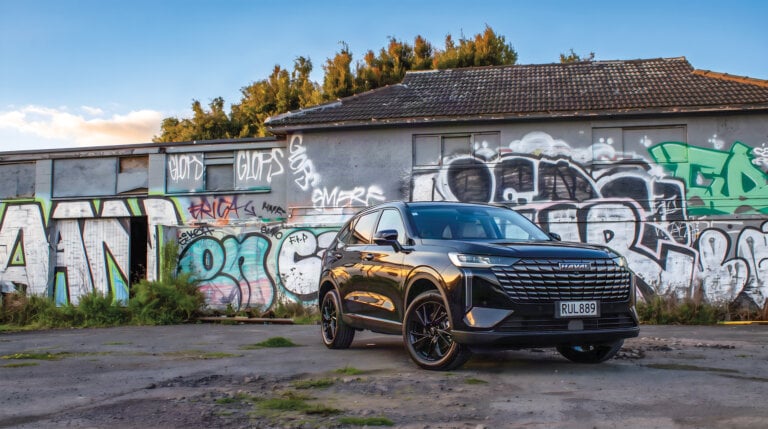
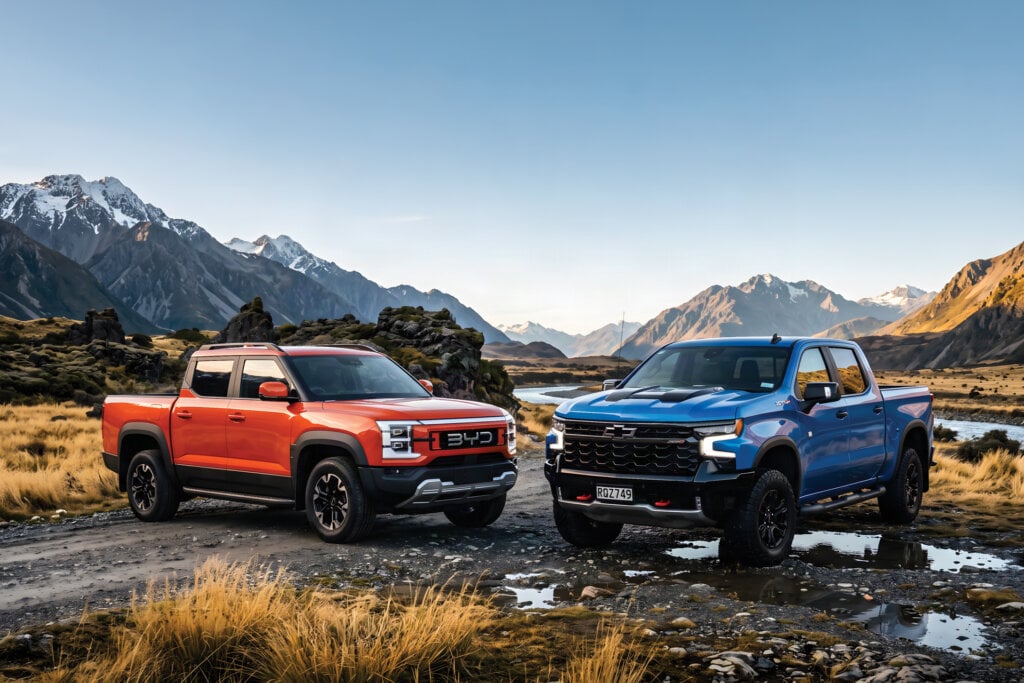
BYD Shark 6 Premium
Powertrain
1.5L IL4 petrol hybrid 321kW 650Nm
Hybrid auto, 4×4, 2.0L/100km, 46g/km
Off-road specifications
Ground clearance – 230mm
Wading – 700mm
Approach angle – 31°
Departure angle – 19.3°
Ramp-over angle – 17°
Differential lock – no
Hauling
Payload – 790 kg
Braked towing capacity – 2500kg
Maximum towball download – 250kg
GVM – 3500kg
GCM – 5750kg
Ownership
Warranty – 6 years / 150,000km
Service intervals – 20,000km / 12 months
BYD Shark 6
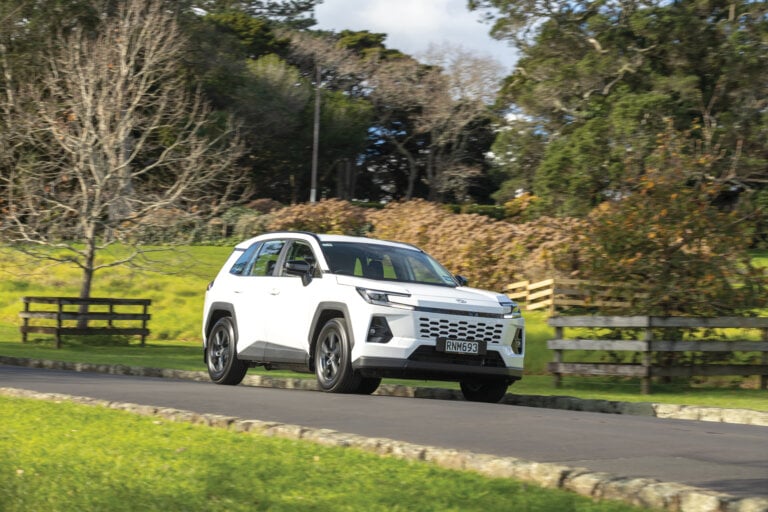
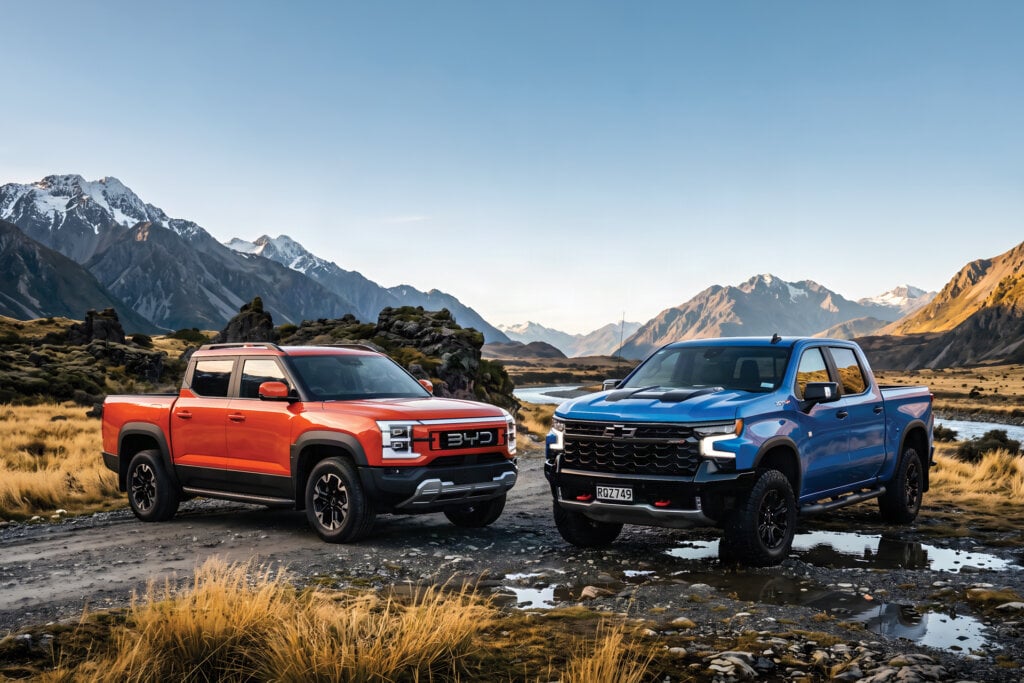
The BYD Shark 6 is aimed more at buyers wanting an SUV with a tray than those spending every weekend in low range, but its plug-in hybrid drivetrain, generous equipment and polished road manners make it a convincing alternative to traditional diesel models.
The range starts with the Cab Chassis at $70,990, followed by the wellside Premium at $71,990 and Performance at $78,990. All use a 29.6kWh battery with dual electric motors delivering AWD, although the Performance receives a larger 2.0-litre turbopetrol and a more powerful front motor.
The Cab Chassis and Premium produce a combined 321kW and 650Nm. The Performance lifts output to 350kW and 700Nm. It also raises braked towing capacity from 2500kg to the class-standard 3500kg.
BYD quotes 100km of electric range and 800km combined for the Cab Chassis and Premium. The Performance is rated at 80km electric and 640km combined under the more realistic WLTP procedure. AC charging is limited to 7kW, while the wellside models can DC charge at up to 55kW.
In the 321kW model, power delivery is notably quick, smooth and refined. Its independent double-wishbone suspension gives it more accurate steering, better balance and tighter roll control than many conventional utes. The ride can feel slightly jittery around town and corrugations send some movement through the cabin, but it settles well at open-road speeds. Strong, progressive brakes add to the confident road manners.
The cabin reinforces its lifestyle focus. It feels well constructed, with few hard plastics, supportive SUV-like seats and a roomy back row. Premium and Performance versions gain a 15.6-inch touchscreen, head-up display and heated and ventilated front seats, while all grades include an 11-speaker Dynaudio system, 360-degree camera and vehicle-to-load capability.
Measuring 5457mm long with a 13.5m turning circle, the wellside Shark is cumbersome in tight spaces. The Premium offers a useful 790kg payload, 230mm of ground clearance and a 700mm wading depth. It lacks low-range gearing and locking differentials, so hardcore off-road users may want something more specialised. It also looks and feels distinctly different from the usual diesel alternatives. For everyday driving, family duties and lighter recreational work, however, the Shark 6 is one of the better electrified utes available.
Chevrolet Silverado 1500 LTZ
Powertrain
6.2L V8, 313kW@5600rpm, 624Nm@4100rpm
10-speed auto, 4×4, 13.7L/100km, 320g/km
Off-road specifications
Ground clearance – 228mm
wading – 700mm
Approach angle – 30°
Departure angle –25°
Ramp-over angle – 22°
Differential lock – rear
Hauling
Payload – 942kg
Braked towing capacity – 4500kg
Maximum towball download – 400kg
GVM – 3505kg
GCM – 6000kg
Ownership
Warranty – 5 years / unlimited kilometres
Service intervals – 12,000km / 12 months
Chevrolet’s Silverado 1500
Chevrolet Silverado 1500 sits at the XXL end of the market, offering lots of cabin space and towing, along with the appeal of a V8. The catch is its size, appetite and premium price.
The local line-up comprises the LTZ Premium at $150,500 and the more off-road-focused ZR2 at $159,900. Both use a 6.2-litre V8, producing 313kW and 624Nm, paired with a smooth-shifting 10-speed auto and switchable four-wheel drive.
The LTZ Premium is the towing specialist. Its maximum braked rating is 4500kg when equipped with a 70mm tow ball, dropping to 3500kg with a 50mm ball. A recent update sees LTZ models gain an increased payload of 942kg while the GVM improves to 3505kg. An integrated brake controller, trailer profiles and up to 14 available camera views make hitching and hauling easier.
The ZR2 trades some towing capacity, rated at 4200kg, for greater off-road ability. It receives a lifted suspension, Multimatic DSSV dampers, locking differentials at both ends, underbody protection and 33-inch mud-terrain tyres. Ground clearance rises to 296mm and payload is listed at 922kg for the MY26i model.
On sealed roads, the LTZ is surprisingly civilised. The V8 and 10-speed transmission deliver their performance smoothly, while the cabin remains impressively quiet at cruising speeds. Steering is slow but predictable, and the truck feels reasonably balanced despite its bulk. Ride comfort is a highlight; the rear axle can still remind you this is a ute, but it is considerably more plush than most one-tonners.
The cabin brings leather-appointed seating, heated and ventilated front seats, a 13.4-inch touchscreen, Bose audio and a head-up display. Rear accommodation is enormous, making the Silverado well suited to long-distance family towing.
At 5931mm long and more than two metres wide, it demands planning around city streets and car parks. Buyers also need to accept V8 running costs and a relatively modest payload compared with some smaller work utes. For towing big loads in comfort, however, few NZ-market pickups offer the same sense of effortlessness. The LTZ is the better road-going all-rounder, while the ZR2 suits buyers willing to trade some towing ability for genuine off-road hardware and clearance. Every new Silverado is now covered by a five-year warranty and five years of roadside assistance.
Ford Ranger Wildtrak 3.0 V6
Powertrain
3.0L V6 TDI, 184kW@3250rpm, 600Nm@1750–2250rpm
10-speed auto, 4×4, 8.3L/100km, 250g/km
Off-road specifications
Ground clearance – 235mm
Wading depth – 800mm
Approach angle – 30°
Departure angle – 23°
Ramp-over angle – 21°
Differential lock – rear
Hauling
Payload – 945kg
Towing – 3500kg braked
Maximum towball download – 350kg
GVM – 3350kg
GCM – 6400kg
Ownership
Warranty – 5 years / 150,000km
Service intervals – 15,000km / 12 months
Ranger remains one of the best-sorted traditional utes on New Zealand roads
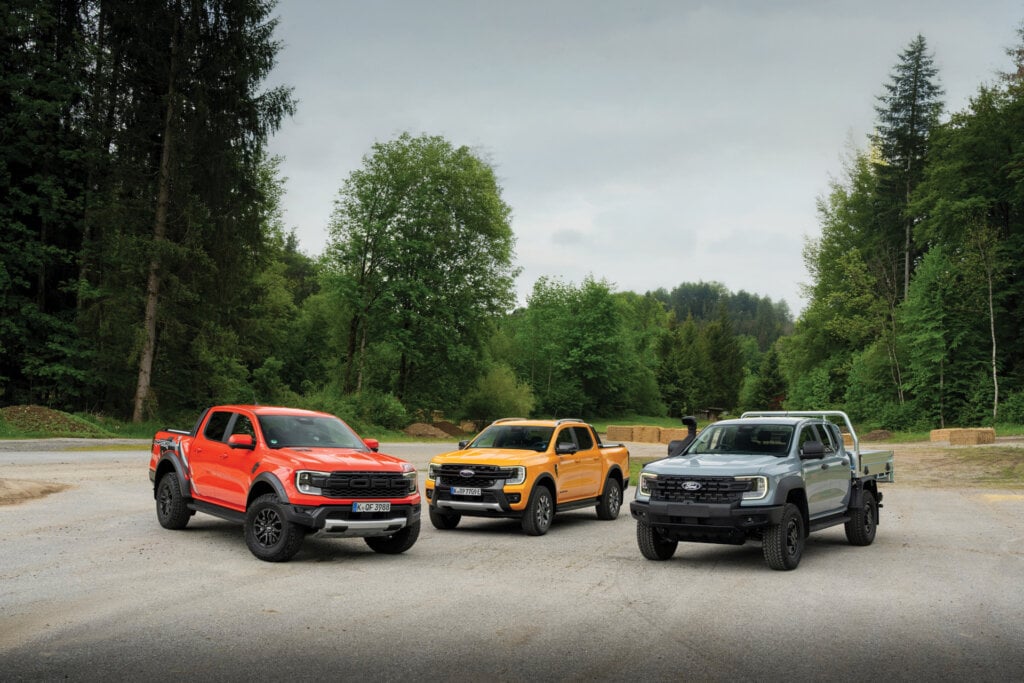
Ford Ranger
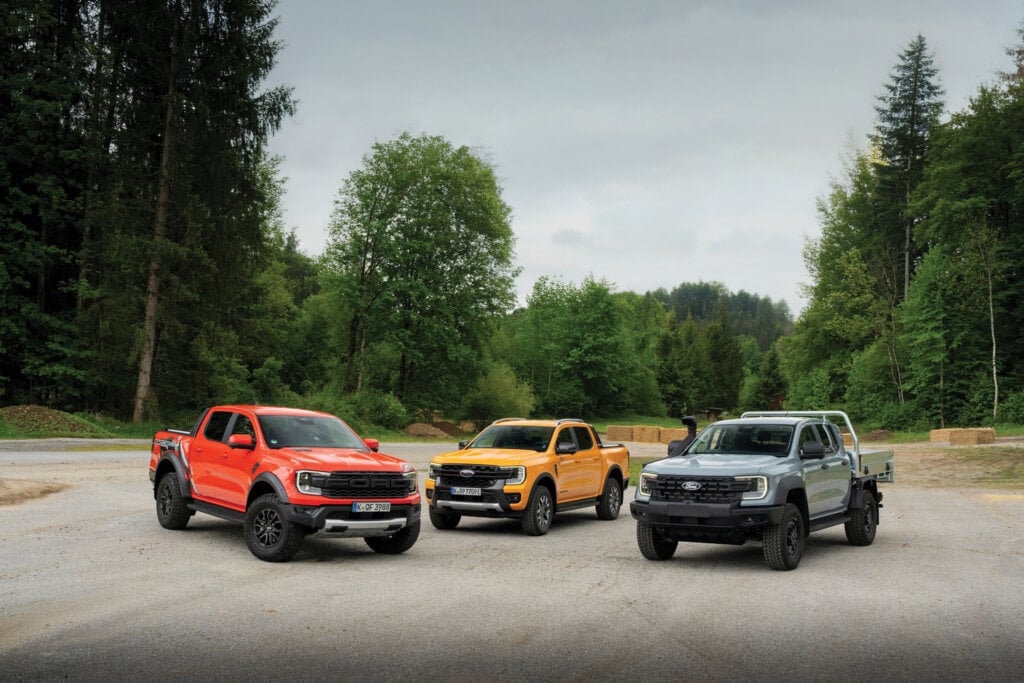
The Ranger remains the ute against which most New Zealand rivals are judged. For MY2026.5, Ford has made the range broader rather than simpler, spanning work-focused cab-chassis models, family-friendly double cabs, adventure grades, plug-in hybrids and the Raptor. Prices start at $54,990 for the XL single-cab chassis and rise to $98,490 for the Raptor.
That breadth is a core strength. Tradies can choose single-, super- or double-cab chassis and pick-up bodies, while lifestyle buyers move through XLT, Wolftrak, Tremor, Wildtrak and Platinum. XLT 2.0 4×2 at $55,990 is the accessible double-cab, while Wildtrak V6 asks $85,990 and Platinum $92,990.
The new entry diesel is a 2.0-litre single-turbo four-cylinder producing 125kW and 405Nm, paired with a ten-speed automatic. It replaces the former bi-turbo and is offered across XL and XLT, with more variants due later. In the XLT 4×2 it feels responsive enough around town, with little lag and a quick-witted transmission. It is a refined oiler too. However, its reduced mid-range muscle becomes evident when overtaking, climbing hills or carrying weight. Buyers who tow heavily will find the larger engine worth the spend.
That engine is Ford’s 3.0-litre turbo-diesel V6, developing 184kW and 600Nm through the same ten-speed auto. It is available from XL through XLT, Wolftrak, Tremor, Wildtrak and Platinum, giving buyers unusual freedom to combine serious pulling power with either a basic or luxurious specification. The V6 is relaxed, strong and effortless, and it is the logical Ranger for regular towing. Mainstream Ranger models can tow up to 3500kg braked, while payload varies by body and grade.
Whatever the engine, Ranger remains one of the best-sorted traditional utes on New Zealand roads. Its steering is clear and positive, the rear suspension is relatively compliant when unladen, and it stays composed on broken seal and gravel. The turning circle is still substantial, but good visibility and camera systems help. Cabin quality depends on grade: an XLT has durable plastics and cloth seats, while Wildtrak and Platinum add more softness and convenience. Ford’s 12-inch touchscreen is now standard across the range, and the cabin is roomy, particularly in the rear.
The Ranger PHEV comes in XLT, Wildtrak and limited-run Stormtrak forms, priced from $82,990. Its 2.3-litre turbo-petrol engine and electric motor produce 207kW and 697Nm, making it the torquiest Ranger. The 11.8kWh usable battery provides only about 30–35km of real-world electric running, and charging is AC-only, but the system is smooth, quiet and punchy. It retains a 3500kg braked tow rating and offers up to 973kg payload. Pro Power Onboard can supply up to 6.9kW to tools or camping equipment. The catch is the premium over diesel models; it makes most sense for owners who can charge daily and complete plenty of short trips.
At the opposite extreme sits Raptor. Its 3.0-litre twin-turbo petrol V6 makes 292kW and 583Nm, while Fox Live Valve dampers, coil-sprung rear suspension, full-time four-wheel drive and front and rear locking differentials turn it into a genuine high-speed off-road performance truck. It rides superbly and is remarkably civilised on-road, but its 2500kg tow limit, roughly 655kg payload and heavy fuel use make it a recreational flagship, not the best workhorse.
Mainstream Rangers carry a five-star ANCAP rating, with AEB, lane keeping and adaptive cruise available, although equipment varies by grade and body.
All Rangers are covered by Ford’s five-year/150,000km warranty, with servicing generally due every 12 months or 15,000km. The 2.0-litre offers the value entry, the V6 diesel is the all-round sweet spot, the PHEV suits charge-friendly routines and Raptor remains the indulgent choice.
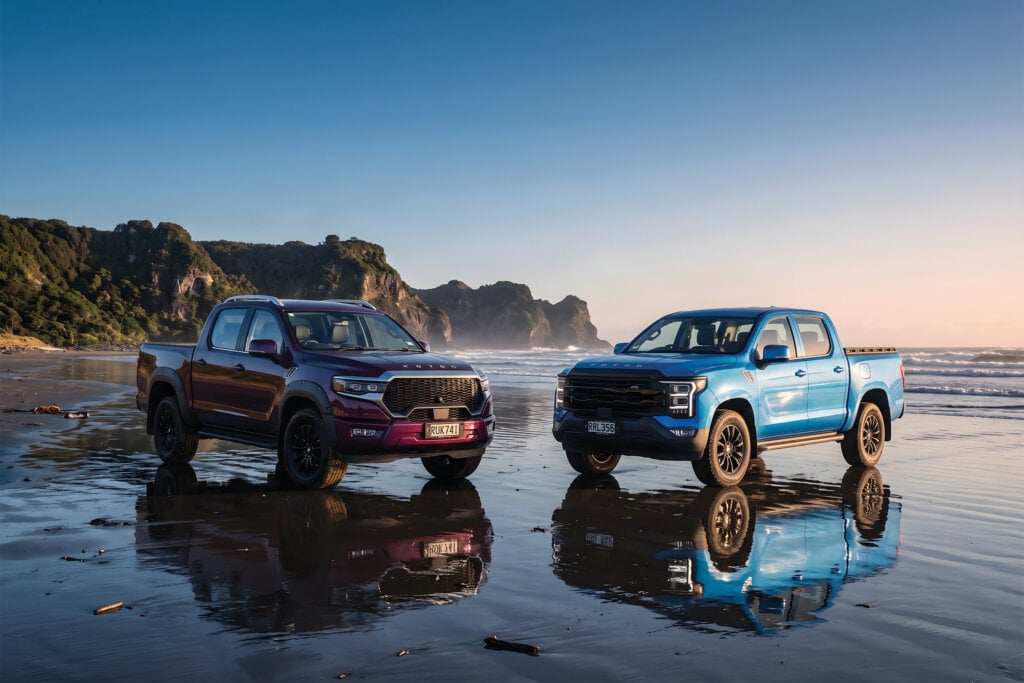
Foton Tunland V9-S 4WD
Powertrain
2.0L IL4 TDI, 120kW@3600rpm, 450Nm@1500–2400rpm
8-speed auto, 4×4, 8.1L/100km, 211g/km
Off-road specifications
Ground clearance – 240mm
Wading depth – 700mm
Approach angle– 28°
Departure angle– 26°
Ramp-over angles – 21°
Differential locks – front and rear
Hauling
Payload – 995kg
Braked towing capacity – 3500kg
Maximum towball download – 300kg
GVM – 3310kg
GCM – 6810kg
Ownership
Warranty – 7 years / unlimited kilometres
Service intervals – 15,000km / 12 months
Foton Tunland V Series
Foton has returned to New Zealand’s ute market with the Tunland V-Series, a much larger and more sophisticated proposition than the brand’s previous pickups. It’s pitched directly at value-focused buyers considering a GWM Cannon Alpha, LDV Terron 9 or MG U9.
The range opens with the rear-wheel-drive V7-C 2WD at $48,990 plus on-road costs. The V7-C 4WD costs $51,990, while the better-equipped V9-S 4WD tops the line-up at $57,990.
All three use a 2.0-litre turbo-diesel four-cylinder assisted by a 48V mild-hybrid system. It produces 120kW and 450Nm, with the latter available from 1500–2400rpm, and drives through a ZF eight-speed automatic. Foton claims combined consumption of 8.1L/100km; our mixed rural drive returned 9.0L/100km.
At 5617mm long, the Tunland is substantially longer than a Ford Ranger, something buyers will notice in tight car parks. That size brings a roomy cabin and useful tray, however, with enough width to carry a standard pallet between the wheel arches.
Every version can tow 3500kg braked. Payload is strongest in the V7 2WD at 1115kg, followed by the V7 4WD at 1050kg and V9 at 995kg. The V7 uses a conventional leaf-sprung rear axle, while the V9 adopts a multi-link, coil-sprung arrangement. The V7 4WD has a rear differential lock; the V9 adds locking differentials at both ends.
The Tunland feels like a commercial vehicle on the road. Its diesel is noisier and less refined than those in established rivals, while 120kW provides adequate rather than brisk performance. Ride quality is reasonable but recognisably ute-like, with the V9’s coil rear suspension providing a modest improvement. It still lacks the polish of the best locally tuned competitors.
Towing ability impressed, with a V7 2WD remaining composed and losing surprisingly little performance when pulling a 2200kg trailer across sealed and gravel roads.
Cabin presentation is a strength. All grades feature synthetic-leather upholstery, powered and heated front seats, a 12.3-inch digital instrument display, 14.6-inch touchscreen, wireless Apple CarPlay and wireless charging. The interior feels reasonably solid, while the V9 adds ventilated front seats, heated outer rear seats, a panoramic roof and dual-zone climate control. Android Auto isn’t currently offered.
There’s no ANCAP rating yet, although adaptive cruise control, autonomous braking and lane-keeping assistance are included. Foton backs every V-Series with a seven-year, unlimited-kilometre warranty and seven years of roadside assistance. For buyers prioritising space, equipment and towing value, the Tunland presents an alternative, provided its dimensions suit their needs.
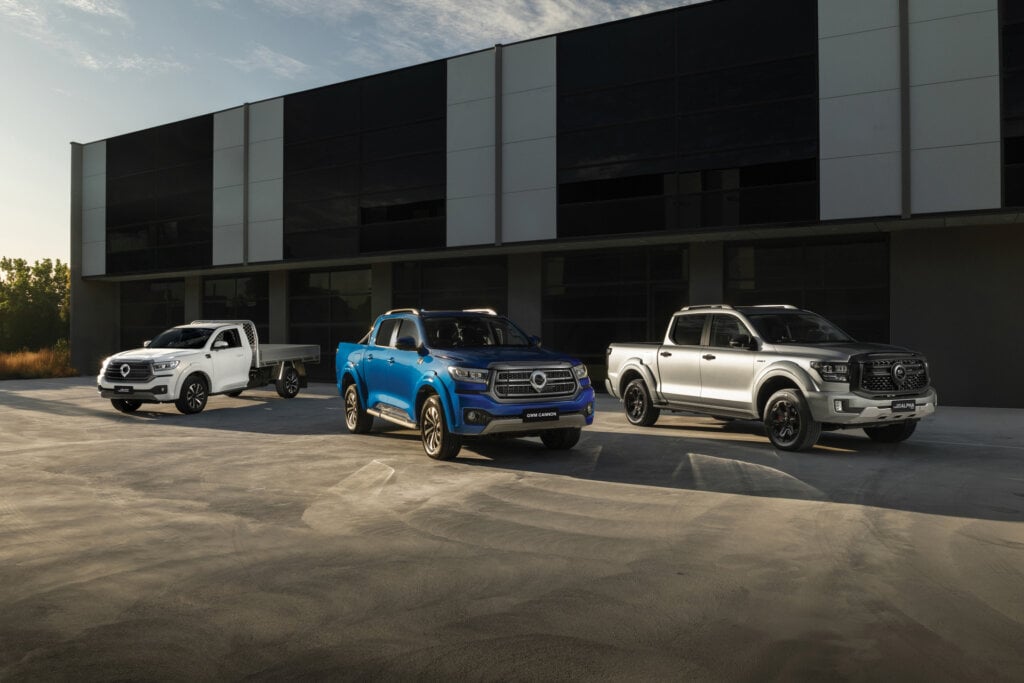
GWM Cannon Alpha Ultra PHEV
Powertrain
2.0L IL4 petrol hybrid, 300kW / 750Nm
9-speed hybrid auto, 4×4, 1.7L/100km, 39g/km
Off-road specifications
Ground clearance – 210mm
Wading depth – 800mm
Approach angle – 28.5°
Departure angle – 23°
Ramp-over angle – 19°
Differential locks – front and rear
Hauling
Payload – 685kg
Braked towing capacity – 3500kg
Maximum towball download – 350kg
GVM – 3495kg
GCM – 6745kg
Ownership
Warranty – 7 years / unlimited kilometres
Service intervals – 15,000km / 12 months
GWM Cannon Ultra
Powertrain
2.4L IL4 TDI, 135kW@3600rpm, 480Nm@1500–2500rpm
9-speed auto, 4×4, 8.4L/100km, 221g/km
Off-road specifications
Ground clearance – 232mm
Wading depth – 500mm
Approach 27°
Departure 25°
Ramp-over angle n.a
Differential lock – rear
Hauling
Payload – 995kg
Braked towing capacity – 3500kg
Maximum towball download – 350kg
GVM – 3225kg
GCM – 6200kg
Ownership
Warranty – 7 years / unlimited kilometres
Service intervals – 15,000km / 12 months
GWM Cannon Alpha
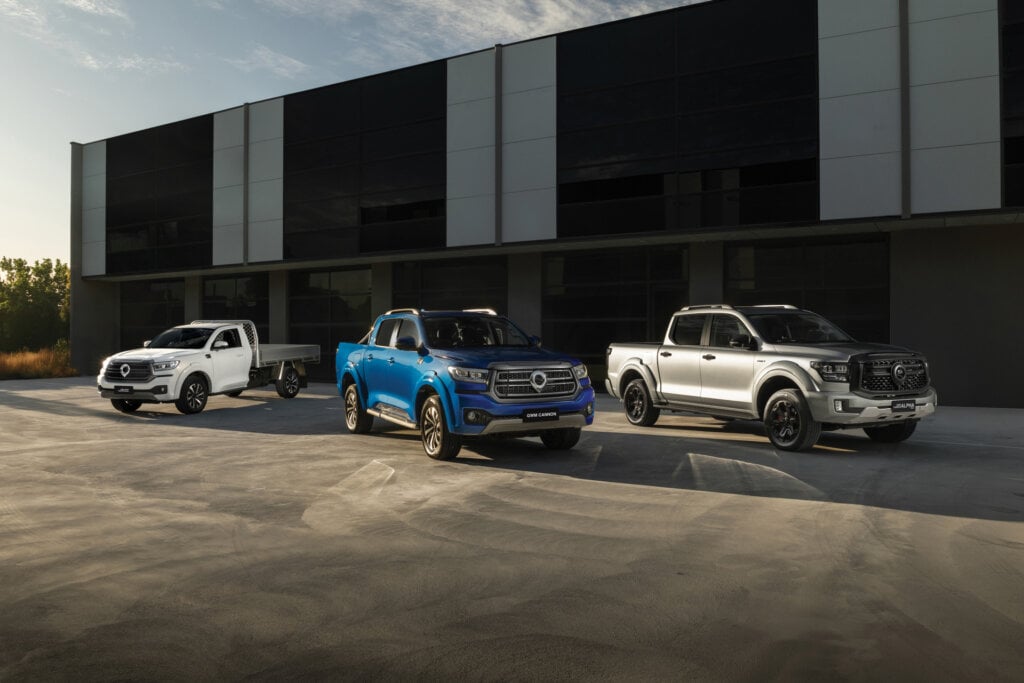
The Cannon Alpha sits above GWM’s regular Cannon as its larger, more luxurious dual-cab ute. For New Zealand buyers, the range currently spans Lux and Ultra 2.4-litre diesels, the Ultra PHEV and the newly announced 3.0-litre Vanta. The 2.4 Lux starts at $54,990, the PHEV is $71,990, the same price as the incoming Vanta, with deliveries expected soon.
The existing 2.4-litre turbo-diesel produces 135kW and 480Nm, driving through a nine-speed automatic and four-wheel-drive system. It remains the straightforward choice for operators who tow, tour remotely or cannot charge regularly. The incoming 3.0-litre four-cylinder diesel lifts outputs to 170kW and 620Nm, while its claimed combined consumption falls to 7.3L/100km.
Those wanting petrol-electric running get a 2.0-litre turbo engine and transmission-mounted motor in the Ultra PHEV. Combined outputs are a muscular 300kW and 750Nm, while its 37.1kWh battery provides a claimed 115km of electric driving and 1060km total range, both using the generous NEDC standard. GWM quotes 1.7L/100km, although that depends heavily on regular charging. Our test returned 89km electrically, while fuel use rose sharply once the battery was depleted.
All versions can tow 3500kg braked. The PHEV also retains proper low range and, in Ultra form, front and rear differential locks. Its 685kg payload is less work-friendly, however, and the spare wheel takes up useful tub width because the battery occupies its normal underbody position.
The Alpha’s cabin is roomy and convincingly assembled, if not quite as polished as the BYD Shark 6’s. Lux includes faux-leather trim and a 12.3-inch infotainment screen; Ultra upgrades to Nappa leather accents, a 14.6-inch display, a 360-degree camera and heated, ventilated and massaging front seats.
On the road, the PHEV rides with impressive calmness for an unladen ute and isolates gravel corrugations well. Steering feedback is modest, the brakes can feel spongy and the hybrid driveline occasionally hesitates or shunts, but overall refinement is sound. Yet its 5445mm length and 13m turning circle are noticeable in town. Diesel buyers gain payload, making those versions better suited to commercial use.
Add a five-star ANCAP rating, and the Alpha shapes as a credible value-led alternative for buyers wanting Ranger-sized capability with more cabin luxury.
GWM Cannon
The GWM Cannon continues to make a value argument in the market. The range comprises Lux and Ultra grades, both combining plenty of equipment with useful towing ability and a big warranty. A plug-in hybrid variant is also on its way.
The Lux starts at $43,490, the Ultra with its extras is $45,490. However, GWM often runs promotional pricing, offering a few thousand dollars off.
The Cannon gets a 2.4-litre diesel producing 135kW and 480Nm, teamed with a nine-speed automatic. That significantly improves on the previous 2.0-litre model, especially when towing. Braked capacity is now 3500kg, while the Lux tested carried a 995kg payload. Combined consumption is quoted at 8.4L/100km.
The on-demand four-wheel-drive system is supplemented by drive modes and a standard rear differential lock.
On the road, the diesel builds torque smartly from low revs and gives the Cannon punchy performance. The nine-speed changes smoothly, although it can be slow to select the right ratio when acceleration is needed. Steering is light and short on feedback, even in Sport mode, while the large 13.1-metre turning circle makes manoeuvres more demanding.
Ride quality is less polished than the class leaders. There is noticeable jiggle when unladen and the Cannon becomes bouncier over rough ground. Its on-demand 4WD system can also feel snatchy because the rear wheels must slip before drive reaches the front, making slow off-road progress harder to manage smoothly.
The cabin makes a better impression now too. It feels well assembled, looks modern and has more soft-touch surfaces than expected at this price. A bright, responsive 12.3-inch touchscreen includes Apple CarPlay and Android Auto, although some virtual buttons are fiddly. Lux brings Comfort-Tek upholstery, while Ultra adds leather-accented trim, heated and ventilated electric front seats, a sunroof, wireless charging and a 360-degree camera.
Safety equipment includes seven airbags, autonomous emergency braking, adaptive cruise control, blind-spot monitoring and lane assistance, although the lane-keeping intervention can be intrusive. A seven-year, unlimited-kilometre warranty and five years of roadside assistance strengthen the value equation. It is not the most sorted ute available, but the Cannon counters with strong equipment, genuine capability and a difficult-to-ignore price.
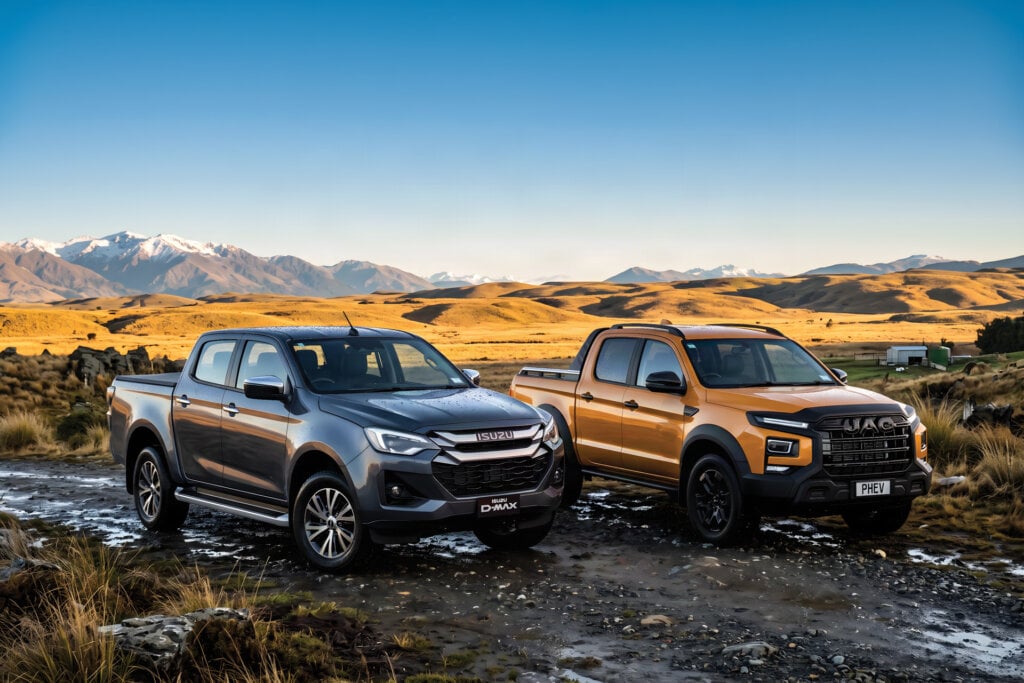
ISUZU D-Max X-Terrain
Powertrain
3.0L IL4 TDI, 140kW@3600rpm, 450Nm@1600–2600rpm
6-speed auto, 4×4, 9.0L/100km, 234g/km
Off-road specifications
Ground clearance – 240mm
Wading depth – 800mm
Approach angle– 30.5°
Departure angle– 19.0°
Ramp-over angle – 23.8°
Differential lock – rear
Hauling
Payload – 925kg
Braked towing capacity – 3500kg
Maximum towball download – 350kg
GVM – 3100kg
GCM – 6000kg
Ownership
Warranty – 3 years / 100,000km
Service intervals – 15,000km / 12 months
JAC T9
Powertrain
2.0L IL4 TDI, 125kW@3600rpm, 410Nm@1500–2500rpm
8-speed auto, 4×4, 7.6L/100km, 202g/km
Off-road specifications
Ground clearance – 210mm
Wading depth – 650mm
Approach angle – 27°
Departure angle – 23°
Ramp-over angle – 23°
Differential lock – rear
Hauling
Payload – 1045kg
Braked towing capacity – 3200kg
Maximum towball download – 320kg
GVM – 3100kg
GCM – 5630kg
Ownership
Warranty – 5 years / 200,000km
Service intervals – 15,000km / 12 months
ISUZU D-Max
Isuzu’s D-Max is a more traditional choice in the crowded ute market. It is built around a ladder-frame chassis, a diesel engine and a range that stretches from cab-chassis workhorses to a well-equipped lifestyle flagship. Buyers can choose from 2WD or 4WD options, plus Single, Space or Double Cab bodies.
The range opens with the LX, starting from $54,990 and it has the widest selection of body styles. The LS starts at $63,990 and moves towards dual-purpose family use, adding 18-inch wheels, LED headlights, side steps, a 9.0-inch touchscreen and a 7.0-inch driver display. At $69,990, the Double Cab-only X-Terrain tops the range with leather-accented trim, heated front seats, a sports blade and distinctive grey exterior detailing.
The D-Max uses Isuzu’s 4JJ3-TCX 3.0-litre turbo-diesel, producing 140kW and 450Nm. A six-speed auto is standard, while braked towing capacity is 3500kg across the range. Four-wheel-drive versions gain Rough Terrain Mode, a rear differential lock, hill-descent control and an 800mm wading depth, making them properly useful away from the seal.
On the road, the engine delivers punchy progress and reaches its torque band quickly. The automatic shifts smoothly on the way up, although it can hesitate when asked for a downshift. Fast electric steering helps the D-Max turn keenly, but filters out much of the road feel. Its unladen ride is firm, with sharper bumps sending a noticeable jiggle through the rear, although that tougher suspension copes well with rough gravel and helps the ute track confidently off road.
The cabin is a major step beyond the utilitarian D-Max models of old. Materials and presentation feel classy for a work-focused ute, the front seats are supportive and comfortable, and the main controls are logically arranged. The rear backrest is rather upright, while the touchscreen is responsive but could offer sharper graphics.
Safety is comprehensive, with eight airbags, AEB, blind-spot monitoring, lane assistance and adaptive cruise control. Isuzu advertises a five-star ANCAP rating across the range. The standard warranty is three years/100,000km, while a current conditional offer extends cover to six years/150,000km. Overall, the D-Max favours toughness, towing ability and straightforward diesel dependability over plushness, but its broad range gives Kiwi buyers plenty of ways to tailor it to work, family life or weekends away.
JAC T9
The JAC T9 range now covers a cab chassis, two diesel wellsides and a plug-in hybrid, all with automatic transmissions and four-wheel drive.
The diesel cab chassis opens proceedings at $44,990, followed by the standard wellside at $46,990. The Black Out Edition costs $49,990, adding darkened trim, black 18-inch alloys and a powered sunroof. At the top, the new T9 PHEV carries a $59,990 launch price, making it NZ’s most affordable electrified ute.
Diesel versions use a 2.0-litre four-cylinder, producing 125kW and 410Nm, paired with a ZF eight-speed auto. The standard wellside can carry 1045kg and tow 3200kg braked, while the cab chassis increases payload to 1165kg. Black Out’s extra equipment reduces its payload to 980kg.
The PHEV combines a 2.0-litre petrol engine with two electric motors for claimed system outputs of 360kW and 674Nm. JAC quotes 100km of electric range and 1005km overall (NEDC figures). It also raises braked towing capacity to 3500kg, carries 915kg and offers 3.3kW vehicle-to-load power.
Equipment is a major T9 selling point. The diesel wellside includes heated electrically adjustable front seats, quilted leatherette trim, a 360-degree camera, wireless phone charging, Apple CarPlay, Android Auto and a 220V rear outlet. There’s even a centre-console compartment that can warm a pie or cool a drink. Proper off-road hardware includes a BorgWarner dual-range transfer case and an Eaton rear differential lock.
All versions also carry a five-star ANCAP rating, with adaptive cruise control, autonomous emergency braking and lane assistance standard, although some alerts can become rather tiresome.
On the road, the diesel’s ride is soft and generally comfortable, while generous suspension travel helps it remain settled across paddocks and larger bumps. The trade-off is more body roll, especially at the rear, and steering that feels overly light and provides limited feedback.
Its engine delivers useful mid-range pull, but turbo lag and a transmission reluctant to kick down make it feel less energetic than the outputs suggest. Our test vehicle also had overactive warning systems, reflective cabin trim and a few intermittent electronic quirks. Overall, the T9 offers strong equipment, genuine off-road ability and sharp pricing, although the established Japanese utes still feel more polished and cohesive.
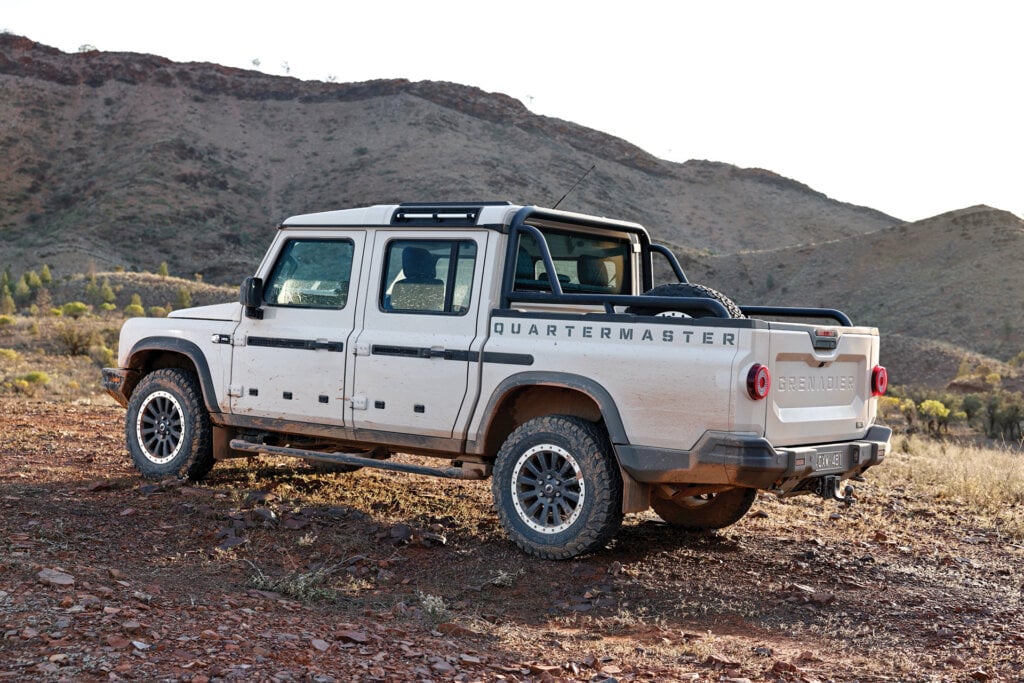
INEOS Grenadier Quartermaster
Powertrain
3.0L, TDI, 183kW@3250–4200rpm, 550Nm@1250–3000rpm
8-speed auto, 4×4, 10.5L/100km, 276g/km
Off-road specifications
Ground clearance – 264mm
Wading depth – 800mm
Approach angle – 36.2°
Departure angle – 22.6°
Ramp-over angle – 26.2°
Differential lock – Rear
Hauling
Payload – 832kg
Maximum braked towing – 3500kg
Maximum towball download – 350kg
GVM – 3550kg
GCM – 7000kg
Ownership
Warranty – 5 years / unlimited kilometres
Service intervals – 15,000km / 12 months
INEOS Grenadier Quartermaster
The Ineos Grenadier Quartermaster is not a conventional one-tonne ute. It takes the old-school off-roader, stretches the wheelbase to 3227mm and adds a tray, creating a 5400mm-long double cab aimed at serious rural and specialised use.
Ineos’s standard Quartermaster is $120,000, while the Trailmaster and Fieldmaster editions are $134,500. Petrol and diesel versions cost the same. Both use BMW-sourced 3.0-litre straight-six engines and a modified ZF eight-speed automatic. The petrol produces 210kW and 440Nm, while the diesel offers 183kW and a more useful 550Nm.
Underneath is a full box-section ladder frame, Carraro beam axles, five-link coil suspension and permanent four-wheel drive. A manually operated two-speed transfer case and lockable centre differential are standard. The off-road-focused Trailmaster adds front and rear differential locks, BFGoodrich all-terrain tyres and a raised air intake, while the Fieldmaster favours leather, heated seats, alloy wheels and Safari roof windows.
The Quartermaster has 264mm of ground clearance, can wade through 800mm of water and tow 3500kg braked. Payload is up to 857kg, so it falls short of several mainstream work utes, although the tray, tie-downs and 225kg-rated tailgate add useful versatility.
The shared Grenadier underpinnings produce acceptable road manners for something so uncompromising. Its Eibach springs and Bilstein dampers deal impressively with potholes and rough gravel, while the solid construction keeps rattles and squeaks at bay. The supportive seats and clearly labelled physical controls are further highlights.
Inside, an aircraft-style overhead panel houses the off-road controls, while wireless Apple CarPlay, wired Android Auto and a central touchscreen provide the essential connectivity functions.
There are compromises. Recirculating-ball steering has free play around centre and little self-centring, while the vehicle’s length makes tight manoeuvres hard work. Fuel use is substantial, too, particularly with the petrol engine.
For Kiwi buyers wanting maximum payload, refinement or value, a Ranger or Hilux makes more sense. But few double-cab utes combine this level of mechanical simplicity, articulation and off-road hardware. A five-year, unlimited-kilometre warranty provides additional reassurance.
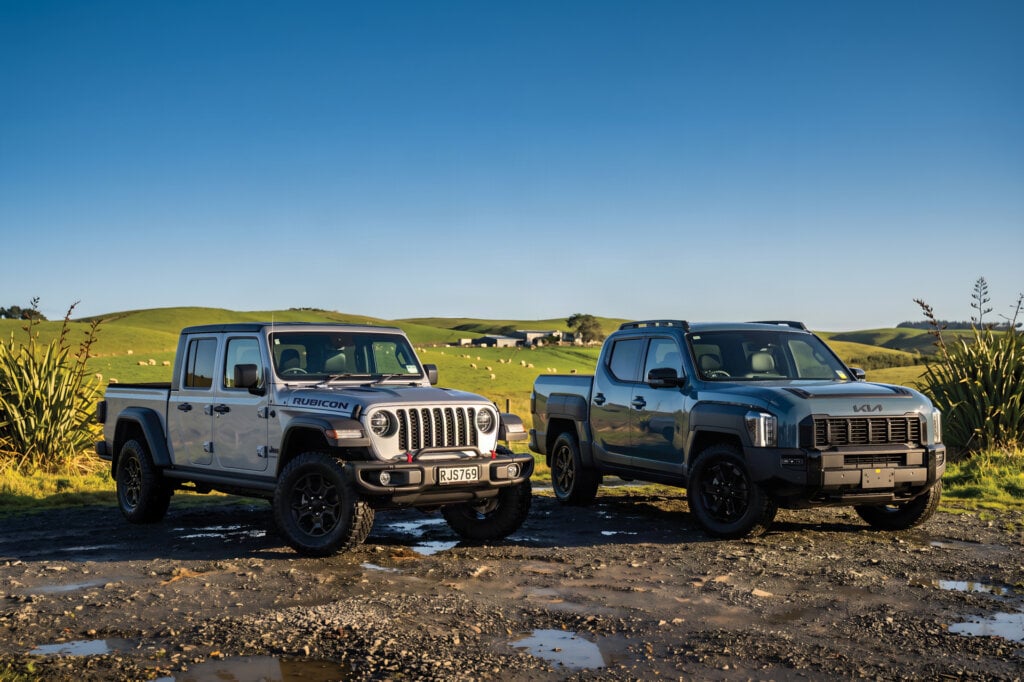
JEEP Gladiator Rubicon
Powertrain
3.6L V6, 209kW@6400rpm, 347Nm@4100rpm
8-speed auto, 4×4, 12.4L/100km, 288g/km
Off-road specifications
Ground clearance – 249mm
Wading depth – 760mm
Approach angle – 40.7°
Departure angle – 25.1°
Ramp-over angle – 18.4°
Differential locks – front and rear
Hauling
Payload – 693kg
Maximum braked towing – 2721kg
Maximum towball download – 272kg
GVM – 2935kg
GCM – 5656kg
Ownership
Warranty – 5 years / 100,000km
Service intervals – 12,000km / 12 months
Kia Tasman X-Pro 4×4
Powertrain
2.2L IL4 TDI, 154kW@3800rpm, 440Nm@1750–2750rpm
8-speed auto, 4×4, 9.3L/100km, 245g/km
Off-road specifications
Ground clearance – 252mm
Wading depth – 800mm
Approach angle – 32.2°
Departure angle – 26.2°
Ramp-over angle – 25.8°
Differential lock – rear
Hauling
Payload – 1013kg
Braked towing capacity – 3500kg
Maximum towball download – 350kg
GVM – 3250kg
GCM – 6200kg
Ownership
Warranty – 5 years / 150,000km
Service intervals – 15,000km / 12 months,
Jeep Gladiator
The Jeep Gladiator is unlike most utes in NZ. It combines Wrangler hardware, a useful tray and the ability to remove its roof and doors. It is essentially a serious recreational 4×4 that happens to be a double-cab pick-up.
The local range has now contracted to one model. Jeep New Zealand is offering the Rubicon as a runout at $79,990 plus on-road costs, a saving of at least $20,000.
Power comes from a naturally aspirated 3.6-litre Pentastar petrol V6 producing 209kW and 347Nm, matched to an eight-speed automatic. It is responsive once revved and the transmission’s low first gear helps get the 2.3-tonne Gladiator moving without much fuss. The catch is consumption: the official figure is 12.4L/100km, while our unladen testing returned closer to 15L/100km.
Rubicon specification brings serious off-road equipment. Its Rock-Trac four-wheel-drive system includes a 4.0:1 low-range ratio, Tru-Lok locking differentials at both ends and an electronically disconnecting front anti-roll bar. Fox dampers, heavy-duty Dana 44 solid axles, 32-inch BFGoodrich tyres, underbody protection and a forward-facing trail camera complete the package. Ground clearance is 249mm and wading depth is 760mm.
There are compromises. Its 2721kg braked towing limit and 693kg payload fall well short of mainstream work utes. At around 5.6m long, it also needs plenty of room in car parks and has a sizeable turning circle.
On-road manners are better than the specification suggests. The rear suspension isn’t excessively stiff when the tray is empty, and it deals confidently with speed bumps and broken surfaces. However, the solid axles and off-road tyres contribute to wandering on narrow roads, tyre noise and less precise cornering than an independent-front-suspension ute. It feels much happier on gravel, where the long-travel suspension absorbs ruts and corrugations impressively.
The cabin mixes rugged design with plush materials, an 8.4-inch Uconnect system, navigation, smartphone mirroring, adaptive cruise control and Alpine audio. Rear space is generous and the folding seats provide useful internal storage. Add the removable hardtop and washable floor, and the Gladiator remains a characterful choice for buyers prioritising off-road ability and personality over traditional ute credentials. Few rivals can match its sense of occasion.
KIA Tasman
Kia has gone all-in with its first ute, offering the Tasman in 10 configurations that span work-focused cab-chassis models through to the highly equipped X-Pro lifestyle flagship.
The range starts with the single-cab TX 2WD cab chassis at $43,690 plus on-road costs. Double-cab wellside pricing begins at $47,690 for the TX 2WD, followed by the TX 4WD at $52,690, TXR at $58,690, TXS at $62,690 and X-Line at $69,690. The X-Pro tops the line-up at $79,690. Single- and double-cab chassis versions provide further options for fleet and trade buyers.
Every Tasman uses Kia’s 2.2-litre four-cylinder turbo-diesel, producing 154kW and 440Nm, matched to an eight-speed automatic. It’s a smooth, relatively quiet combination, with little hesitation low in the rev range and an auto that responds quickly when more pace is required. It doesn’t have the torque figure of a Ranger V6, but it rarely feels short-changed in everyday driving.
All 4WD versions include selectable 2H, 4H, automatic 4A and low-range 4L settings. Most use a mechanical locking rear differential, while the X-Pro gains an electromechanical locker, Rock terrain mode and Kia’s X-Trek low-speed off-road cruise control. Its 252mm ground clearance, useful axle articulation and clear ground-view camera make it particularly capable away from sealed roads.
Braked towing capacity is 3500kg across the range, with an integrated trailer brake controller fitted as standard. Payload varies by model but exceeds 1000kg on several versions. Official combined consumption ranges from 8.5L/100km for the double-cab TX 2WD to 9.3L/100km for the X-Pro.
The Tasman’s cabin is one of its strengths. It feels more SUV-like and polished than many established utes, with sensible physical controls, generous storage and a wide digital display. X-Line and X-Pro versions add reclining rear seats, dual wireless charging and more sophisticated camera technology.
It’s less convincing when unladen, with a fidgety ride over imperfect roads and occasional bump-steer through rough corners. Still, the steering is light, the body remains tidy on smoother roads and 4A gives reassuring traction on gravel. Ownership cover is competitive too, with a five-year/150,000km warranty and 15,000km or 12-month service intervals.
Add its roomy cabin, large tray and competitive pricing, and the Tasman is a credible rival to the segment’s established names.
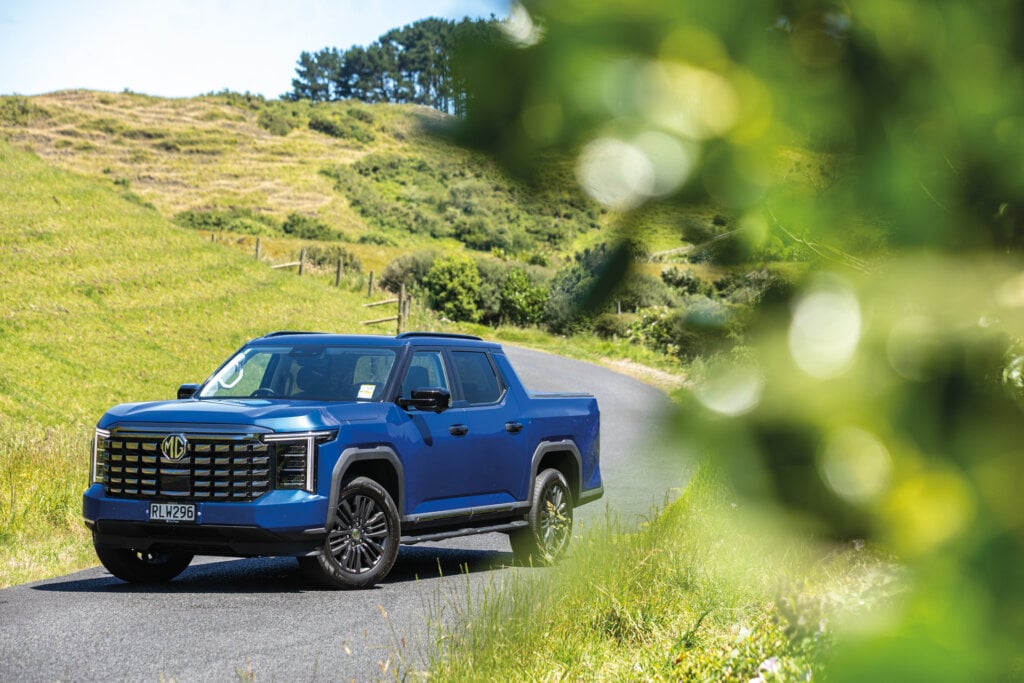
MGU9 Explore Pro
Powertrain
2.5L IL4 TDI, 160kW@3250rpm, 520Nm@1500 -2500rpm 8-speed auto, 4×4, 7.9L/100km, 208g/km
Off-road specifications
Ground clearance – 220mm
Wading depth – 550mm
Approach angle – 28°
Departure angle – 25°
Ramp-over angle – 20°
Differential locks – front and rear
Hauling
Payload – 770kg
Braked towing capacity – 3500kg
Maximum towball download – 350kg
GVM – 3320kg
GCM – 6500kg
Ownership
Standard warranty – Five years / unlimited kilometres
Service intervals – 10,000km / 12 months
MGU9
MG’s first ute takes a different route from most double-cabs, trading the traditional leaf-sprung rear axle for independent multi-link suspension while retaining a 3500kg braked tow rating.
The New Zealand range opens with the MGU9 Explore at $60,990. Explore X costs $63,990, while the flagship Explore Pro is $68,990. All three use a 2.5-litre turbo-diesel producing 160kW and 520Nm, matched to a ZF eight-speed automatic and BorgWarner four-wheel-drive system.
The Explore includes 18-inch alloys, an electronic rear differential lock, full-size spare, two 12.3-inch displays and wireless Apple CarPlay and Android Auto. Explore X adds 19-inch wheels, heated front seats and steering wheel, folding heated mirrors and wireless phone charging. Explore Pro brings 20-inch wheels, a front differential lock, panoramic sunroof, ventilated and massaging front seats, heated rear seats and JBL audio.
Its clever folding tailgate incorporates steps and can extend the load floor. An optional $6190 Smart Hatch opens the partition between the cabin and tray; fold the rear seats and the U9 can carry objects up to 2.4m long. It’s a bit of a gimmick however.
Payload is the compromise. The Explore carries 870kg, Explore X 835kg and Explore Pro 770kg, putting them below many conventional one-tonners. All tow 3500kg braked, however, and offer an 80-litre fuel tank. The Explore Pro’s claimed consumption is 7.9L/100km.
The cabin feels pleasant with plenty of faux leather while its large central shifter adds a little theatre.
On-road, the independent rear suspension reduces the jitter that often troubles unladen utes, particularly on gravel. It handles better than many leaf-sprung alternatives, but isn’t the complete cure for ute ride quality. Its larger dimensions are noticeable around town, making parking a chore.
The diesel delivers convincing shove and useful off-road torque, while front and rear locks give the Pro confidence over rough terrain. Less impressive is the intrusive lane-keeping assistance, which can tug too aggressively at the steering on winding roads.
MG backs the MGU9 with a five-year/unlimited-kilometre warranty, extendable to seven years/200,000km through authorised-dealer servicing. Overall, it’s spacious, capable and innovative, although its pricing and reduced payload put it directly against established ute favourites.
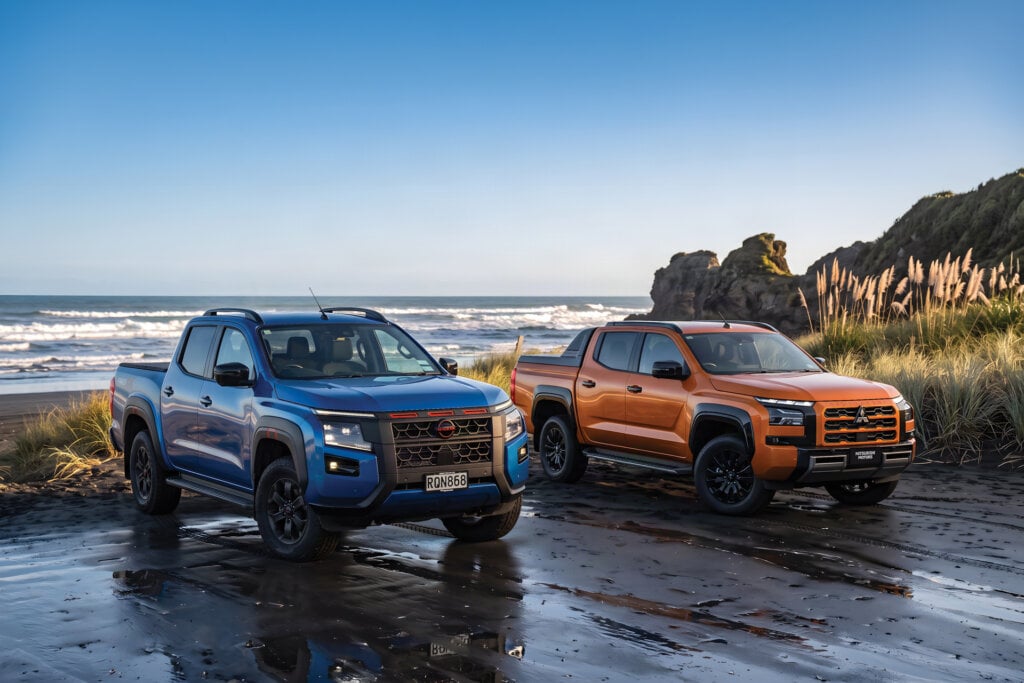
Mitsubishi Triton VRX 4×4
Powertrain
2.4L IL4 TDI, 150kW@3500rpm, 470Nm@1500–2750rpm
6-speed auto, 4×4, 8.8L/100km, 233g/km
Off-road specifications
Ground clearance – 222mm
Wading depth – 500mm
Approach angle – 30.4°
Departure angle – 22.8°
Ramp-over angle – 23.4°
Differential lock – rear
Hauling
Payload – 1075kg
Maximum braked towing – 3500kg
Maximum tow-ball download – 350kg
GVM – 3200kg
GCM – 6250kg
Ownership
Warranty – 5 years / 130,000km
Service intervals – 15,000km / 12 months
Nissan Navara PRO-4X
Powertrain
2.4L IL4 TDI, 150kW@3500rpm, 470Nm@1500–2750rpm
6-speed auto, 4×4, 7.7L/100km, 203g/km
Off-road specifications
Ground clearance – 228mm
Wading depth – 800mm
Approach angle – 30.4°
Departure angle – 22.8°
Ramp-over angle – 23.4°
Differential lock – rear
Hauling
Payload – 1050kg
Maximum braked towing – 3500kg
Maximum tow-ball download – 350kg
GVM – 3190kg
GCM – 6250kg
Ownership
Warranty – 5 years / 150,000km
Service intervals – 15,000km / 12 months
Mitsubishi Triton
The Mitsubishi Triton remains one of NZ’s more affordable established-brand utes, with a broad range spanning single-cab workhorses through to the well-equipped VRX lifestyle model.
Pricing starts at $38,690 for the GLX 2WD single-cab chassis and reaches $59,990 for the VRX 4WD double-cab wellside. Between them sit GLX, GLXR and GLX-Sport variants, with single-, club- and double-cab bodies, cab-chassis and wellside configurations, with two- or four-wheel drive.
Every Triton uses a 2.4-litre bi-turbo diesel producing 150kW and 470Nm, paired with a six-speed auto. Torque arrives early, making it relaxed around town, while the transmission just gets on with its job. Consumption is around 8.8L/100km, although the VRX averaged 9.5L/100km on test.
The fundamentals are shared across the line-up. Triton can tow 3500kg braked, carries a payload of 1000kg or more and includes a locking rear differential. 4WD models add a Super Select II system, offering rear drive, an AWD setting, a locked 4×4 mode, and low range.
GLX is intended for work and fleet duties, while GLXR adds comfort and presentation. The GLX-Sport brings black 18-inch wheels, a sports bar, leather steering wheel and additional equipment for $49,990. VRX sits at the top with leather upholstery, heated and powered front seats, a heated steering wheel, surround-view camera and extra safety technology.
Inside, the Triton has a straightforward operation. Its screen is modest, but physical ventilation controls, chunky door pulls and a conventional gearlever are easy to use. Material quality reflects the price, although the cabin feels solid and storage is plentiful. Rear accommodation is adequate, but three adults will find it tight.
The unladen ride is a highlight. Robust dampers and well-judged rebound control help it absorb speed humps and corrugations without the bounce that troubles some rivals. There’s still some jiggle on the highway and body roll when pushed, but the steering is nicely weighted and it remains composed on gravel.
Add five-star ANCAP safety, a five-year/130,000km warranty and 15,000km service intervals, and Triton shapes up as honest value for buyers. It’s not the flashiest ute, but it delivers a polished powertrain, sound dynamics and genuine capability without stretching the budget.
Nissan Navara
With the latest Navara, Nissan has kept its local range simple, offering four double-cab models, all with automatic transmissions and four-wheel drive.
Pricing starts at $54,690 for the work-focused SL, followed by the better-equipped ST at $57,690. The ST-X costs $62,690, while the flagship PRO-4X asks $67,690. That places the Navara above many Chinese alternatives and, somewhat awkwardly, its closely related Mitsubishi Triton cousin. Every grade receives LED lighting, while an around-view camera helps make its substantial dimensions more manageable.
Navara uses the Triton’s ladder-frame platform, 2.4-litre bi-turbo diesel and six-speed automatic, although Nissan adds its own styling and locally developed Premcar suspension tune. The engine produces 150kW and 470Nm, providing useful pull from low revs without excessive diesel clatter or lag. Nissan quotes combined consumption of 7.7L/100km, although around 10L/100km is more realistic in everyday driving.
All versions can tow 3500kg braked and carry more than one tonne. A locking rear differential is standard, while the ST-X and PRO-4X gain Nissan’s Super 4WD system with an on-demand setting, terrain modes and low range. Towbars, tub liners and tailgate assistance remain optional, however, leaving the Navara less comprehensively prepared than some rivals.
On the road, the Navara makes a positive impression. Its ride is settled for an unladen one-tonner, with less rear-end jiggle and rocking than expected. The steering has reassuring weight, it tracks accurately through corners and the all-terrain tyres provide strong grip. The six-speed automatic also works well, keeping the engine near its useful 1500–2000rpm range and responding promptly when a downshift is required.
Inside, the design is conventional but easy to understand. The nine-inch touchscreen, physical controls and analogue instruments favour usability. PRO-4X adds powered, heated leather-accented front seats, although abundant hard plastics and thin carpeting undermine the premium pitch slightly.
Nissan’s ownership package provides a strong closing argument: warranty coverage can extend to 10 years or 300,000km when scheduled servicing is completed through Nissan. The Navara is capable, comfortable and well sorted, but sharper showroom pricing may be needed to lure buyers away from Ranger and Triton.
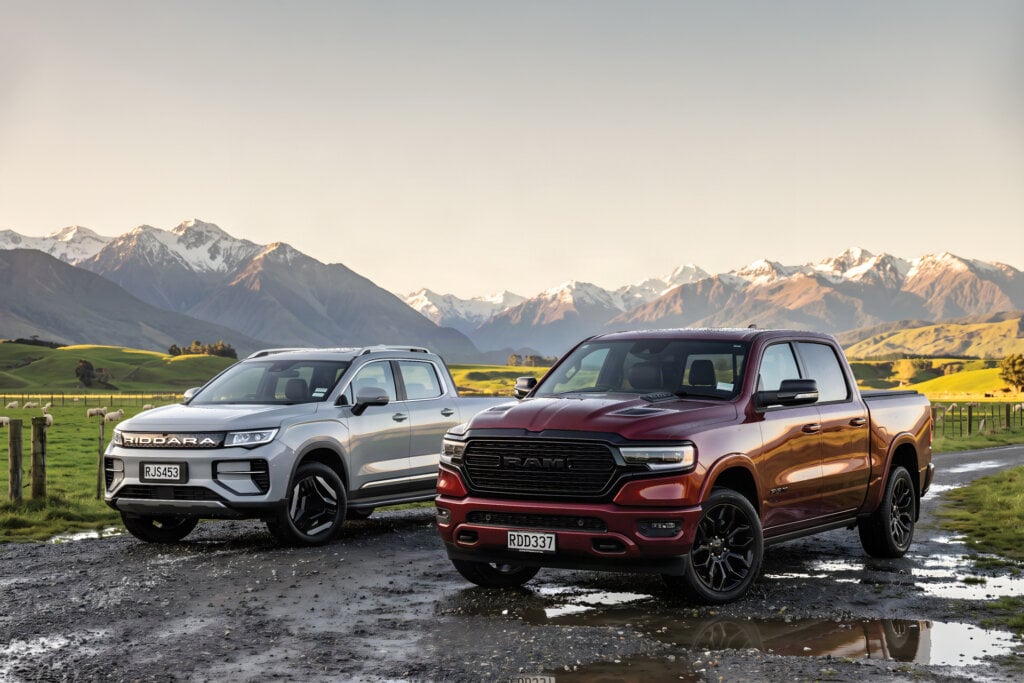
Ram 1500 Limited High Output
Powertrain
3.0L IL6 TT, 403kW@5700rpm, 707Nm@3500rpm
8-speed auto, 4×4, 11.8L/100km, 306g/km
Off-road specifications
Ground clearance — 217mm
Wading depth — 600mm
Approach angle — 20.4°
Departure angle — 20.4°
Ramp-over angle — 18.6°
Differential lock — Rear
Hauling
Payload — 727kg
Maximum braked towing — 4200kg
Maximum towball download — 420kg
GVM — 3505kg
GCM — 7285kg
Ownership
Warranty — 3 years / 100,000km
Service intervals — 12,000km or 12 months
Riddara RD6 Pro
Powertrain
Dual motors, 315kW, 595Nm
Single-speed auto, AWD, 20.5kWh/100km, 0g/km
Off-road specifications
Ground clearance — 225mm
Wading depth — 815mm
Approach angle — 23°
Departure angle — 26°
Ramp-over angle — 16°
Differential lock — No
Hauling
Payload — 1030kg
Maximum braked towing — 3000kg
Maximum towball download — 250kg
GVM — 3235kg
GCM — n.a
Ownership
Warranty — 7 years / unlimited kilometres
Service intervals — 20,000km or 12 months
Ram 1500
The Ram 1500 occupies a niche above conventional one-tonne utes, offering substantially more cabin space, towing capacity and road presence. It also carries a substantial price, although the arrival of the Express Black Edition has lowered the cost of joining the club.
Ram’s current New Zealand pricing starts at $119,990 for the run-out Big Horn, the previous gen model the last to offer V8 power locally. The newer Express Black Edition is $124,990, followed by the Laramie Sport at a promotional $149,990, the off-road-focused Rebel at $159,990 and the flagship Limited at $185,990.
The Ram 1500 range now uses the 3.0-litre twin-turbo Hurricane straight-six, delivering 313kW and 635Nm. Limited turns up the boost with a 403kW/707Nm high-output version. All use an eight-speed automatic and four-wheel drive.
Depending on the variant, the 1500 can tow up to 4500kg braked. The Big Horn is the work-oriented choice, available with two tub lengths, while Express trades leather, larger displays and some convenience equipment for a more affordable price and greater payload. Rebel adds Bilstein suspension, a one-inch lift, all-terrain tyres, underbody protection and an electronic rear differential lock.
Limited takes a luxury approach, bringing four-corner air suspension, RamBox storage, a 14.4-inch touchscreen, passenger display, Harman Kardon audio and massaging front seats. Its cabin feels more like an expensive SUV than a work truck, with generous soft-touch materials and exceptional rear-seat room.
Despite its size, the Ram is surprisingly approachable on the road. The steering is light and direct, while the air suspension absorbs rough surfaces, keeps the body composed and automatically levels the vehicle when towing. There is still no disguising its length and width in tight car parks or narrow urban streets, but the cameras help.
The Hurricane engine lacks the old V8 soundtrack, yet compensates with immediate response and effortless performance. Even towing 3.5 tonnes, it remains calm and strong on hills. Fuel consumption rises sharply with a trailer attached, however, so running costs remain firmly in full-size-truck territory.
For Kiwi buyers regularly towing heavy loads, the Ram offers capability and comfort beyond a normal ute. Just make sure it fits the driveway and your usual parking spaces first.
Riddara RD6 Pro
The Riddara RD6 Pro takes a different route through New Zealand’s varied ute market. While rivals such as the BYD Shark 6, Ford Ranger PHEV and GWM Cannon Alpha PHEV retain petrol engines, Geely’s newcomer is fully electric. There is one well-equipped model, priced from $69,990.
Built on Geely’s SEA passenger-car architecture, the RD6 uses dual electric motors producing 315kW and 595Nm. All-wheel drive is standard and the claimed 0–100km/h time is 4.5 seconds, giving this practical double-cab the acceleration of a performance car. Its 73kWh LFP battery delivers a claimed 360km WLTP range, while charging peaks at 11kW AC and 110kW DC. A 30–80 per cent DC charge takes about 30 minutes.
Those figures make it best suited to urban trades, fleets and regional users with predictable daily mileage. Long-distance towing will require more planning, although the RD6 can still pull 3000kg braked and carry a 1030kg payload. Its 1194-litre tray measures 1525mm long and 1450mm wide, while a 70-litre front boot provides storage. Four 240V sockets and up to 6kW of vehicle-to-load output can power tools or camping equipment.
The monocoque construction and independent multilink rear suspension also give the Riddara an advantage on the road. It rides more calmly than a conventional leaf-sprung ute, corners with the composure of a crossover and remains quiet around town. Accurate steering, good body control and instant power make it easy to drive, although coarse bumps can still send a thud through the rear.
Inside, the finish is closer to an SUV than a work truck. There are heated and ventilated seats front and rear, a 14.6-inch touchscreen, a 10.2-inch digital instrument display and physical climate controls. Rear space is generous, while the 540-degree camera helps when parking.
Seven drive modes, 225mm of ground clearance and an 815mm wading claim provide useful off-road ability, though this isn’t intended for hardcore rock crawling. Safety equipment is comprehensive, but the lane assistance and voice control could use better local calibration.
Geely backs the RD6 with a seven-year, unlimited-kilometre vehicle warranty and an eight-year battery warranty. Range remains its main compromise, but for buyers whose work fits an EV, the RD6 is quick, refined and useful.
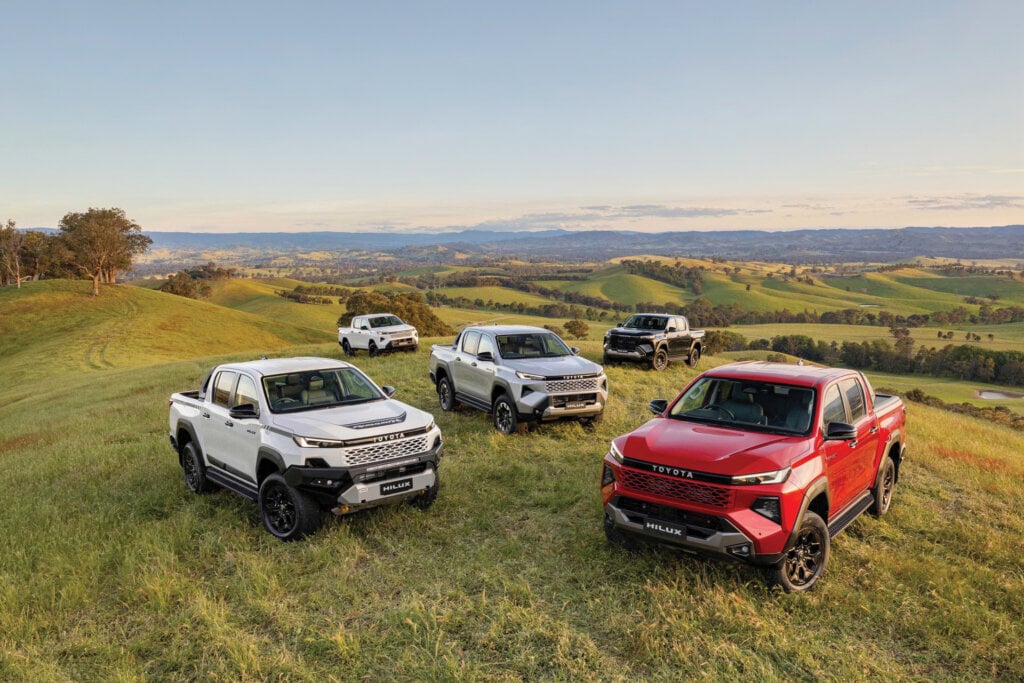
Toyota Hilux SR5 Limited Hybrid 4×4
Powertrain
2.8L IL TDI, 150kW@3000–3400rpm, 500Nm@1600–2800rpm
6-speed auto, 4×4, 8.3L/100km, 220g/km
Off-road specifications
Ground clearance — 224mm
Wading depth — 700mm
Approach angle — 29°
Departure angle — 25°
Ramp-over angle — not published
Differential lock — rear
Hauling
Payload — 940kg
Maximum braked towing — 3500kg
Maximum towball download — 350kg
GVM — 3120kg
GCM — 6300kg
Ownership
Warranty — 5 years / 150,000km
Service intervals — 15,000km / 12 months
Toyota has given the Hilux its biggest overhaul in years while keeping the proven foundations that have made it a fixture of New Zealand worksites, farms and boat ramps
Toyota Hilux
Toyota has given the Hilux its biggest overhaul in years while keeping the proven foundations that have made it a fixture of New Zealand worksites, farms and boat ramps. The 2026 range spans single-, extra- and double-cab bodies, cab-chassis and wellside configurations, four trim grades and three powertrain choices, including the first battery-electric Hilux.
The line-up starts with the rear-drive SR PreRunner double cab at $49,990 driveaway. Most buyers are likely to look towards the 4WD SR, SR5, SR5 Limited and Adventure grades, with manual transmissions available in selected diesel variants. The well-equipped SR5 Limited Hybrid costs $62,990, while Adventure sits at the lifestyle-focused end with unique styling and added cabin detailing.
Toyota calls this the ninth-generation Hilux, although much of the previous model remains underneath. The ladder chassis, cab structure and glasshouse carry over, but the front and rear styling are new, the body has been reinforced and the cabin thoroughly redesigned. Electric power steering also replaces the old hydraulic system, reducing effort around town.
The familiar 2.8-litre turbo-diesel produces 150kW and 500Nm with the six-speed automatic. Manual versions retain 150kW but torque drops to 420Nm. Automatic diesel models use a 48-volt mild-hybrid system that assists acceleration and helps reduce engine load without affecting the Hilux’s core capability. Most 4WD versions retain a 3500kg braked tow rating, low range, a rear differential lock and 700mm wading depth.
The diesel has strong mid-range pull and little noticeable lag, although it remains vocal and the six-speed automatic can be slow to respond. Sport mode helps. Official consumption for the SR5 Limited is 8.3L/100km, though our accessorised test vehicle averaged closer to 13L/100km.
Higher grades receive a more comfort-focused rear suspension tune. The result is a compliant unladen ride by ute standards, with good stability and rear-end control. Electric steering makes low-speed manoeuvres easier, but feels slightly vague at higher speeds. Overall grip is sound, and the Hilux remains predictable on sealed roads and loose surfaces.
Inside, the upgrade is more convincing. A 12.3-inch touchscreen, wireless Apple CarPlay and Android Auto, improved storage and physical switches for ventilation and off-road functions make it easy to live with. SR5 Limited adds leather-accented upholstery, powered and heated front seats, a heated steering wheel, digital instruments, JBL audio and a surround-view camera. The latest Toyota Safety Sense package and a five-star ANCAP rating apply across the range.
Then there’s the Hilux BEV. Toyota offers an SR cab-chassis at $79,990, an SR wellside at $81,990 and SR5 at $85,990. Its 59.2kWh battery feeds two motors producing 144kW combined, giving permanent AWD and immediate, quiet acceleration. Toyota quotes up to 315km of NEDC range, 150kW DC charging and a 30-minute 10–80 per cent charging time.
The electric Hilux drives well, with excellent slippery-surface traction and a lower centre of gravity helping cornering. The catch is range: around 200–250km is more realistic in mixed use, and loads increase consumption sharply. Payload drops to 715kg and towing to 2000kg, compared with around 940kg and 3500kg for the diesel SR5 Limited.
Cabin construction feels sturdy rather than luxurious, with worker-grade SR models using fabric seats and vinyl floors. Rear accommodation remains adequate rather than generous, but tray dimensions are unchanged. Toyota’s extensive national dealer network, parts supply and capped-price servicing also remain important advantages for commercial operators.
That makes the BEV best suited to fleets with predictable routes and depot charging. For everyone else, the diesel remains the more versatile choice. All Hilux models include Toyota’s driveaway pricing and Service Advantage, with servicing every 15,000km or 12 months and warranty coverage extending to five years when servicing conditions are met.
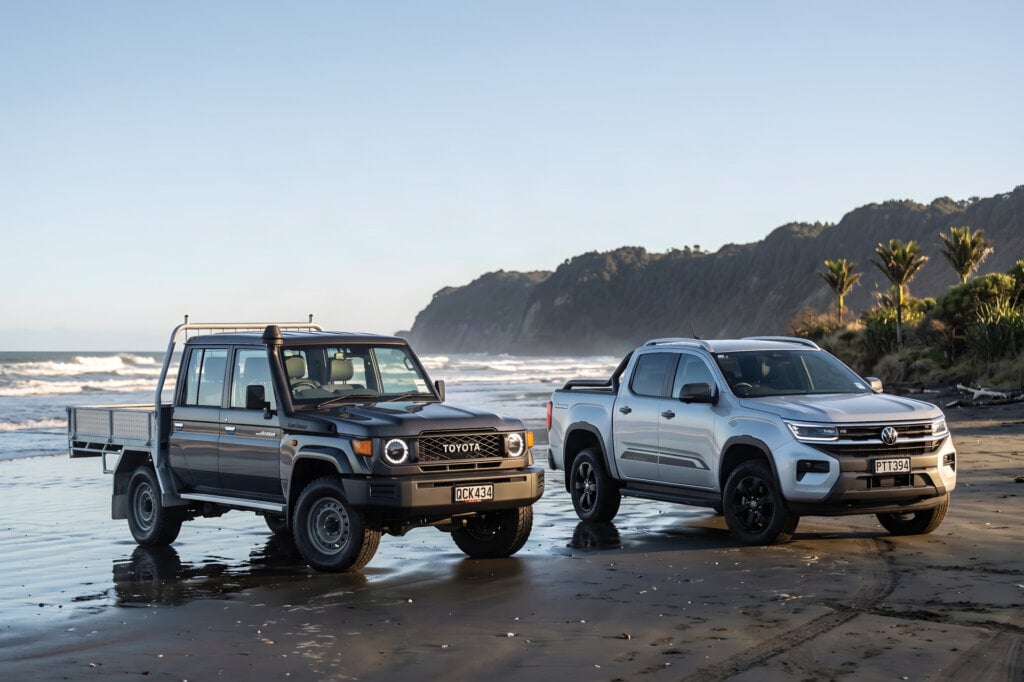
Toyota Land Cruiser 70 LT Double Cab
Powertrain
2.8L IL4 TDI, 150kW@3000–3400rpm, 500Nm@1600–2800rpm
6-speed auto, 4×4, 10.6L/100km, 279g/km
Off-road specifications
Ground clearance — 302mm
Wading depth — 700mm
Approach angle — 35°
Departure angle — 29°
Ramp-over angle — n.a
Differential lock — rear
Hauling
Payload — 1075kg
Maximum braked towing — 3500kg
Maximum towball download — 350kg
GVM — 3300kg
GCM — 6800kg
Ownership
Warranty — 5 years / 150,000km
Service intervals — 15,000km / 12 months
Volkswagen Amarok PanAmericana
Powertrain
3.0L V6 TDI, 184kW@3250rpm, 600Nm@1750–2250rpm
10-speed auto, 4×4, 9.6L/100km, 254g/km
Off-road specifications
Ground clearance — 217mm
Wading depth — 800mm
Approach angle — 30°
Departure angle — 25.6°
Ramp-over angle — 22°
Differential lock — Rear
Hauling
Payload — 933kg
Maximum braked towing — 3500kg
Maximum towball download — 350kg
GVM — 3350kg
GCM — 6400kg
Ownership
Warranty — 5 years / 150,000km
Service intervals — 15,000km / 12 months
Toyota Land Cruiser 70
Toyota’s Land Cruiser 70 remains the ute for buyers who consider a Hilux too civilised. Its formula of a ladder chassis, live axles and four-wheel drive has changed little, although updates make daily use less demanding.
Toyota New Zealand offers four versions. The LT Single Cab costs $78,490 driveaway and the LT Double Cab $82,790. An LX Double Cab asks $89,990. Both cab-chassis models require a tray, which isn’t included in those prices.
The 4.5-litre V8 and manual gearbox have been discontinued. Every 70 uses Toyota’s 2.8-litre four-cylinder turbodiesel, producing 150kW and 500Nm, with a six-speed automatic and part-time four-wheel drive. It makes 70Nm more torque than the V8, uses less diesel and retains the 3500kg braked towing capacity. Combined consumption is rated at 10.6L/100km, although our testing returned around 13L/100km.
Capability remains the reason to buy one. Low range, a 130-litre tank and factory snorkel suit farms, forestry tracks and worksites; LX models add front and rear differential locks. The LT Double Cab has a 3300kg GVM and a nominal 1075kg payload before a tray and accessories are fitted.
It’s easier to drive than the V8 manual, thanks to strong low-speed torque and the smooth automatic. The ride is also better than its rigid-axle, leaf-sprung specification suggests. It doesn’t buck excessively when unladen and remains stable on gravel, but there’s no disguising the slow steering, substantial body lean and huge 14.4m turning circle. The narrow tyres also flex and make plenty of noise on sealed roads.
Inside, the mix of decades is charming. Electric windows, USB ports, Apple CarPlay and Android Auto sit alongside vinyl flooring, manually adjusted mirrors and basic ventilation controls. Toyota Safety Sense brings autonomous braking, lane-departure warning, road-sign recognition and automatic high beam, although this still isn’t an ideal family vehicle.
Toyota’s driveaway package includes five years of warranty cover, roadside assistance, capped-price servicing and WoF checks, subject to its servicing conditions.
Other utes are quieter, safer and more comfortable. Few, however, match the 70’s durability and off-road credentials. The automatic makes it more usable without undermining the dependable simplicity that keeps buyers coming back.
Volkswagen Amarok
Volkswagen has pared the Amarok range back to three V6 diesel models for 2026, reinforcing its position at the premium end of New Zealand’s ute market. The Style lists at $92,990, the PanAmericana at $99,990 and the Aventura at $106,990.
The mechanical package is common across the line-up. A 3.0-litre turbo-diesel V6 produces 184kW at 3250rpm and 600Nm between 1750 and 2250rpm, driving through a 10-speed automatic and selectable 4MOTION system. Drivers can choose 2H, 4A, 4H or 4L, and every model has a mechanical rear differential lock. Official combined consumption is 9.6L/100km.
Style is no bare-bones work truck. It has 18-inch alloys, heated leather seats, a 12-inch infotainment screen, wireless Apple CarPlay and Android Auto, navigation, a digital instrument panel and a surround-view camera. PanAmericana adds the adventure look with black exterior detailing, all-terrain tyres, a spray-in tray liner and a Harman Kardon audio system. Aventura takes the more polished route, adding chrome highlights, 20-inch wheels and a body-coloured sports bar; a 21-inch wheel and powered roller-cover package is optional.
All three can tow 3500kg braked with a maximum 350kg towball load. Payload varies from 964kg for Style to 933kg for PanAmericana and 868kg for Aventura on its standard 20-inch wheels. Ground clearance is 217mm, while the 800mm wading depth and low-range gearing provide genuine off-road ability.
On the road, the V6 is quiet, muscular and rarely short of shove, although there can be a brief pause when accelerating hard from rest. The 10-speed auto shifts smoothly and the 4A setting adds useful all-weather security. Amarok’s comfort suspension keeps the usual unladen ute jiggle well controlled, while the steering is light around town and positive on the open road.
The Ford Ranger connection is obvious underneath, but Volkswagen’s seats, cabin presentation and exterior treatment give Amarok its own character. It feels well assembled, spacious and more SUV-like than many work-focused alternatives. A five-star ANCAP rating and extensive active safety equipment strengthen its family-friendly credentials too. The main catch is price, but buyers receive five-year/150,000km warranty cover, five years of roadside assistance and the first three scheduled services.