Louis Vuitton and Singer build the world’s most expensive way to carry a surfboard
Words: Richard Edwards
Louis Vuitton has found a new place to put its monogram, revealing two heavily reworked classic Porsche 911s built with Singer, the California outfit famous for charging supercar money to make old 964s better than Porsche ever did.
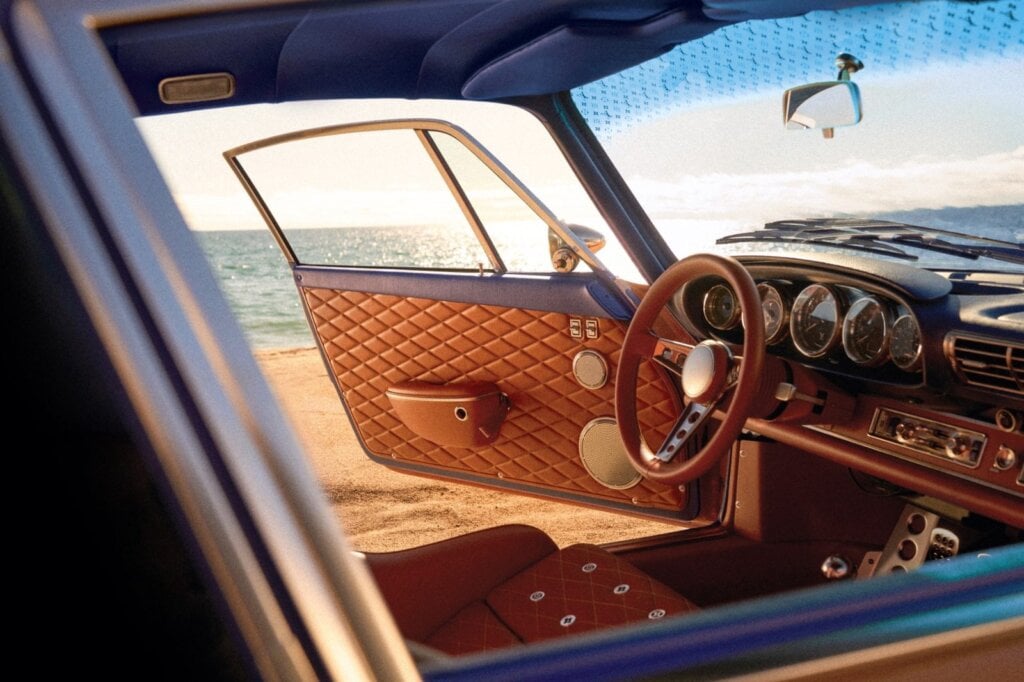
The project apparently began with a request for a dashboard clock. Louis Vuitton’s Swiss watch workshop built one based on its Tambour line, then decided it could not stop there, and a year later the pair had redesigned the entire instrument cluster, replaced every plastic fitting with hand-finished rhodium-plated metal, and trimmed the cabins in the leather normally reserved for the House’s trunks and handbags.

The first car, based on Singer’s Classic restoration of a 964-generation coupe, wears a saffron and cobalt livery drawn from Louis Vuitton’s packaging archive. It runs Singer’s 4.0-litre naturally aspirated air-cooled flat six, a six-speed manual and carbon-ceramic brakes, plus a bespoke roof rack designed to carry a trunk, a pair of skis or a Louis Vuitton surfboard with oak and walnut marquetry. The seats carry hand-punched ventilation eyelets shaped as Monogram flowers, and the engine grille hides an LV motif for anyone peering in at cars and coffee.

The second is a Classic Turbo cabriolet designed by Nicolas Ghesquière, Louis Vuitton’s womenswear artistic director, who took inspiration from classic motorboats. It pairs the 3.8-litre twin-turbo flat six with a varnished wooden rear deck, wooden bumpers, and a luggage bay lined like a runabout. The white paint references the limestone of the company’s Paris headquarters, which is the sort of detail you get when a fashion house writes the spec sheet.
Both cars come with capsule wardrobes so the owner can match the upholstery, covering everything from racing jackets and driving gloves to a carbon-fibre jet helmet and a gold Tambour watch. Even the key gets its own pouch, folder and necklace.
Louis Vuitton chairman of watches Jean Arnault says the collaboration drew on every workshop in the company for the first time, from trunk makers to the fashion and footwear teams. Singer founder Rob Dickinson says the brief exposed his team to techniques developed over decades of Louis Vuitton production.
Neither company has mentioned a price, which is traditional in this part of the market. For context, a standard Singer restoration starts somewhere north of NZ$1.5 million before options, and these two are one-offs commissioned by a company that sells a canvas tote for four figures.
It is also a genuine historical reunion of sorts. Louis Vuitton built fitted car trunks from 1897, supplied luggage for the Paris to Beijing race, and two Vuitton grandsons built their own car in 1909. Whether any of that history involved a surfboard is not recorded.